Guides / Cost
Blanket Orders and Kanban for Swiss Parts: Price and Stock
November 3, 2026
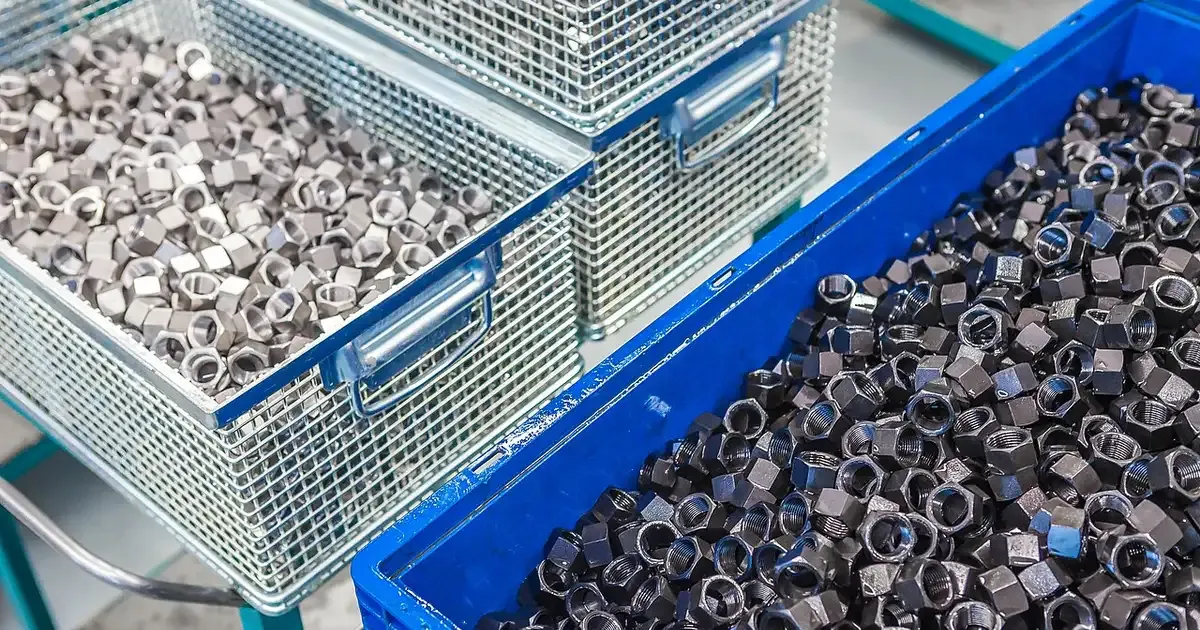
Kanban supply for Swiss turned parts means the buyer commits to a price and a total quantity, and consumption triggers each shipment. A returnable bin, a scan or a weekly count tells the shop to deliver a fixed quantity, and the shop holds enough stock or bar to meet it. It suits steady demand on a stable drawing. It is a poor fit for parts that change revision every few months or for volumes that swing without warning.
This guide explains the three common structures, how to size the signal, what the commitment does to price and which stock terms to agree before the first release. Our minimum order quantity guide covers the lot-size side, and this article covers what happens once you agree to buy in a stream.
What kanban means for turned parts
According to Wikipedia, kanban maintains inventory levels: a signal is sent to produce and deliver a new shipment as material is consumed. It grew out of a visual replenishment signal, an empty box, known as the two bin system. The same article describes the supplier side: with a supplier holding one bin, the factory sends an empty bin with its card, and the supplier delivers a full one. Under electronic kanban, the supplier is expected to dispatch material within a specified lead time.
For a small turned part, the pieces are simple:
- A container with a fixed quantity. A bin holds, say, one agreed count of parts. The count is on the label.
- A signal. The empty bin goes back, a scan fires or the buyer sends a weekly count of what is left.
- A lead time. The shop promises delivery within an agreed number of days from the signal.
- A cap and a floor. A maximum stock the shop is asked to carry and a minimum that triggers a rebuild.
None of this changes how the parts are made. A Swiss lathe still runs them in lots, because setup is the expensive step. What changes is that a lot is sized against the stream, not against one order. Our packaging and kitting guide covers how containers and labels are agreed.
Three structures buyers actually use
| Structure | Who holds the stock | Price | Main risk |
|---|---|---|---|
| Blanket order with releases | The shop, until each release ships | Fixed for the term | Buyer must take the committed quantity |
| Vendor managed stock at the shop | The shop, sometimes owned by the buyer | Fixed for the term | Cost of holding stock shifts to the shop |
| Kanban bins at the buyer | The buyer, owned on delivery or on use | Fixed for the term | Buyer carries stock and obsolescence |
Blanket order. According to Wikipedia, a blanket order is a purchase order placed to allow multiple delivery dates over a period of time, also called a blanket purchase agreement or call-off order. Release orders are created against it as needed. The price is fixed for the agreed term, and buyers may gain discount pricing through volume commitments or price breaks. It ends when the contract is fulfilled, when the period ends or when a maximum order value is reached. For the supplier, it brings predictable business and cash flow.
Vendor managed inventory. Wikipedia describes VMI as a practice where the supplier manages inventory held by a customer, and notes that there is no standard definition. The vendor determines the order size from shared inventory data, and stock can sit at the supplier, in a warehouse or on the buyer’s premises. Ownership varies: the vendor may own stock until it is issued, or the buyer may own it on delivery with payment deferred until use. A 2003 high-tech sector study cited by Wikipedia found that VMI can shift burdens to suppliers, with significant additional operating expenses. Expect that cost to show up in the piece price.
Consignment. Consignment stock is legally owned by one party but held by another. The Wikipedia article on consignment says title stays with the supplier until the goods are sold, and the holder pays only for what it sells. Applied to a turned part, the shop carries finished parts at your dock and invoices on use. It is attractive for the buyer and expensive for the shop, so it normally comes with a higher price or a firm volume commitment.
How to size the signal
Two questions set the size: how many parts a container holds and how many containers circulate. The second depends on demand, lead time and how much variation you want to cover.
The statistical starting point is the safety stock formula. According to Wikipedia, with constant lead time L, mean demand E(D) and demand standard deviation σ_D per period, safety stock is z × σ_D × √L, where z comes from the service level, for example 1.65 for 95 percent. When lead time also varies, the formula becomes z × √(E(L)·σ_D² + E(D)²·σ_L²). The same article warns that no universal formula exists for safety stock and that applying the one above can cause serious damage.
An illustration, using made-up round numbers that are not a quote. A buyer uses 2,000 parts a day with a standard deviation of 400, and the shop’s replenishment lead time is 10 days.
- Stock to cover lead time: 2,000 × 10 = 20,000 parts.
- Safety stock at 95 percent service: 1.65 × 400 × √10, about 2,087 parts.
- Total about 22,100. With a container of 5,000 parts, that is 4.4, so five containers circulate.
The Lean Enterprise Institute is blunt about formulas like this. Its article on resizing supermarkets says there are several formulae linking kanban cards and parts but advises against hunting for a standard method, and that for high-runner parts there is no set formula in lead time and packaging size. It suggests reviewing each part monthly, simulating how the settings behave and aiming for no missed deliveries while reducing inventory. It also names the purchasing inputs that matter: the vendor, the minimum purchase quantity, the delivery lead time and the price.
The practical reading for a Swiss buyer: start with a formula, then run a few months and adjust. Do not lock the container count into the contract on day one.
What the commitment does to price
The price effect comes from three places. We know of no public price table for Swiss parts, so the numbers have to come from quotes.
- Setup is spread over longer lots. When the shop knows a year of demand, it can run larger lots and amortize setup over more parts. Ask for the piece price at several lot sizes against the same drawing.
- Bar can be bought against the standing order. A shop that knows the annual quantity can plan its bar purchases instead of buying per order. Our bar remnant and yield guide shows why bar buying matters to piece cost.
- Scheduling is easier. A steady stream lets a shop fill machine time, which is worth something to it even without a stated discount.
Against that, stock has a cost. If the shop holds a month of finished parts, it carries the cost of money and the risk of a drawing change. A fair quote separates the piece price from the stock holding charge, so you can see what a lower cap would save. Our total cost guide lists the other costs that move with order pattern.
Bar prices move. Many contracts cover this with a material price adjustment clause tied to a published index or to the shop’s bar invoice, with a threshold before it applies. Agree the clause before signing, because a fixed price over a year with a free-floating raw material is a dispute waiting to happen.
Stock terms to agree before the first release
Write these into the agreement, not into an email:
- Maximum and minimum stock. The shop builds to the maximum and rebuilds at the minimum.
- Ownership transfer. When title and risk pass: on delivery to your dock, on use, or on shipment.
- Forecast and commitment window. How many weeks of forecast are firm, and how many are an estimate.
- Shortfall rule. What happens if you consume less than the committed quantity: a carry-over, a payment for the unused balance or a price reset.
- Revision and obsolescence. Who pays for stock when the drawing changes, and for how many parts.
- Lot traceability. Every container carries lot and heat or bar identification, so a quality issue can be traced and contained.
- Quality records. The inspection record is delivered with each release or on request. Our inspection guide lists what to agree.
- Count and audit. How often stock at the shop or at your site is counted and reconciled.
Where this goes wrong
The most common problem is a signal that arrives late. The container is empty, the signal travels slowly and the line stops before the shop can start a lot. Cut the signal path first, then the container size.
The second is a stable drawing that is not stable. Revisions during the term strand stock. Add a revision cut-in rule: parts on hand are used up, or bought back, before the new revision ships.
The third is an unspoken quality hold. If a lot fails inspection, who pays for the replacement and how fast does it ship? A buffer of good stock is the main reason to run kanban at all, so keep it clean.
Call-off terms are part of the path described in our guide to the Swiss machining quote.
Getting a kanban or blanket quote
State in the RFQ the annual quantity, the expected release size, the release frequency, the length of the term, the revision status of the drawing and whether you want the shop to hold stock. Ask each shop to quote the part both as a one-off lot and under the standing structure, with the stock holding charge shown separately. Our quote comparison guide shows how to compare them line by line.
Send the drawing and the supply pattern through the RFQ form. We match it with up to three shops that run Swiss-type lathes and reply within 24 business hours.
Sources
- Kanban, Wikipedia: signal, two bin system and supplier kanban.
- Blanket order, Wikipedia: release orders, fixed price, volume commitments.
- Vendor-managed inventory, Wikipedia: ownership variants, risks.
- Consignment, Wikipedia: title and payment on use.
- Safety stock, Wikipedia: safety stock formulas and the service level z value.
- How do I re-size supermarkets, Lean Enterprise Institute: caution on card formulas and purchasing inputs.
Frequently asked questions
What is kanban supply for machined parts?
It is a standing supply agreement in which consumption sends the signal to ship more parts. A returnable container, a scan or a weekly count tells the shop to deliver a fixed quantity. Kanban keeps inventory at an agreed level, so the buyer does not issue a new purchase order for each shipment.
How is kanban different from a blanket order?
A blanket order is a purchase order that allows multiple delivery dates over a period, with releases against it. Kanban describes how the releases are triggered, by consumption signals instead of a schedule. Many Swiss part deals use both: a blanket order sets price and total quantity, and kanban sets the rhythm.
Who owns the stock in a vendor managed or consignment arrangement?
It varies and must be written down. In vendor managed inventory the supplier may own the stock until it is issued, or the buyer may own it on delivery with payment deferred until use. In consignment, title stays with the supplier until the goods are used or sold. Ask for the transfer point in the contract.
Does a blanket order lower the price of Swiss turned parts?
It can. A blanket order fixes price for the term and can bring volume discounts or price breaks, and the supplier gains predictable work. No public discount table exists for Swiss parts. Ask each shop to quote the same part at the committed annual quantity and at one-off lot sizes, and compare.
Need a quote for this part?
Send the drawing. We match you with up to 3 Swiss shops and reply within 24 business hours.
Get matched with a Swiss shop