Guides / Cost
Bar Remnant and Material Yield: How Much of the Bar Becomes Parts
October 24, 2026
Every Swiss-type part starts as a length of bar. Not all of the bar ends up in finished parts. Some leaves as chips, some as the thin slice the cut-off tool removes between parts and some as the last stub of every bar that the machine cannot feed. The share that becomes parts is the material yield, and on expensive alloys it is one of the larger levers on the unit price.
This guide explains each source of loss, shows what typical yields look like with worked figures and lists what a buyer can ask for and change.
Where the material goes
Four losses sit between the bar you buy and the parts you receive.
Chips from turning. If the part is smaller than the bar, the lathe cuts away the difference. A part with a groove or a reduced section loses material along the way, and a part machined from a bar much larger than its widest feature loses a lot of it.
Cut-off width. The cut-off tool is a thin blade, and each cut removes a slice of bar the width of the blade, usually between 0.5 and 2 mm. A facing pass that cleans the end of the next part adds a few tenths of a millimeter. Both lose material on every part.
The remnant. The last portion of each bar, held in the collet and the bushing, cannot be pushed through further. The remnant is typically somewhere between about 80 and 300 mm, depending on the machine, the feeder and the way the bar is clamped. On some machines a remnant puller or the sub spindle reduces it.
Scrap parts and setup pieces. The first pieces off a new setup, test cuts and the occasional bad part are material that is not shipped. On a long run this loss is small. On a short run it can be large.
Yield in numbers
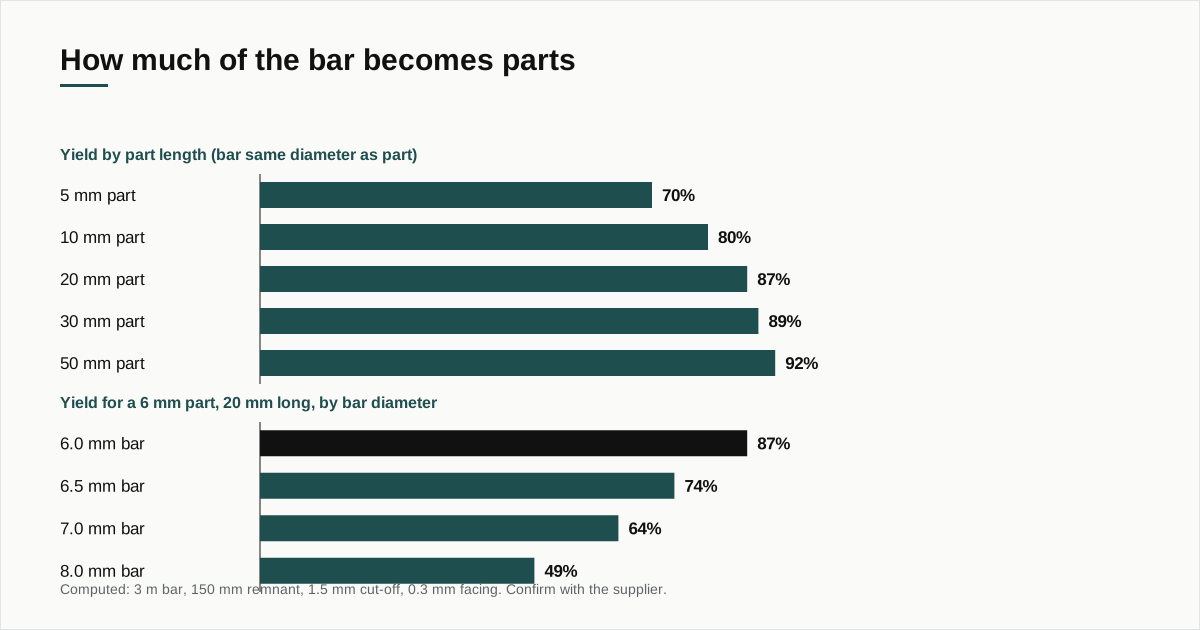
Material yield is the mass of the shipped parts divided by the mass of the bar consumed. The loss from cut-off and remnant is easy to model, and the table shows typical figures for a round part cut from a bar of the same diameter, with a 3 meter bar, a 150 mm remnant, a 1.5 mm cut-off and a 0.3 mm facing allowance.
| Part length | Parts per bar | Yield from cut-off and remnant |
|---|---|---|
| 5 mm | about 419 | about 70% |
| 10 mm | about 241 | about 80% |
| 20 mm | about 130 | about 87% |
| 30 mm | about 89 | about 89% |
| 50 mm | about 55 | about 92% |
A short part loses a large fraction of its length to the cut-off kerf, so a 5 mm part wastes about three tenths of the bar before it has been touched by any other loss. A 50 mm part wastes less than a tenth. The yield does not depend on the diameter when bar and part are the same size, so the same percentages apply to a 3 mm and a 12 mm part.
These are computed figures from the stated assumptions, and real shops differ. Confirm the actual yield with the supplier for your part.
The effect of oversize bar
Bar comes in standard diameters, and the part rarely matches one exactly. If the widest feature of the part is 6.1 mm, the shop needs 6.5 or 7 mm bar, and every cubic millimeter between the part and the bar goes to chips.
| Bar diameter for a 6 mm part, 20 mm long | Yield |
|---|---|
| 6.0 mm | about 87% |
| 6.5 mm | about 74% |
| 7.0 mm | about 64% |
| 8.0 mm | about 49% |
This is why a part dimension can matter more than the machining. Changing a 6.1 mm head to 6.0 mm lets the shop use 6 mm bar and lifts the yield by about 13 points. In an expensive alloy that saving can exceed the machining cost of the part. It is also a reason to ask the shop whether a standard bar size fits the design, and to share the flexibility on the drawing.
Remnant length and bar length
Two machine-side factors affect yield.
| Remnant length | Yield for a 20 mm part |
|---|---|
| 80 mm | about 89% |
| 150 mm | about 87% |
| 250 mm | about 84% |
| 400 mm | about 79% |
| Bar length | Yield for a 20 mm part with a 150 mm remnant |
|---|---|
| 1.5 m | about 81% |
| 3.0 m | about 87% |
| 3.6 m | about 88% |
A longer bar spreads the remnant over more parts. Most Swiss work uses a bar around 3 meters, and some shops use longer or shorter. A shop whose machines leave a short remnant, or whose bar feeder pushes the stub through, loses less per bar. The bar feeder guide explains how the feeder affects the remnant.
Cut-off width
A thinner cut-off blade removes less material. Typical widths run from under 1 mm for small parts to 2 mm or more for larger ones. Narrower blades are weaker and break more easily, and shops balance the loss against the risk. For a 10 mm part, cutting the blade from 1.5 to 0.8 mm raises the cut-off-and-remnant yield from about 80 to about 85 percent.
The material also matters. In a brittle or hard alloy a thin blade chips. In a soft one it deflects. A shop with experience in the alloy will choose a width it trusts, and a buyer does not usually control it.
When it matters
Yield is a small factor in cheap alloys and a large one in expensive ones.
| Alloy | Bar share of unit price | Yield sensitivity |
|---|---|---|
| Free machining brass | Low | Low |
| Free machining steel | Low | Low |
| Austenitic stainless | Moderate | Moderate |
| Titanium | High | High |
| Cobalt chrome and nickel alloys | High | High |
| Tantalum and niobium | Very high | Very high |
For a brass part the yield is a rounding error. For a titanium bone screw the remnant and the kerf can be a noticeable fraction of the price. The titanium guide and the cost guide show where material sits in the price build-up, and the tantalum and niobium guide covers the extreme case.
Remnant by machine and feeder
Not every machine leaves the same stub. The remnant depends on how far the bar can be pushed before the clamping device reaches the guide bushing.
Standard feeder with a pusher. The feeder pushes the bar until the pusher meets the collet, and the stub left is the length from the bushing back to the pusher stop. It is typically the longest remnant.
Remnant puller. After the last cut, the sub spindle or a dedicated tool pulls the remaining stub through, so the machine can work almost to the end of the bar. The stub shrinks considerably, though the pulling step takes a few seconds and a different setup.
Short stub operation. Some shops cut a final part from the remnant on a second machine or in a short-run job, converting scrap into a few more pieces. This only pays off on expensive alloys.
Long bar feeders. A longer bar means fewer bar changes, and the remnant per part falls with it.
The live tooling guide covers the tool stations that make such tricks possible, and the sub spindle article shows what the second spindle does besides back working. A shop that has thought about its remnant can tell you the figure for your machine in a sentence.
Recycling and credits
Chips and remnants have scrap value, and in expensive alloys the value is significant. Some shops return a credit on the quote, others keep it and quote a lower material price. The two approaches should come out about the same if the figures are honest, but they look different on paper.
Ask how the shop handles scrap, and whether the material price on the quote is gross or net of credit. A quote that lists bar by the kilogram with no scrap credit and no yield assumption invites a revision later. A quote that states bar size, remnant, kerf and credit is easier to compare.
Chips of different alloys must be kept apart to hold their value, and shops that machine many materials need a discipline for it. That discipline is part of what the auditing guide looks at on a visit.
How a buyer can improve yield
- Size the part to a standard bar. Ask which bar sizes the shop stocks and see if the widest feature can sit just under one.
- Avoid a single wide feature. A head or collar that is wider than the rest forces the larger bar for the whole part.
- Share the volume. A forecast lets the shop buy bar in full lengths and avoid the cost of partial bars.
- Allow longer parts. If two short parts can be one longer part, the cut-off loss halves. This applies to features that can be joined or made in a single pass.
- Ask about remnant policy. Some shops bill the remnant as a separate line, others spread it in the price.
- Ask for the yield. A good shop can show the parts per bar and the bar size on request.
A worked example
Take a titanium part 3 mm in diameter and 10 mm long, with a head of 3.4 mm. The shop quotes on 3.5 mm bar. The yield from cut-off and remnant is about 80 percent, and the bar size mismatch takes the effective yield to roughly 60 percent or a little less, since the 3.4 mm head is cut from a 3.5 mm bar and the body is cut down further.
If the head were redesigned to 3.0 mm to use 3 mm bar, the yield would rise to the 80 percent from cut-off alone. In titanium, with bar at a large share of the price, the unit price could drop by a noticeable margin. The change costs nothing to the function if the head’s size is not critical.
Bar is one line of a quote; see our guide to the Swiss machining quote for the rest.
Getting parts quoted
Send the drawing and STEP file through the RFQ form. State the material, the widest feature and the yearly volume, and mention any flexibility on the head or collar diameter. We match the part with up to three shops that run Swiss-type lathes and reply within 24 business hours.
If the part is in an expensive alloy, ask each shop for the bar size, remnant and cut-off width assumed in its quote. The three figures explain most of the difference between quotes.
Frequently asked questions
What is a bar remnant?
The piece of bar left at the end of each length that the machine cannot feed through the guide bushing and collet. The shop discards or recycles it. On a Swiss-type lathe it is typically measured in tens of millimeters to a few hundred, depending on the machine and the bar feeder.
Do I pay for the remnant?
Usually yes, either as a line on the quote or built into the material cost per part. In cheap alloys it is a small share of the price. In titanium, tantalum or cobalt chrome it can be a visible one, and some quotes credit back recycled scrap.
Can I reduce material cost by changing the part?
Sometimes. A part sized to fit a standard bar diameter wastes less than one that forces a larger bar. A shorter cut-off width and a part length that divides into the bar length well also help. Ask the shop to show the yield on your part.
Need a quote for this part?
Send the drawing. We match you with up to 3 Swiss shops and reply within 24 business hours.
Get matched with a Swiss shop