Guides / Choosing a Supplier
ISO 16232 Technical Cleanliness for Swiss Turned Parts: What to Specify
October 30, 2026
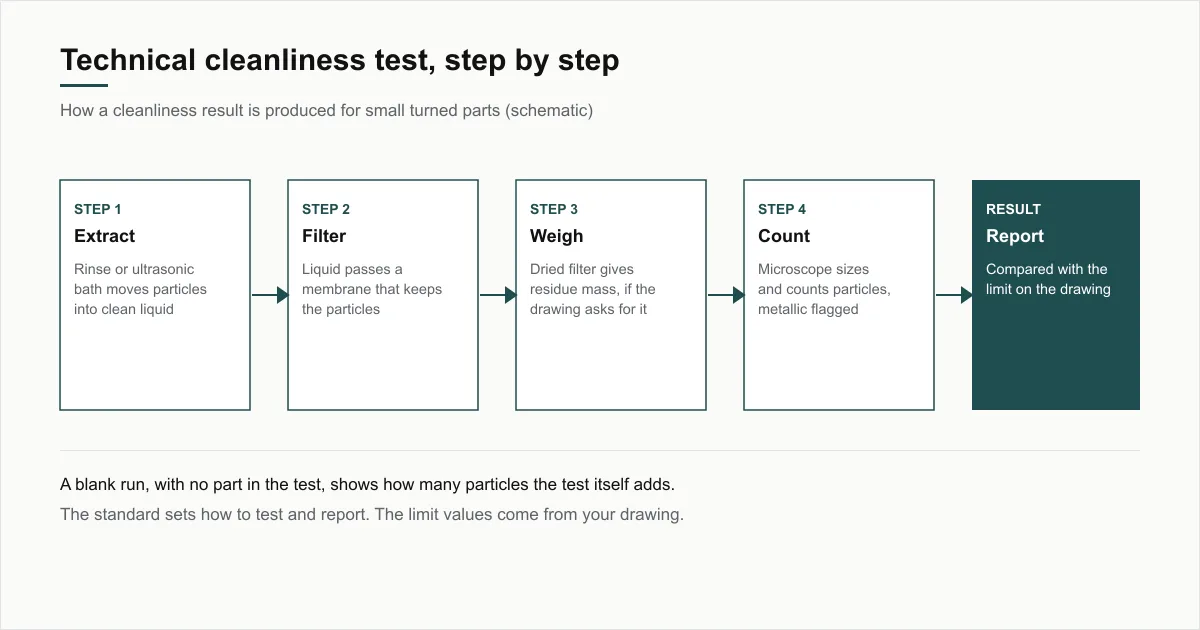
ISO 16232 is the road vehicle standard that says how to measure particle contamination on a part and how to report the result. It does not say how clean your part must be. That limit comes from the drawing, so the first job of a buyer is to write a limit and name the test method before the quote, not after the first lot fails. This guide explains what the standard covers, how a cleanliness test runs on small turned parts, what drives cost and what to put in the RFQ.
Swiss-turned parts meet this requirement often. They are small, they often have cross holes, blind bores and threads where chips collect, and they go into fuel systems, brake systems, e-mobility electronics and medical devices where one hard particle can cause a failure. Our guide to Swiss machining inspection and quality covers dimensional checks. This one covers particles.
What ISO 16232 is
The current edition is ISO 16232:2018, titled Road vehicles, Cleanliness of components and systems, published in December 2018. According to the AFNOR store listing, it replaced ten 2007 parts of the series on fluid circuit components, which covered extraction by agitation, pressure rinsing, ultrasonic techniques and a functional test bench, along with gravimetric analysis, microscopy, light extinction counting and the expression of results.
The scope is how to apply and document methods that measure particulate contamination on functionally relevant parts and systems. It covers cleanliness checks during initial evaluation, incoming and outgoing inspection, and quality control of cleaning, surface treatment and assembly. The aim is that results are comparable across the automotive supply chain.
Three points follow from the scope:
- It does not set limit values. The document says it does not define cleanliness limit values for specific components, and Annex H gives guidance on deriving them.
- It excludes filmy contamination such as grease and oil.
- It excludes checks that cannot be quantified, such as visual inspection and wipe tests.
So a drawing note that says only “clean per ISO 16232” is incomplete. It names a method family and no limit.
VDA 19.1 sits beside it
Many customer specifications cite VDA 19.1 instead, or together with ISO 16232. VDA 19.1 is the German automotive association’s guideline for inspecting technical cleanliness. Its drafting group also worked on the first public ISO 16232 series, and the VDA text is more detailed, with examples. A third edition is listed by the VDA store, with sources giving the date as 2025 or 2026, so check the edition on the document your customer cites.
The revision, as summarized by a cleanliness lab, separates two uses. A limit value test is the standardized test on a representative part, mainly for approval and verifying a specification. Process monitoring is frequent, fast and trend-capable testing in production, and may use partial areas and non-VDA methods if they are reproducible. The revision also adds dry extraction methods such as suction, and names failure modes such as short circuits and optical blockage that matter for e-mobility and driver assistance systems. A companion document, VDA 19.2, covers the environment, logistics, personnel and assembly equipment where cleanliness matters.
How a test runs
The details differ by lab and by part, but the workflow is the same.
- Blank value. The lab first runs the test with no part, to find how many particles the test itself adds.
- Extraction. Particles are removed from the part by rinsing, shaking, ultrasonic cleaning or pressure rinsing into a clean liquid. Newer editions add dry methods.
- Filtration. The liquid passes through a membrane filter that deposits the particles on its surface. One reference notes that 47 mm is the default membrane diameter for aerospace, automotive and oil work.
- Weighing. The dried filter can be weighed to give a residue mass. That gives a rough total, but no size or type.
- Microscopy. A microscope with image analysis counts and sizes the particles. One lab gives its detection limit as 5 µm and notes that results can be reported for 50 µm and larger only, as VDA 19.1 expects.
- Classification. Particles are separated into metallic and non-metallic, and fibers are identified. One microscope maker defines a fiber as a particle with a length to maximum inner diameter ratio above 20 and an inner diameter under 50 µm. Metallic particles show dark under crossed polarizers.
- Report. The result is a particle size distribution compared with the limit, often with photographs of the largest particles.
Allow time. One accredited lab lists a typical turnaround of 3 weeks after samples arrive, so a cleanliness requirement should be settled before first article, not at the end.
The blank value problem
A cleanliness test only means something if the test itself is clean. A cleanliness lab explains that under VDA 19.1 of 2015 the blank value must be no more than 10 percent of the limit, measured by residue weight or per size class, and that it is not subtracted from the result. For very clean parts the 10 percent criterion may not be technically feasible, because equipment contamination has a disproportionate effect. In that case, the lab suggests measures such as better scales, larger batches, new glassware or extraction in a clean room area, and says an unmet blank criterion should be documented and agreed with the customer.
For a buyer the lesson is practical. Ask the lab to report the blank value with every result, and ask whether it met the criterion. A pass with a high blank value is a weaker result than a pass with a clean blank.
Why small turned parts collect particles
Swiss machining makes parts with features that hold contamination:
- Chips and swarf in cross holes, blind bores and thread roots, especially on long slender parts with deep drilled holes.
- Burrs that detach later. A burr that breaks loose in service is a particle. Our deburring guide covers the methods.
- Coolant and oil residue that traps fine particles. See the coolant guide.
- Handling and packaging. A clean part dropped into an unclean bag or tray is contaminated again.
The part itself rarely makes the difference. The cleaning step, the handling after it and the packaging do. The secondary operations guide lists how cleaning and packaging are typically scoped, and the packaging and kitting guide covers the packaging side.
What it costs and where cost comes from
No public price list exists for technical cleanliness work, and no reliable per-part figure applies across parts, so treat any generic number with caution. The cost comes from four places:
| Cost driver | What it is |
|---|---|
| Cleaning process | Equipment, solvent or aqueous baths, time per part |
| Handling and packaging | Controlled area, gloves, tray or bag type, kitting |
| Verification | Lab tests on samples, plus the lab turnaround |
| Rework and rejects | Parts that fail go back through cleaning or are scrapped |
The tighter the limit and the smaller the particle size that counts, the more each of these costs. A limit written without regard to the function of the part is the most common way to overpay.
What to write on the drawing
A complete cleanliness requirement answers the following:
- The standard and edition, such as ISO 16232:2018 or the VDA 19.1 edition your customer uses.
- The limit: maximum particle size, number of particles per size class or total residue, and whether it applies per part or per surface area.
- The extraction method, or a statement that the supplier proposes one and your customer approves it.
- Which particles count: all, or metallic only, with a rule for fibers.
- Sampling: how many parts per test and how often.
- Handling and packaging after cleaning, such as sealed bags or trays and storage conditions.
- The report you expect and the maximum blank value.
The limit values and size classes are chosen by your engineering team for the function of the part. This article does not suggest values, because they depend on the application.
Choosing a shop
Ask any shop you are considering:
- Do you have a defined cleaning process for this kind of part, and who validates it?
- Do you test cleanliness in house or through a lab, and which method?
- Can you show a previous cleanliness report, with the blank value, on a similar part?
- How are parts handled and packed after cleaning?
A shop that has done this work will answer directly. A shop that has not should say so, and that is better than a promise. Our certifications guide explains what the quality system standards do and do not prove. A certificate does not replace a cleanliness report.
Cleanliness is one of the gates in our guide to Swiss machining supplier qualification.
To get Swiss turned parts quoted with a cleanliness requirement, send the drawing and the cleanliness specification through the RFQ form. We match it with up to three shops that run Swiss-type lathes and reply within 24 business hours. Put the requirement in the first message, so each shop prices the cleaning with the machining.
Sources
- ISO 16232:2018, Road vehicles, Cleanliness of components and systems (AFNOR store listing): scope, exclusions, replaced parts.
- VDA 19.1 and VDA 19.2, test standards overview (cleancontrolling): titles and aims of both documents.
- What the new VDA 19.1 changes (cleancontrolling): limit value testing vs process monitoring, dry extraction.
- Blank value in technical cleanliness (cleancontrolling): 10 percent criterion and reporting.
- Cleanliness of automotive components, Leica Microsystems: extraction, filtration, fibers and metallic particles.
- An overview of the washing method in component cleanliness inspections, Evident: rinsing, filtration and membrane diameters; a microscope maker.
- Cleanliness test service, Measurlabs: commercial lab; workflow, detection limit and turnaround, directional only.
Frequently asked questions
Does ISO 16232 set cleanliness limits for my part?
No. ISO 16232:2018 says it does not define cleanliness limit values for specific components or systems, and gives guidance in Annex H on deriving them. The limit comes from your drawing or specification, usually set by the function of the part. Write it down before quoting, because it drives cleaning cost.
What is the difference between ISO 16232 and VDA 19.1?
Both describe how to inspect particulate contamination on functionally relevant automotive parts. VDA 19.1 is the German automotive association's guideline, written by the group that also worked on the first ISO 16232 series, and it goes into more detail. Many customer specifications cite VDA 19.1. Ask which one your customer's document names.
What is a blank value in a cleanliness test?
The blank value is the particle count the test adds that does not come from the part. Under VDA 19.1 of 2015 it must not exceed 10 percent of the limit, by residue weight or per size class. A high blank value can make a result unreliable, so ask the lab to report it.
Does a normal Swiss shop wash cover technical cleanliness?
Usually not. A standard degrease removes oil and loose chips but is not verified by particle count. Technical cleanliness needs a defined cleaning process, controlled handling and packaging, and an inspection under a stated method. Say so in the RFQ, because it changes labor, equipment and price.
Need a quote for this part?
Send the drawing. We match you with up to 3 Swiss shops and reply within 24 business hours.
Get matched with a Swiss shop