Guides / Process
Deburring Micro Parts: Tumbling, Thermal and Electrochemical Methods
October 29, 2026
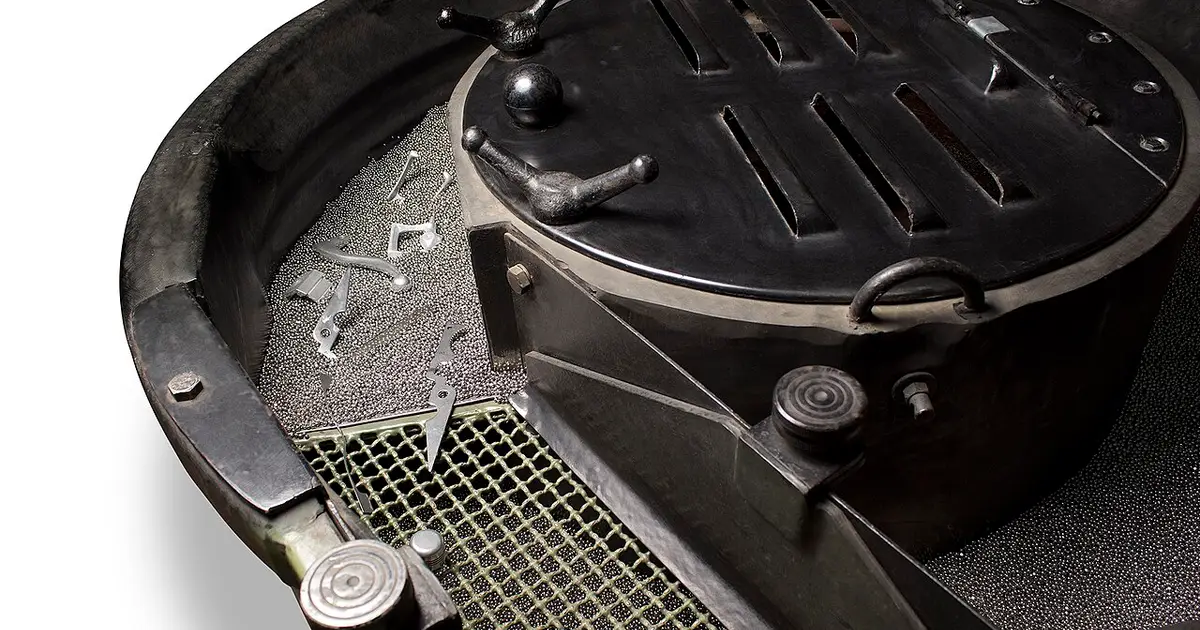
The right way to deburr a small turned part depends on where the burr sits. External edges on many parts at once suit tumbling or vibratory finishing. Burrs inside cross holes and at intersecting bores need a process that reaches them, such as electrochemical or thermal deburring. Interior passages suit abrasive flow. Most Swiss parts have both kinds of burr, so the drawing should say what condition each edge must reach and leave the method to the shop.
This guide compares the common methods, explains how they behave on micro parts and shows how to write deburring into an RFQ. Our secondary operations guide gives the wider scope, and this article goes deeper on deburring alone.
Where burrs form on a Swiss part
A Swiss lathe leaves fewer burrs than a part made in several setups, but it does not leave none. The common places are:
- The cut off face, where the part separates from the bar.
- Thread starts and thread roots.
- The exit side of drilled and cross holes.
- Slots and milled flats from live tooling.
- The edge where a cross hole meets a bore.
The last one is the hardest. A burr inside a bore where a cross hole breaks through cannot be reached by a brush or a file. It is also the burr most likely to break loose later and become a particle, which matters for fluid systems and for any cleanliness requirement. Our ISO 16232 guide explains why.
Tumbling and vibratory finishing
Mass finishing is the default for external edges. According to Wikipedia, the two main types are tumble (barrel) finishing and vibratory finishing, both using cyclical action to create grinding contact. Processes can be wet or dry, batch or continuous. Cycle times range from about 10 minutes for nonferrous workpieces to 2 hours for hardened steel.
The choice of media sets what happens to the edge. Cutting media remove burrs and smooth surfaces. Luster media are generally not abrasive and deburr by peening the burr over rather than removing it. Steel media are case-hardened, have low wear and are used for light deburring and cleaning. Ceramic media are the general workhorse, with low cost and low wear. Compounds suspend small particles, keep parts clean and inhibit corrosion.
The risk on micro parts is part-on-part contact. Wikipedia notes that the media to part volume ratio controls it: at low ratios considerable contact occurs, and higher ratios limit it. For slender pins and parts with fine threads, that means two things in practice. First, run a sample lot and inspect it under magnification. Second, say on the drawing which features must not change, such as a thread form, a sealing edge or a tip. This is our reading of the principle, not a published limit, so confirm it on your own part.
Tumbling reaches outside edges and open features. It does not reliably reach the inside of a small blind bore or a cross hole, because media cannot get in.
Thermal energy deburring
Thermal energy method (TEM) deburring, also called thermal deburring, is the process for burrs that cannot be reached. According to Wikipedia, the workpiece is sealed in an explosion-proof chamber that is filled with an oxygen and fuel mix, and the mixture is ignited. The burn lasts about 20 milliseconds, with a peak temperature of about 3,000 °C. A patent that describes the process says burrs go first because of their large surface and small mass, while the part’s thermal mass protects it, and that the load-to-load cycle is on the order of half a minute.
It reaches every surface the gas reaches, including cross hole intersections. It is also a heavy process: the chamber needs clamping and explosion protection, which puts it in the hands of dedicated finishing shops rather than most turning shops.
Limits on small parts are worth knowing:
- The patent notes that gas consumption can become excessive for a small part, which raises cost per cycle. Ask the shop how many parts it loads per cycle.
- Remove cutting oil and loose chips first, and ask the finishing shop what cleanliness it requires before parts go in the chamber.
- Thin walls and fine features may not tolerate the heat of a burn-off. Ask the shop to run a sample.
- The result is a burn-off, so edges may show a slight oxide or heat tint. If appearance matters, state it.
Electrochemical deburring
Electrochemical deburring (ECD) removes burrs by dissolving them. Wikipedia describes it as a use of electrochemical machining that dissolves burrs on precision parts and on hard-to-reach edges such as intersecting holes, with a salt or glycol solution and a current applied through a specialized tool. Burrs come off in 5 to 10 seconds and the rest of the workpiece is unaffected.
The electrochemical machining entry adds that no mechanical or thermal stress is transferred to the part, that material is removed without sparks and that the tool does not wear. The tool-to-workpiece gap is about 80 to 800 micrometers, and typical current density is 0.1 to 5 A/mm².
Limits:
- It works only on electrically conductive materials. Plastics and composites are out.
- It needs a tool shaped to the edge being deburred, so it is set up per part number. That is a fixture and tool cost, like a mold on a small scale, and the volume must justify it.
- The electrolyte is saline or acidic and can corrode tools and equipment, so parts need a rinse and corrosion protection afterward.
ECD suits a part with a specific, repeatable burr location, such as a cross hole in a hydraulic or fuel fitting, at a volume that pays for the tool.
Abrasive flow and other methods
Abrasive flow machining (AFM) pushes a putty-like abrasive medium through a passage with a hydraulic ram. According to Wikipedia, it removes burrs, polishes and forms radii on interior surfaces, slots, holes and cavities that other processes struggle to reach, and it removes material at a low rate. The medium acts as a flexible file that molds itself to the passage. It suits internal passages in valve bodies and nozzles more than slender solid parts. Our nozzle and injector guide covers parts where this matters.
Other methods fill gaps. Brushing and manual deburring are precise and controllable, but they are labor per part and show immediately in the price at volume. Cryogenic deburring, described on Wikipedia as tumbling or blasting at about −195 °C, is used for plastic and die-cast parts, not for turned metal.
Comparison table
| Method | Reaches | Strength | Watch for |
|---|---|---|---|
| Tumbling, vibratory | External edges, open features | Many parts per batch, low cost | Part-on-part contact, threads, no access to bores |
| Thermal energy | Every surface the gas reaches | Cross hole intersections, fast cycle | Gas cost on small parts, cleanliness, thin walls |
| Electrochemical | A specific edge, set per part | No mechanical or thermal stress | Conductive metals only, tool per part |
| Abrasive flow | Interior passages | Reaches long internal paths | Low removal rate, fixture needed |
| Brush, manual | Anything a hand can reach | Controllable | Labor per part |
How to write it in the RFQ
Describe the condition you need, not the process. A method note can lock a shop into a process that does not suit your part, and a shop that knows its own equipment can often offer a cheaper route. A workable block of text states:
- Edge condition. A maximum burr height or edge break, with a tolerance, for named edges. Example format: “edge break 0.1 to 0.3 mm on diameter A, no burr visible at 10x magnification”. Your engineering team sets the values.
- Cross holes and bores. A separate rule, since these are the hard ones. State whether burrs inside are acceptable and how they will be checked.
- Protected features. Thread forms, sealing edges, tips and any surface that must not be rounded.
- Check method. Visual under magnification, a borescope for bores or a vision system. Our vision inspection guide shows what automated checks can see.
- Cleanliness after deburring. If particles matter, state the cleaning and verification requirements as well.
State the appearance requirement too. A thermal burn-off, a tumbled finish and a hand-deburred edge look different, and the surface finish guide explains how finish and edge condition interact.
Getting deburring priced with the machining
Deburring is a common reason two quotes for the same part differ. One shop assumes tumbling and another assumes hand deburring on every part, and the second looks expensive for a reason that has nothing to do with the lathe. Ask each shop which method it will use on which edge, whether it is done in house or by a partner and how it is checked.
Send the drawing and the edge condition notes through the RFQ form. We match it with up to three shops that run Swiss-type lathes and reply within 24 business hours. If your part has cross hole burrs, say so in the first message so the shops price the right process.
Sources
- Deburring, Wikipedia: thermal energy, electrochemical and cryogenic methods.
- Mass finishing, Wikipedia: tumble and vibratory finishing, media, cycle times, media ratio.
- Electrochemical machining, Wikipedia: process, gap, current density, limits.
- Abrasive flow machining, Wikipedia: process and use on interior surfaces.
- US8034282B2, Thermal energy machine, Google Patents: background on the thermal process, cycle time and gas use on small parts.
Frequently asked questions
Which deburring method is best for small turned parts?
It depends on where the burr is. Tumbling or vibratory finishing handles external edges on many parts at once. Electrochemical or thermal methods reach intersecting holes and internal edges. Abrasive flow reaches interior passages. Most Swiss parts need one method for outside edges and another, or a tool change, for cross holes.
Can tumbling damage micro parts?
It can. Parts collide with each other and with the media, so slender pins can bend or nick and threads can be dulled. A higher media to part ratio reduces part-on-part contact. Test a sample lot first, and state on the drawing which edges and threads must not change.
What is thermal deburring?
Thermal energy deburring seals parts in a chamber with a gas mixture and ignites it. The burr burns away in about 20 milliseconds because it has a large surface and small mass. It reaches burrs in places a tool cannot, but gas use can be high for small parts, and parts must be clean first.
How do I specify deburring on a drawing?
State the condition, not the method: a maximum edge break or burr height on named edges, plus a rule for cross holes and thread starts. Add how it will be checked, such as under magnification. A method note can lock the shop into a process that does not suit your part.
Need a quote for this part?
Send the drawing. We match you with up to 3 Swiss shops and reply within 24 business hours.
Get matched with a Swiss shop