Guides / Process
Knurling Swiss Turned Parts: Straight, Diamond and Cut Patterns Compared
October 16, 2026
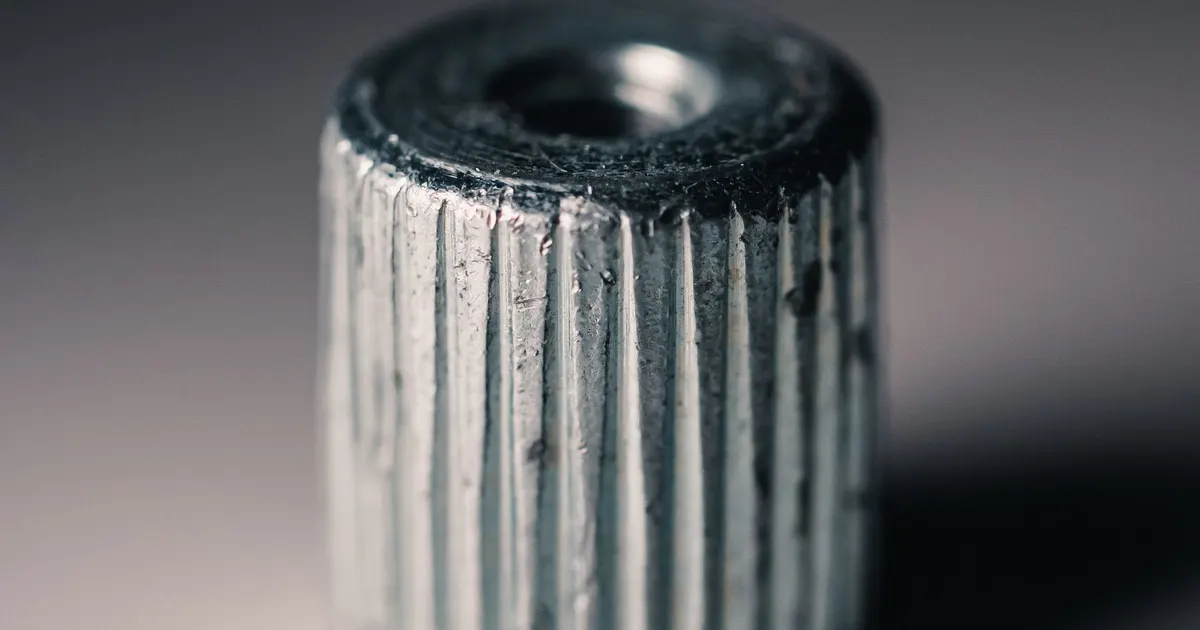
Knurling is a pattern of ridges pressed or cut into the outside of a round part. It gives a grip for fingers, a surface for a press fit or a mark that reads as a knob. On a Swiss-type lathe it is a common feature on small knobs, adjusters, inserts and shafts, and it is also a feature whose drawing callouts often cause confusion at the quote stage.
This guide covers the main patterns, how the process works on a slender part, how the diameter changes and what a drawing should say.
The three patterns
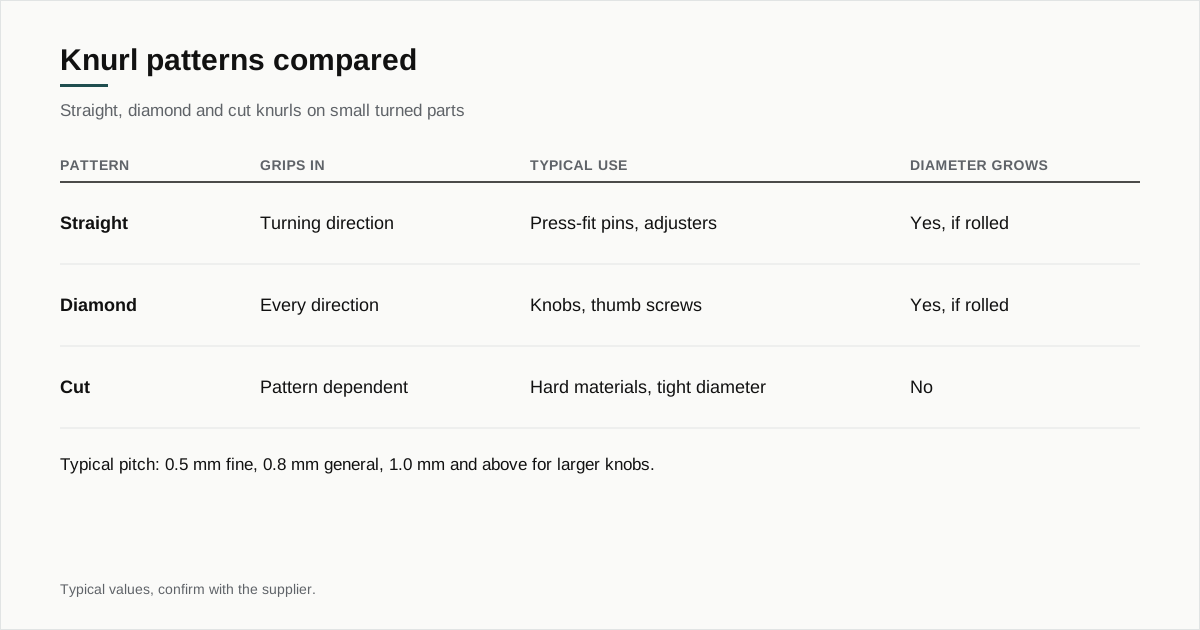
Straight knurl. Parallel ridges running along the length of the part. It grips in the turning direction and slides along the axis. Typical uses are press-fit pins, where the ridges bite into the bore wall, and adjusters that turn in a socket.
Diamond knurl. Two sets of ridges crossing at an angle, producing a raised pyramid pattern. It grips in every direction, so it is the usual choice for knobs and thumb screws. It can be right-hand, left-hand or both, which is what makes the diamond.
Cut knurl. Produced by a cutting tool that removes material rather than displacing it. The pattern can look similar to a rolled knurl, but the ridges are cleaner and there is no growth in diameter. Hard materials and parts with tight diameter limits use this method.
A fourth option, a form knurl on a profiled surface, appears on parts with a tapered or crowned grip zone. The wheel follows the contour while it rolls.
Pitch
Pitch is the distance between ridges. A coarse pitch is easy to feel and hard to machine on a small part. A fine pitch is more subtle and more consistent.
| Pitch (typical) | Typical use | Notes |
|---|---|---|
| 0.5 mm | Fine grip, small knobs | Common on small parts |
| 0.8 mm | General hand grip | A standard pitch |
| 1.0 mm | Larger knobs, press fits | Needs a larger diameter |
| 1.2 mm and above | Coarse grip | Rare on parts under 10 mm |
Pitch has to suit the diameter. On a very small part, a coarse pitch does not close around the circumference evenly, and the pattern shows a seam or a mismatched ridge where it starts and ends. A shop picks a pitch that divides well into the circumference. Describing the function and the preferred pitch is better than demanding a pitch the diameter cannot support.
Standards exist for knurl pitches and forms. ASME B94.6 covers knurling in the United States, and DIN 82 is widely used in Europe. If your drawing refers to one, name it and the form designation. If it does not, give pitch and pattern in plain terms.
How it is done on a Swiss-type lathe
A rolling knurl tool carries one, two or three hardened wheels with the reverse pattern cut on them. The tool presses against the rotating part, and the wheels displace material into ridges. Two things make this challenging on a slender part.
Radial force. A rolling knurl pushes hard on the workpiece. On a free-standing slender part the force bends it, so the pattern comes out uneven. On a Swiss-type lathe the cut sits next to the guide bushing, where the bar is supported, and that is why Swiss machines handle knurling on slender work that other lathes cannot. Two-wheel tools that squeeze the part from both sides cancel most of the radial load, so they are preferred on thin parts.
Start and end. The knurl has to begin and end somewhere. A rolled pattern ends with a ramp where the wheel enters, and a runout on the other side where it exits. Where the grip zone is bounded by a shoulder, the wheel cannot reach all the way, and a short plain section remains. A drawing that demands a knurl running right up to a shoulder needs a relief groove, or a cut knurl, or acceptance of a plain band.
Diameter growth and blank size
Rolling displaces material outward as well as inward. The peaks of the ridges rise above the original surface, and the valleys sink below it. The finished outside diameter is therefore larger than the blank diameter before knurling, typically by a fraction of the pitch.
This creates a trap on drawings. If the drawing calls out only the blank diameter and a pitch, the finished diameter depends on how the shop sets the tool. If it calls out only the finished diameter, the shop can calculate the blank. The better way is to specify the finished knurled diameter with a tolerance wide enough to survive the process, typically about ±0.05 to ±0.1 mm on small parts, and let the shop adjust the blank to reach it. Confirm the figures with the shop before the first order.
A mating part that slides over the knurl is a different case. If the mating bore is sized to the ridge peaks, the blank must be controlled tightly. State the function: press fit into a bore, hand grip or decoration.
Materials
| Material | Rolled knurl | Notes |
|---|---|---|
| Brass | Easy | Clean ridges, common choice |
| Aluminum | Easy | Soft, can smear at fine pitch |
| Free machining steel | Good | Common and predictable |
| Austenitic stainless | Possible | Work hardens, needs sharp wheels |
| Hardened steel | Not by rolling | Knurl before heat treatment or cut it |
| Plastics | Not usual | Cut or molded in instead |
Brass is the easiest, and a brass knob is the textbook knurled part. The brass guide explains why. Stainless is workable, but it springs back and hardens as it is formed, so the wheels wear. The stainless guide covers the material in more detail.
Cleanliness
Rolling knurls produce small flakes of metal at the ridge tips, and the ridges themselves trap oil and chips. If the part goes into a medical device, an optical instrument or a clean assembly, state the cleaning requirement. Knurled surfaces are harder to clean than smooth ones. Ultrasonic cleaning is usual, and the secondary operations guide covers what else is available.
Knurling also affects finishing. Plating or anodizing builds a coating onto the ridges and changes the size, so a coated knurl may need a different blank. Say which finish follows.
Common problems and how they are avoided
Double tracking. If the wheel does not start at the same angle on each revolution, the ridges do not line up, and the pattern shows a second set of ridges between the first. This happens when the pitch does not divide evenly into the circumference at the blank diameter. A shop avoids it by adjusting the blank diameter slightly, which is another reason the finished diameter should carry a tolerance that allows it.
Torn or flaking ridges. Material that is too hard, a wheel that is dull or a feed that is too fast tears the ridge tips instead of forming them. Free machining grades with lead or sulfur additions sometimes crumble under the wheel, so a shop may prefer a non-leaded grade for knurled parts. If your part is made from one grade and the knurl is critical, say so before quoting.
Part bending. A rolling tool pressing on one side bends a slender part. The shop counters this with a two-wheel tool, a position close to the guide bushing and a slower infeed. If the part is long and thin and the knurl sits far from the bushing, expect a discussion about moving the knurl or cutting it instead of rolling it.
Wheel wear. Each wheel wears with use, and the pitch it produces changes slightly as it does. For a part where the ridge count or depth is inspected, the shop checks it at intervals and replaces wheels on a count. The inspection guide covers how to set a sample plan for features like this.
What to put on the drawing
Specify the result, not the tool:
- Pattern, straight or diamond, with the angle for diamond
- Pitch or a standard designation
- Finished diameter with tolerance, taken over the ridge peaks
- Length of the knurled zone and its position
- Edge condition at both ends, such as a chamfer to lead the wheel in
- Material condition, including any hardness
- Function, such as press fit or hand grip
A chamfer at the leading edge helps the wheel enter cleanly. A drawing without one forces the shop to start the knurl on a sharp edge, which can leave a burr or a torn first ridge.
How knurling affects price
Knurling is cheap in cycle time. A rolled knurl typically adds a few seconds, because the wheel runs in the same turn as the turning. The cost sits in tooling and in setup, since each pitch and pattern needs its own wheels. If your part is a standard pitch and diamond or straight pattern, the shop probably has the wheels. A custom pitch means buying a tool.
The cost guide explains how tooling spreads over a run, and the tooling charges guide shows when a one-time charge is reasonable.
Where knurling appears
Adjuster knobs and thumb screws on instruments use diamond knurls for grip. Press-fit pins and inserts use straight knurls to hold in a plastic or soft metal housing, a use also seen in the connector pin guide. Motor shafts and drive pins sometimes carry a straight knurl so a hub can be pressed on without a keyway. In each case the knurl does a job, and the job is what the drawing should describe.
Getting knurled parts quoted
Send the drawing and STEP file through the RFQ form. State the pattern, the pitch, the finished diameter, the material and the yearly volume. We match the part with up to three shops that run Swiss-type lathes and reply within 24 business hours.
If you are choosing between a knurl and a smooth surface with flats, ask the shops to quote both. The price difference is usually small, and it helps you decide on grip against cost with a real figure.
Frequently asked questions
Does knurling change the outside diameter of the part?
Yes. Rolling a knurl displaces material, so the finished outside diameter ends up larger than the blank turned before knurling. The pitch, the pattern and the material set how much. Dimension the finished knurled diameter on the drawing, and let the shop pick the blank size that produces it.
Which is better for a grip surface, straight or diamond?
Diamond gives grip in both the turning direction and along the axis, which suits knobs and hand-turned parts. Straight gives grip in the turning direction only and suits press fits, where the ridges bite into a mating bore. The function decides, not the look.
Can a hardened part be knurled?
Generally not by rolling. A knurl wheel needs a material soft enough to displace. Hardened steel is usually knurled before heat treatment, or knurled by cutting instead of rolling. Tell the shop the hardness and the order of operations.
Need a quote for this part?
Send the drawing. We match you with up to 3 Swiss shops and reply within 24 business hours.
Get matched with a Swiss shop