Guides / Materials
Nickel Silver and Aluminum Bronze on Swiss-Type Lathes: Two Copper Alloys Compared
October 18, 2026
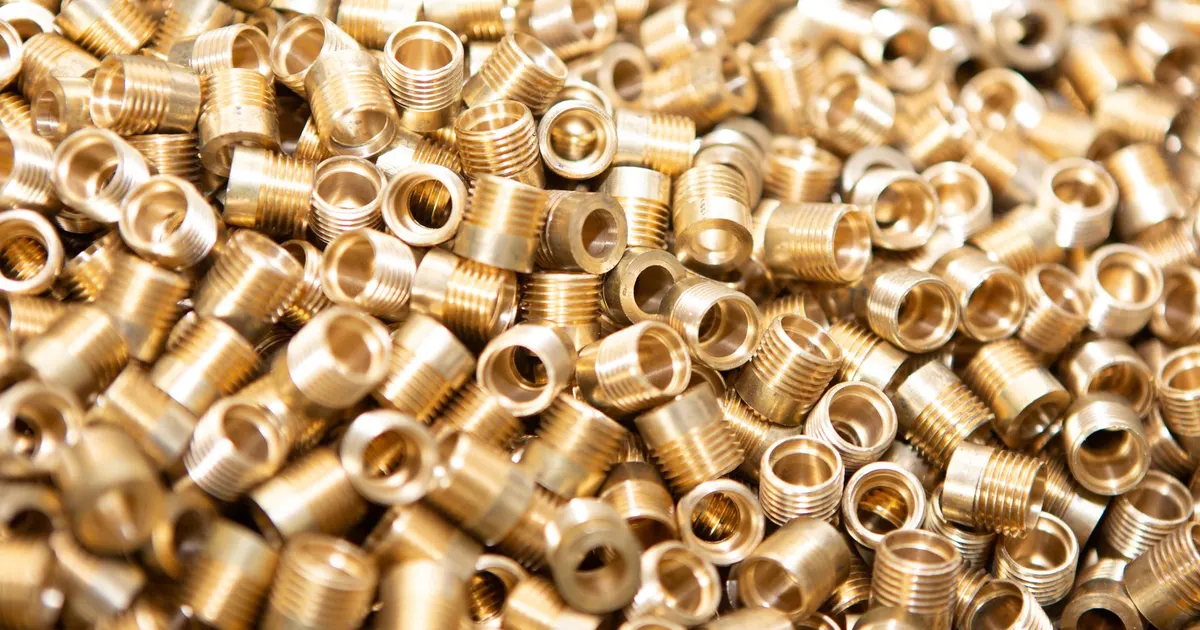
Brass is the default copper alloy for small turned parts, and it is the right default most of the time. Two other copper alloys appear when brass falls short. Nickel silver offers a silver color, tarnish resistance and spring behavior. Aluminum bronze offers strength, wear resistance and corrosion resistance that brass cannot match. Neither machines like brass, and both reward a shop that knows them.
This guide compares the two alloys, explains how they behave on a Swiss-type lathe and covers what a buyer should specify.
Nickel silver
Nickel silver is a copper alloy with nickel and zinc. A common wrought grade, C75200, contains roughly 65 percent copper, 18 percent nickel and 17 percent zinc, and a leaded variant exists for easier machining. The nickel gives the color, a pale silver with a slight warm tone, and the resistance to tarnish. Bar and rod are covered by standards such as ASTM B151.
Properties that matter for turned parts:
- Color and polish. It takes a bright polish and keeps it, which makes it a substitute for silver plating on hardware.
- Tarnish and corrosion resistance. Better than brass in the atmosphere and in body contact, and acceptable in many mild environments.
- Strength and springiness. Moderate strength, with good elastic behavior in cold worked tempers.
- Electrical conductivity. Low, around 5 to 6 percent of pure copper, so it is not a conductor choice.
Typical applications are eyewear screws and hinges, musical instrument parts, zipper and snap components, keys, decorative fittings and watch parts.
Aluminum bronze
Aluminum bronze is copper with about 6 to 12 percent aluminum, often with iron, nickel or silicon added. The aluminum forms a tough, self-healing surface oxide that gives the alloy its corrosion resistance, and the alloying elements give it strength that approaches that of a medium carbon steel.
Wrought grades include C61300, C63000 and the silicon-bearing C64200. Bar and rod are covered by standards such as ASTM B150. Cast grades such as C95400 are common in larger parts but are not usually used for Swiss work.
Properties that matter for turned parts:
- High strength. Tensile strength in the range of about 500 to 800 MPa, depending on grade and condition.
- Wear resistance. Good in sliding contact, with low galling against steel.
- Corrosion resistance. Very good in seawater and many chemicals.
- Non-sparking. Used in places where a spark is a hazard.
- Golden color. Often used for its appearance as well as its properties.
Typical applications are bushings, valve seats and stems, pump parts, marine fittings and wear plates. At the small sizes of Swiss work, the usual items are bushings, guide pins, valve parts and small gears.
How they compare
| Property | Free cutting brass (C36000) | Nickel silver (C75200) | Aluminum bronze (C63000) |
|---|---|---|---|
| Color | Yellow | Silver | Gold |
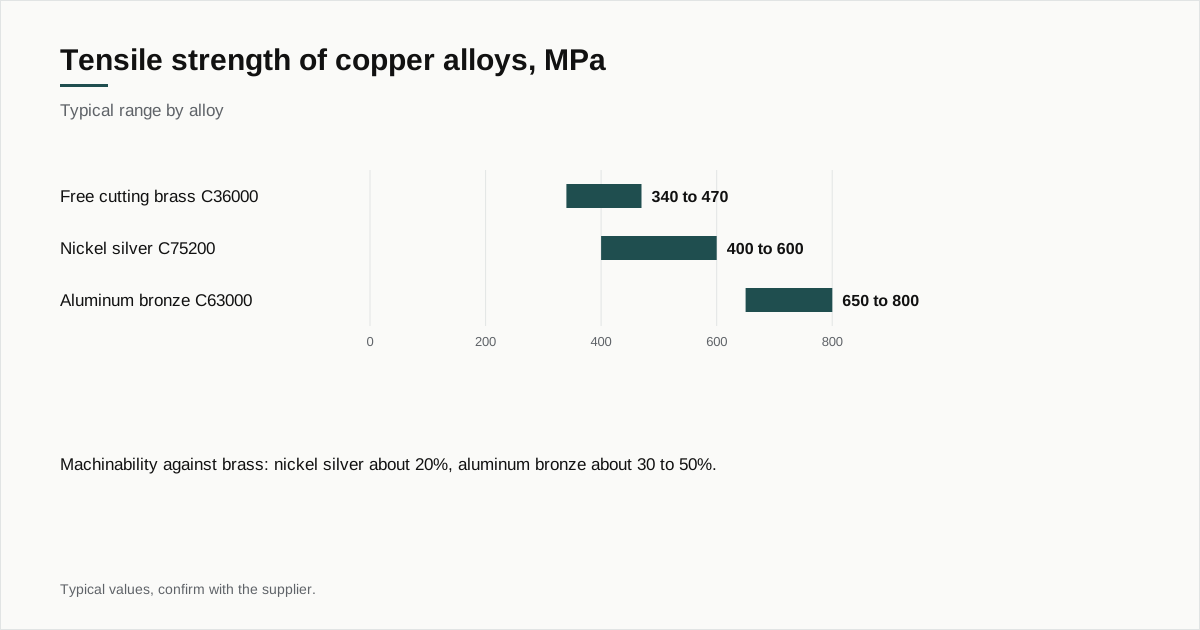
| Tensile strength (typical) | about 340 to 470 MPa | about 400 to 600 MPa | about 650 to 800 MPa |
| Hardness trend | Soft | Moderate | Hard |
| Machinability (relative to brass) | 100% | about 20% | about 30 to 50% |
| Corrosion resistance | Fair | Good | Very good |
| Tool wear | Low | Moderate | High |
| Material cost | Low | Moderate to high | Moderate to high |
Figures are typical, and they shift with grade and temper. The headline is that both alloys cost more to machine than brass by a clear margin, and a part designed around brass should be requoted if the material changes. The brass guide explains why brass is so easy and what its limits are.
Machining nickel silver
Nickel silver is gummy. The metal flows under the tool, and the nickel makes it tougher than brass. Typical behavior on a Swiss-type lathe:
Chips. Long and stringy in the unleaded grades. Chip breakers and pressure coolant keep them from wrapping the bar. A leaded grade breaks its chips better and is the usual choice for volume.
Built-up edge. Material sticks to the tool and breaks away, leaving a rough surface. Sharp, polished tools and the right speed reduce it.
Work hardening. Moderate. A dull tool or a dwell raises the surface hardness and makes the next cut harder.
Burrs. Present and firm. Deburring a small nickel silver part for a visible application takes care.
Surface finish. A fine finish is available with a sharp tool. Since the purpose is often appearance, shops spend effort on finish, and the surface finish guide explains how it is specified.
Lead content. Leaded grades may fall under restrictions on lead in consumer products. If your product needs a lead-free material, state it, since the free machining version is the one affected.
Machining aluminum bronze
Aluminum bronze is tougher and more abrasive than most copper alloys. Typical behavior:
Tool wear. The aluminum oxide in the structure and the strength of the alloy wear the edge. Tool life is a fraction of what it is in brass. Coated carbide is typical.
Speed. Lower than brass, and in the range of what a shop would use for a tough steel.
Chips. Continuous in the plain grades, and a silicon-bearing or leaded variant breaks better.
Heat. The alloy’s low thermal conductivity compared with other copper alloys keeps heat near the cutting edge, so coolant delivery matters.
Burrs. Strong and hard to remove, particularly on the exit of a hole.
Threading and tapping. Doable, with sharp tools. The strength makes thread forming difficult, so a cut thread is more common than a rolled one.
Cutting aluminum bronze is closer to cutting a steel than a brass. The tool wear guide explains why tools are changed by count, which suits an abrasive material like this one.
Stability, springback and tolerances
Both alloys behave differently from brass when a tolerance is tight.
Nickel silver springs back. It is elastic enough that a thin or slender part deflects under the tool and returns slightly after the cut, so a diameter measured right off the machine can differ from the same part a few minutes later. Shops compensate with light finishing passes and by measuring after the part has settled. A thin-walled nickel silver tube is a harder job than the same tube in brass.
Aluminum bronze holds size. It is stiff and stable, and it responds to the tool predictably, once the tool wear is under control. Diameter drift comes from the insert wearing, which is why shops change inserts by count.
Residual stress. Cold drawn bar in either alloy carries internal stress. When a cut removes material, the stress is released and the part can move. Stress relieved bar or a roughing pass followed by a finishing pass reduces the effect. Slender parts with a long cut are most exposed.
Temperature. Copper alloys expand more than steel, so a part measured warm differs from one measured at room temperature. Shops that hold tight tolerances measure at a controlled temperature. The tolerance guide explains what a realistic number looks like for these alloys.
Choosing between them
The two alloys rarely compete for the same job. A rule of thumb that works:
- If the requirement is a silver look with tarnish resistance, and the loads are light, nickel silver fits.
- If the requirement is strength, wear or corrosion resistance in service, aluminum bronze fits.
- If the requirement is cost and ease of machining, brass fits, with plating if a color is needed.
- If the requirement is both a silver look and high strength, stainless steel is usually the answer, and the stainless guide covers it.
When in doubt, describe the function and environment rather than naming the alloy. A shop that sees a bushing running against a steel shaft in a damp environment will suggest the right material, and one that sees a decorative pin will suggest another.
Cost picture
| Cost driver | Nickel silver | Aluminum bronze |
|---|---|---|
| Material price | Higher than brass, tied to nickel | Higher than brass |
| Cycle time | Longer than brass | Longer still |
| Tool wear | Moderate | High |
| Bar availability in small sizes | Good | Limited |
| Finishing | Polish often required | Usually as machined |
If a part can be made in brass and a plated finish gives the color you want, brass is usually cheaper than nickel silver. If a bushing needs wear resistance and a less expensive option, such as bronze with a lower aluminum content or a hardened steel, may work, the shop can quote several. The cost guide explains how material and machining combine, and the materials guide compares the options.
A worked example
Take a hinge pin for an eyewear frame, 1.2 mm in diameter and 8 mm long, with a head and a thread. The pin must resist tarnish and match a silver-colored frame.
Nickel silver is the natural choice. A leaded grade machines well enough for volume, and the turned surface needs light polishing for appearance. Brass would machine faster and need plating to match, which adds a step and a coating that can wear through. Stainless would match the color but is harder to machine at this size.
Now take a guide bushing 6 mm in diameter and 10 mm long that slides against a steel shaft in a wet environment. Brass wears and corrodes. Aluminum bronze resists both, and it runs against steel without galling. The part costs more and cuts slower, and the service life justifies it.
What to put on the drawing
- Alloy designation and standard, such as C75200 or C63000
- Temper or condition, if strength matters
- Leaded or lead-free, since this changes machinability
- Surface finish and polish requirement
- Plating or other finish, if any
- Burr limits on visible or mating edges
- Corrosion or wear requirement, which tells the shop why the alloy was chosen
Getting these parts quoted
Send the drawing and STEP file through the RFQ form. State the alloy, the condition, the finish and the yearly volume. We match the part with up to three shops that run Swiss-type lathes and reply within 24 business hours.
If you are unsure whether you need one of these alloys, describe the function and the environment. The shops can often propose a cheaper material that does the same job, and quote it next to your first choice.
Frequently asked questions
Does nickel silver contain silver?
No. Nickel silver, also called German silver, is a copper alloy with nickel and zinc. The name comes from its silvery color. It resists tarnish better than brass and takes a bright polish, which is why it appears on instrument parts, hinges, keys and decorative hardware.
Why choose aluminum bronze over brass?
For strength, wear resistance and corrosion resistance, particularly in seawater and sliding contact. Aluminum bronze bushings and valve parts outlast brass in demanding service. The price is slower machining, faster tool wear and a higher material cost.
Are these alloys easy to find in small bar sizes?
Nickel silver in small round bar is usually available. Aluminum bronze in small diameters for Swiss work is less common than in larger sizes, and some grades are mostly cast or large bar. Check availability for your diameter before you design around a grade.
Need a quote for this part?
Send the drawing. We match you with up to 3 Swiss shops and reply within 24 business hours.
Get matched with a Swiss shop