Guides / Materials
Tellurium Copper C14500 on Swiss Lathes: Machining Conductive Small Parts
October 26, 2026
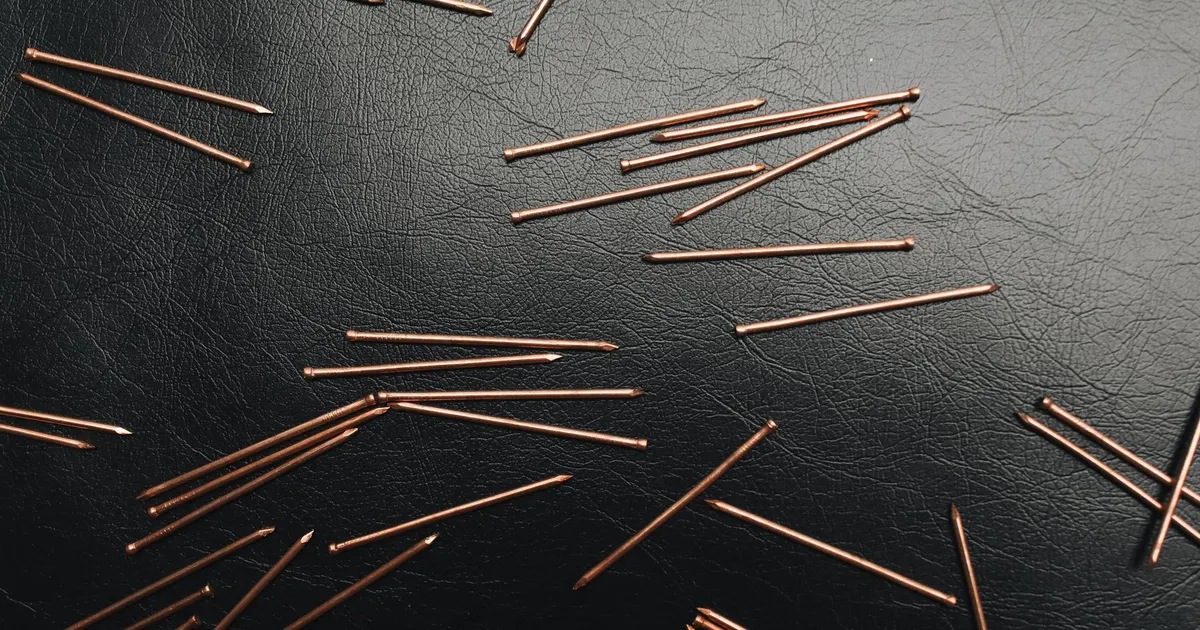
Copper carries current and heat better than almost any other common metal, and it is hard to machine. Pure copper is soft and sticky, and it wraps around the tool in long strands. Tellurium copper, designated C14500 in the UNS system, was developed to solve that. A small addition of tellurium keeps conductivity high and lets the chip break short.
This guide covers where C14500 fits against pure copper and brass, how it behaves on a Swiss-type lathe, what to watch on burrs and plating and how to describe the material on a drawing.
What C14500 is
Tellurium copper is copper with roughly half a percent of tellurium and a trace of phosphorus. The balance is copper at about 99 percent, which is why the electrical and thermal properties stay close to pure copper. The tellurium forms tiny particles in the structure that act as chip breakers, in the same way lead does in free cutting brass.
It is covered by free-cutting copper standards such as ASTM B301 in the United States, and similar specifications apply elsewhere. Confirm the exact designation with your supplier, because tempers and tolerances differ between specifications.
Typical applications for small turned parts:
- Electrical contacts and terminals where low resistance matters
- Connector pins and sockets that carry current
- Welding electrode tips and holders
- Heat conduction parts such as small thermal posts
- Parts that are plated afterward with silver, nickel or gold
The connector pin guide and the RF connector guide cover cases where copper alloys are chosen against brass or beryllium copper.
Where it sits among copper alloys
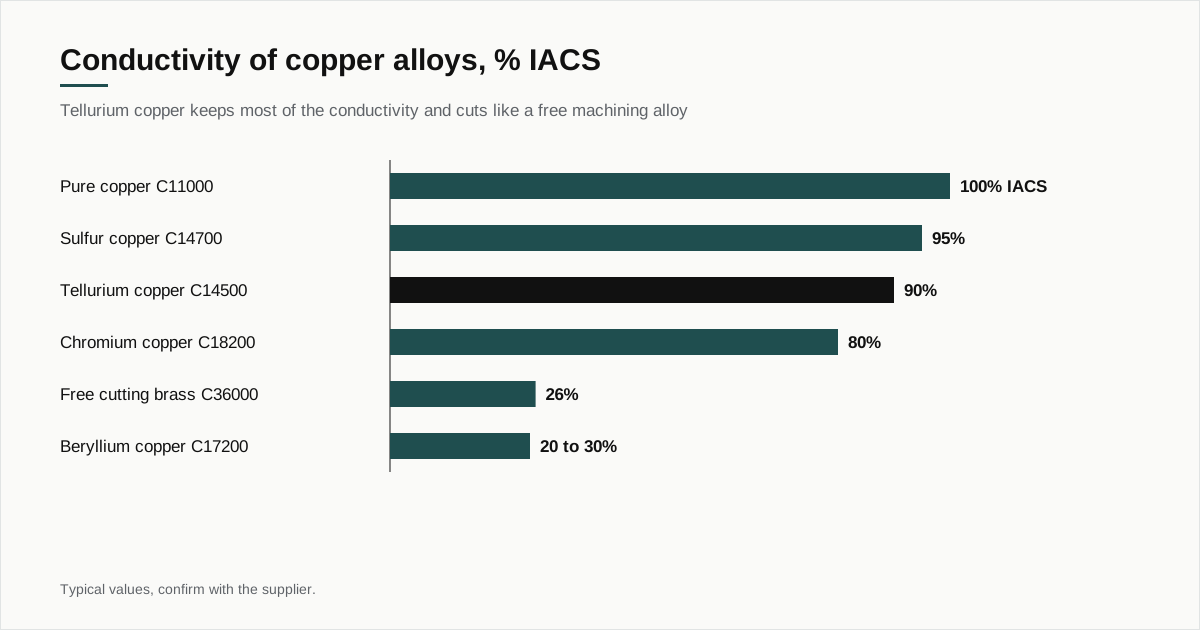
| Alloy | Typical conductivity | Machinability against free cutting brass | Notes |
|---|---|---|---|
| Pure copper (C11000) | about 100% IACS | very low, about 20% | Gummy, long chips |
| Tellurium copper (C14500) | about 90% IACS | about 80 to 90% | Short chips, good surface |
| Sulfur copper (C14700) | about 95% IACS | about 80% | Similar use, different additive |
| Chromium copper (C18200) | about 80% IACS | low, about 20 to 40% | Heat treatable, stronger |
| Free cutting brass (C36000) | about 26% IACS | 100% | Reference alloy, lower conductivity |
| Beryllium copper (C17200) | about 20 to 30% IACS | low | Spring alloy, covered separately |
All figures are typical and vary with temper and standard. The point is the trade-off: you pay a small conductivity penalty against pure copper and gain a large improvement in machinability. Brass, by contrast, is easy to machine and a poor conductor. The brass guide explains why brass dominates when conductivity does not matter.
How it behaves on a Swiss-type lathe
On a Swiss-type lathe, C14500 behaves much like a softer free cutting brass with a few differences.
Chips. The chips are short and manageable, which matters on a Swiss-type lathe where chips can wrap around a small part or the bushing. A part cut from pure copper at the same size would jam the machine within a few cycles. With tellurium copper, the machine runs unattended.
Cutting speed. Surface speeds are high, comparable to brass, and tool life is long because copper alloys are not abrasive. Sharp, polished, positive-rake inserts are the norm, since a dull edge pushes the soft metal instead of cutting it.
Surface finish. A good finish is achievable straight from the lathe, and many parts need no polishing. The surface can still smear if the tool is dull or the feed is wrong, so shops tune it for each part. The surface finish guide explains how finish is specified.
Burrs. Copper alloys form burrs readily. The metal is soft and ductile, so an exiting tool pushes the edge over instead of shearing it. Burrs on a connector pin or a contact face can affect how it mates, so the burr requirement deserves a line on the drawing.
Threading and knurling. Both work well. Threads in C14500 are clean, and the soft metal forms a knurl easily. A part with a thread and a knurl, such as a small terminal, is a normal request.
Deformation under clamping. The metal is soft. A collet or sub spindle that grips hard can mark or squeeze a thin wall, so shops use controlled grip force on thin-walled parts.
Temper and material condition
Copper alloys come in tempers that describe how much the bar has been cold worked. Harder tempers have higher strength and slightly lower conductivity. Softer tempers are easier to form and weaker.
| Condition | Typical tensile strength | Effect |
|---|---|---|
| Annealed (soft) | about 220 to 260 MPa | Soft, burrs more, highest conductivity |
| Half hard | about 260 to 340 MPa | Common for machining |
| Hard | about 340 MPa and above | Stiffer, machines slightly cleaner |
For turned parts, half hard and hard drawn bar are common because they machine cleaner than soft stock and hold shape better. The stock condition matters on slender parts, where a harder temper deflects less. State the temper if a mechanical property matters and let the shop buy the matching bar.
Plating and finishing
Most C14500 parts that carry current are plated, because bare copper tarnishes and develops a surface oxide that raises contact resistance. Typical finishes are:
- Nickel, as an undercoat that also blocks copper diffusion into the top layer
- Silver, for low resistance contacts
- Gold, over nickel, for connectors that mate often
- Tin, for solderability
The order of operations matters. The part is turned, deburred, cleaned and then plated, and each step affects the next. A burr plated over is still a burr. A surface smeared by a dull tool traps plating chemicals. Plating also adds thickness, so a diameter that must meet a final dimension needs the shop to turn it undersize by the plating amount. The secondary operations guide covers how finishing steps are sequenced.
Why chip control decides the economics
On a Swiss-type lathe, the cut happens a few millimeters from the guide bushing, and the chips have nowhere to go except into a narrow space around the tool. A long stringy chip winds around the bar, the tool or the bushing, and the operator has to stop the machine to clear it. Even a short interruption on a part with a 20 second cycle destroys the hourly output.
This is why pure copper is rarely run on Swiss-type machines at volume, and why the choice between C14500 and C11000 is rarely about conductivity alone. A shop will run a conductive part in C14500 unattended overnight, while the same part in pure copper may need an operator nearby or chip breaking tricks such as peck turning and high pressure coolant. Those tricks add cycle time, and the extra time can cost more than the alloy premium.
If the design genuinely needs the last few percent of conductivity that pure copper gives, say so and expect a higher price and a narrower field of shops. If it needs good conductivity, C14500 is usually the better balance.
A worked example
Take a contact pin 2 mm in diameter and 15 mm long, with a rounded tip, a collar and a thread. It carries a few amperes in a test fixture and is silver plated afterward. The drawing asks for at least 85 percent of pure copper conductivity.
C14500 meets the conductivity with margin, machines in a short cycle, forms the thread cleanly and leaves a surface that takes plating well. Brass at 26 percent of pure copper conductivity would fail the requirement. Chromium copper at around 80 percent would also fall short in its common tempers, and it machines slowly. Pure copper would meet the number but cost more in machine time and in scrap from smeared surfaces.
The decision is clear from the numbers, and the drawing should state the conductivity floor so the shop does not substitute an easier alloy. A shop that does not know about the requirement may quote brass, which is cheaper and fails.
Problems to watch for
Smearing and built-up edge. A dull tool smears copper over the surface instead of cutting it. The surface looks fine and then fails under plating. Frequent insert changes on contact faces are the fix.
Burr at the cut-off. The back face of a copper pin carries a burr after cut-off. Back working on a sub spindle can remove it in cycle, and the sub-spindle guide explains how.
Marks from handling. Copper is soft, and parts that fall into a bin together dent each other. Thin pins bend. If the part is delicate, ask about the method of collection and packing, which the packaging guide covers.
Surface contamination. Finger marks, cutting fluid residue and oxidation build up fast on bare copper. State the cleaning requirement and the time limit between machining and plating.
Cost picture
Material cost is the first surprise. Copper alloys are priced by the kilogram, and the price tracks the copper market, which is volatile. C14500 carries a premium over pure copper and a larger one over brass because of the tellurium and the smaller market. Parts that look cheap in brass can cost noticeably more in tellurium copper, mostly from bar cost.
Machining cost is lower than for harder alloys. Cycle times are short and tools last, so for a given part, run time is comparable to brass. The material adds a larger share of the unit price than it would for a cheaper alloy. The materials guide compares the options, and the cost guide shows how material and machining add up.
Bar availability is the other factor. Ground or precision drawn bar in the sizes Swiss work needs is less common in C14500 than in brass, so a shop may need to order, which affects lead time. The bar feeder guide covers bar handling for small diameters.
What to put on the drawing
- Material designation, such as C14500 or UNS C14500, with the standard if there is one
- Temper, if strength or stiffness matters
- Conductivity requirement, as a minimum percentage, if it applies
- Burr requirement at the contact surfaces
- Plating, with thickness and the point in the sequence
- Surface finish on contact faces
- Lead-free or other composition requirement, if there is one
If conductivity is critical, ask for a certificate with the lot, and consider testing the bar. A copper alloy that is close in name but not in composition can miss a conductivity requirement.
Getting tellurium copper parts quoted
Send the drawing and STEP file through the RFQ form. State the alloy, the temper, any plating and the yearly volume, and mark the surfaces that carry current. We match the part with up to three shops that run Swiss-type lathes and reply within 24 business hours.
If you are choosing between tellurium copper and brass, ask the shops to quote both. The unit price difference, set against the conductivity you need, shows whether the better conductor is worth the premium on your part.
Frequently asked questions
Why not just use pure copper for a conductive part?
Pure copper machines poorly. It is soft and gummy, the chips come off in long strings and the surface tears. Tellurium copper keeps most of the conductivity of pure copper and breaks its chips into short pieces, so the same part runs faster and comes off the lathe cleaner.
How much conductivity do I lose with C14500?
Typically a small amount. C14500 is rated at roughly 90 percent of the conductivity of annealed pure copper in its common tempers, while brass is around a quarter. Confirm the value for the temper and the standard you buy, because it varies with cold work.
Is tellurium copper restricted like leaded brass?
Tellurium copper contains no lead, which is its main attraction for lead-free designs. Requirements still depend on the product and the market, so check the regulation or customer specification that applies to your part.
Need a quote for this part?
Send the drawing. We match you with up to 3 Swiss shops and reply within 24 business hours.
Get matched with a Swiss shop