Guides / Materials
Tantalum and Niobium on Swiss Lathes: Machining Gummy Refractory Metals
October 25, 2026
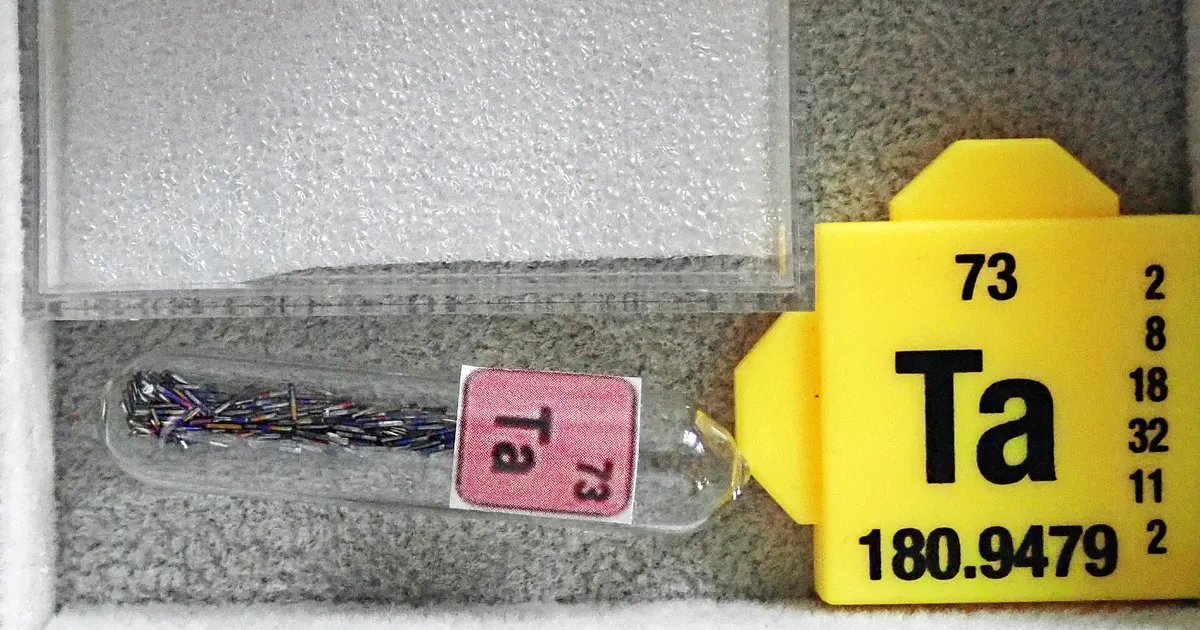
Tantalum and niobium are refractory metals. They have very high melting points, resist most acids and, in the case of tantalum, are accepted by the body as implant material. They also sit among the more frustrating metals to cut. Both are soft, tough and gummy, and both smear onto tools instead of shearing cleanly.
This guide covers what the two metals are used for in small turned parts, how they behave on a Swiss-type lathe, what drives their cost and what to state on a drawing.
The two metals
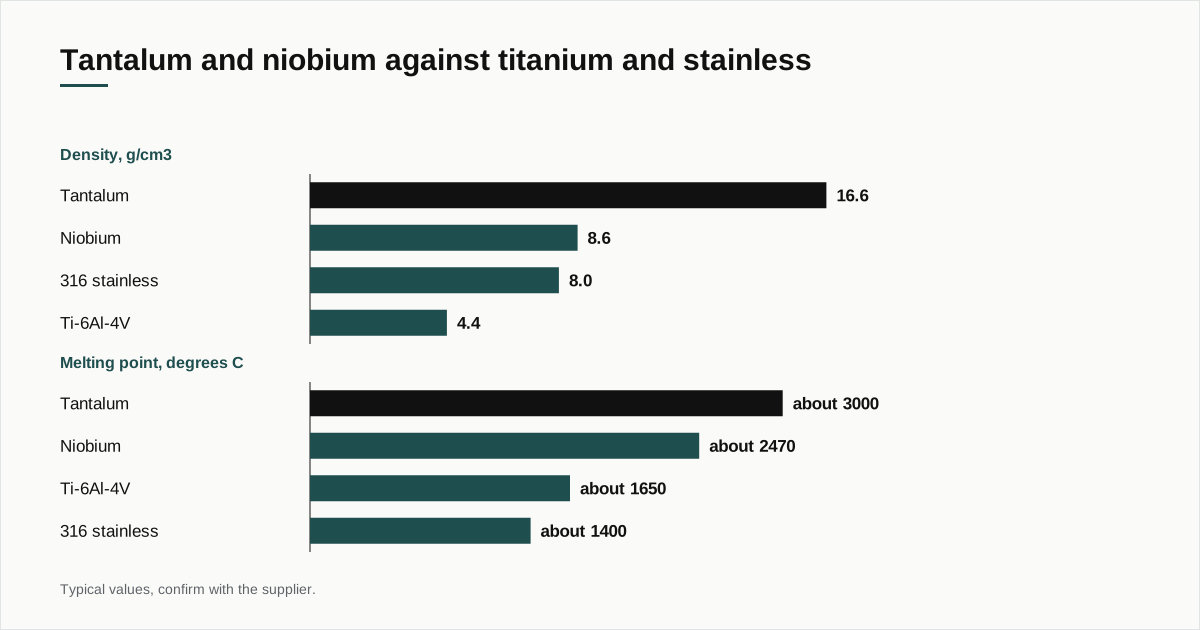
Tantalum is dense, about twice the density of steel, with a melting point above 3000 degrees Celsius. It forms a stable oxide that makes it resistant to nearly all acids at ordinary temperatures, and it is biocompatible, which is why it appears in implant markers and some orthopedic and dental parts. Its radiopacity, meaning it shows on an X-ray, makes it useful in medical devices.
Niobium is lighter than tantalum, with a density a little above that of steel, and a melting point near 2500 degrees Celsius. Niobium and its alloys are used in superconducting devices, in some aerospace and nuclear parts and in decorative applications, where an anodized surface takes on bright colors.
Both are available as pure metals and as alloys. A common tantalum alloy adds tungsten for higher strength, and niobium appears in alloys such as niobium-titanium for superconductors.
Standards that apply to bar and rod include ASTM B365 for tantalum and ASTM B392 for niobium, and ASTM F560 covers unalloyed tantalum for surgical implants. Check which one your customer requires.
Typical small parts:
- Implant markers and radiopaque parts in medical devices
- Capacitor and electronic components that need a stable oxide
- Chemical process parts such as small fittings and nozzles that see acids
- Superconducting and cryogenic parts in niobium
- High temperature hardware such as small fasteners and fixtures
How they compare
| Property | Tantalum | Niobium | Titanium (Ti-6Al-4V) | 316 stainless |
|---|---|---|---|---|
| Density (g/cm³) | about 16.6 | about 8.6 | about 4.4 | about 8.0 |
| Melting point (°C) | about 3000 | about 2470 | about 1650 | about 1400 |
| Machinability | Poor, gummy | Poor, gummy | Moderate | Fair |
| Corrosion resistance | Excellent in acids | Very good | Very good | Good |
| Bar cost per kilogram | Very high | High | Moderate | Low |
All values are typical. The point is the combination: high density means a small part is heavy, high bar cost raises the stakes of every scrapped part and gummy cutting makes scrap more likely.
Why they are gummy
Both metals are soft and ductile in their annealed state. A tool does not shear the chip cleanly. The metal flows ahead of the edge, folds and sticks to the tool face, forming a built-up edge that grows and breaks off. The surface comes out smeared, with torn patches, and the tool wears fast.
On a Swiss-type lathe, a few effects follow:
Long, stringy chips. Pure tantalum and niobium do not break chips well. Chips wrap around the part and the tool. Chip breakers and high pressure coolant are essential, and chip clearing is a regular part of the program.
Heat concentrates in the tool. Tantalum has relatively low thermal conductivity compared with copper, so the heat stays near the edge and wears it. Coolant must reach the cut.
Work hardening. Both metals harden under the tool less than austenitic stainless, but a dull tool or a dwell on the surface still raises the hardness and makes the next pass harder.
Galling. The metal sticks to guide bushings and fixtures. A rough or worn bushing marks the bar, and marks on tantalum bar can be deep.
Tools, speeds and coolant
Practices differ between shops, and the following is typical rather than a recipe.
| Aspect | Typical practice |
|---|---|
| Tool material | Sharp, uncoated or lightly coated carbide with a polished face |
| Rake | Positive, to shear instead of push |
| Cutting speed | Low to moderate, below the speed for stainless |
| Feed | Steady and not too light, to avoid rubbing |
| Depth of cut | Enough to get under the work-hardened layer |
| Coolant | Plenty, at high pressure, with good filtration |
| Tool change | By part count, before the edge dulls |
Light feeds are tempting on a delicate part, and they are a common cause of trouble, because a tool that rubs instead of cutting heats the surface and smears it. A shop that knows the metal will use a feed that cuts and a tool that stays sharp.
Threading is demanding. The metal tears and the thread can come out rough. Thread rolling is sometimes used instead of cutting, since it forms the thread without removing metal, though it needs a good core diameter. The thread whirling guide covers another route for threads on slender parts.
Surface finish depends on the sharpness of the tool and the stability of the cut. A fine finish is possible, and it takes care. The surface finish guide explains how finish is specified.
Alloys and bar condition
Pure tantalum and pure niobium are the softest and gummiest versions. Alloying changes this. Adding tungsten to tantalum raises the strength and the hardness, and the alloy cuts a little more cleanly, though it still demands sharp tools and stiff setups. Niobium alloys with titanium, zirconium or hafnium behave in different ways, and their cutting behavior depends on the exact composition.
The condition of the bar matters as much as the alloy. Annealed bar is soft and gummy. Cold worked bar is harder, holds shape better on slender parts and cuts more cleanly, at the cost of lower ductility. A buyer who does not care about the condition can leave it open, and the shop will choose the one that machines best. A buyer who needs a particular strength, grain size or ductility, as medical implants often do, should state it, with the standard.
Parts that are machined in the cold worked state and then annealed need a vacuum furnace, since tantalum and niobium absorb oxygen and nitrogen at high temperature and become brittle. That step is rare for small turned parts, but if your drawing calls for it, say so early, as the number of vacuum heat treaters is small.
Bar cost, remnants and yield
Material dominates the cost of a small tantalum part. A Swiss-type lathe does not use the whole bar. The last portion of each bar, called the remnant, cannot be fed through the guide bushing, and each part loses a cut-off width as chips. In tantalum these losses are expensive.
A shop can reduce the loss by using a bar of the right length, by feeding as far as the machine allows and by recycling the remnants and chips, though recycling pays back only a part of the price and takes time. Ask how the quote treats remnants, and whether chips are returned or credited. The bar remnant article explains how remnants affect the price of expensive alloys.
Bar availability is the other factor. Tantalum and niobium come in limited diameters and lengths, and ground bar, which Swiss-type work with a guide bushing prefers, is not always available. A shop may buy the nearest size and turn it, adding material cost. Lead time for bar can run to weeks, which shows up in delivery.
Traceability and conflict minerals
Tantalum is one of four minerals, with tin, tungsten and gold, covered by conflict mineral rules in several markets. Customers in regulated industries often ask for a declaration that the metal is conflict free and for the smelter of origin. The shop depends on its bar supplier for this information.
If the part is for a medical device or a company with a supply chain policy, state the requirement in the request for quote, and ask the shop what documentation comes with the bar. A mill certificate, a heat or lot number and a supplier declaration are typical. The certifications guide explains what a certificate does and does not tell you.
Safety
Solid tantalum and niobium are safe to handle. Fine powder and very fine chips of either metal can ignite, though bulk machining chips are not usually a hazard. Shops keep fine swarf contained, avoid letting it dry in piles and follow their local rules for metal fines. If your part is ground or polished, which generates fine particles, ask how the dust is managed.
A worked example
Take a radiopaque marker band 2 mm in outside diameter, 1.4 mm in bore and 3 mm long, made from unalloyed tantalum. The wall is 0.3 mm thick, and the part must be burr free on both ends because it is crimped onto a catheter.
The shop buys annealed tantalum bar in a size close to 2 mm, turns the outside, drills and bores the inside, then parts the ring off with the sub spindle holding it. Thin wall and soft metal call for a light grip and a sharp cut-off tool. A tool change every few hundred parts keeps the edges clean. The finished rings are deburred by a process that does not remove metal from the thin wall, cleaned and inspected under magnification.
The cost is mostly in the material and the slow, careful cycle. A single scrapped ring costs more than a brass equivalent in a box of parts, which is why shops quoting this work carry a scrap allowance and why buyers see a high unit price.
What to put on the drawing
- Material, standard and grade, such as unalloyed tantalum to ASTM F560 for implants, or a specific alloy
- Condition, usually annealed
- Traceability and documentation you need with the bar
- Surface finish and burr limits
- Cleaning and packaging requirements, especially for medical parts
- Yearly volume, so the shop can plan bar purchases
Getting tantalum and niobium parts quoted
Send the drawing and STEP file through the RFQ form. State the metal, the standard, the documentation you need and the yearly volume. We match the part with up to three shops that run Swiss-type lathes and reply within 24 business hours.
Expect fewer quotes than for steel or brass, since not every shop machines these metals. If a quote comes in far below the others, ask what bar size and scrap allowance it assumes. A low figure that ignores yield is a figure that tends to be revised later.
Frequently asked questions
Why are tantalum parts so expensive?
Mostly because of the metal. Tantalum bar costs many times more than stainless steel per kilogram, and a Swiss-type lathe wastes some of it as a bar remnant and as chips. The machining itself is slow, which adds to the price. For small parts the material often outweighs the machining cost.
Can tantalum and niobium be machined on a standard Swiss-type lathe?
Yes, with the right tools and settings. Both are gummy, stick to the tool and need sharp carbide, steady feeds and plenty of coolant. They need no special machine, but they need a shop with experience, since an inexperienced shop will lose tools and parts.
Do I need to document where the tantalum came from?
Often yes. Tantalum is one of the minerals covered by conflict mineral rules in some markets, and many customers ask for supply chain declarations. Ask the shop what traceability it can supply with the bar, and state your requirement in the request for quote.
Need a quote for this part?
Send the drawing. We match you with up to 3 Swiss shops and reply within 24 business hours.
Get matched with a Swiss shop