Guides / Process
Polygon Turning on Swiss Lathes: How Hex and Square Features Are Made
October 21, 2026

Polygon turning is a way to cut a hex, square, double flat or other many-sided shape on a round bar while the bar is still turning in the lathe. It takes a few seconds per part and needs no second machine. For small parts in volume, that is the difference between a hex head that costs a few cents and one that costs several times more.
This guide explains how the process works, what shapes it makes, what it cannot do and how to draw a part so the shop is free to use it.
How the process works
A normal turning tool stays still while the part rotates. In polygon turning, a small cutter head is mounted on the tool post, and it rotates too. The cutter head carries two or three inserts that sweep across the bar as the bar turns. The two rotations are locked together in a fixed ratio by the control. Because the ratio is fixed, each insert returns to the bar at the same angle every revolution and removes the same sliver of material, so a flat appears.
The ratio and the number of inserts set the number of sides. Your shop sets this in the program, not in the tooling, which is why one head can produce a hex today and a square tomorrow. The depth of the cut sets how large the flat is, and the distance between the cutter axis and the bar axis sets how curved the flat is.
On a Swiss-type lathe the cut happens close to the guide bushing, where the bar is supported. This matters for slender parts. A hex machined on a free-standing bar would deflect, and a hex machined next to the bushing does not. That is one reason polygon turning suits Swiss-type work better than it suits a conventional lathe cutting a long overhang.
Which shapes it makes
Polygon turning is usually described as a hex tool, but it covers more:
Hexagon. The most common use: a hex collar on a fitting, a hex drive on a screw or a nut flat on a threaded shaft.
Square. Used for drive stubs, valve stems and adjustment shafts that take a square key.
Double flat. Two parallel flats on opposite sides of a round shaft, sometimes called wrench flats or a double D. A pin that must not rotate in a slot often carries one.
Triangle, pentagon and octagon. Less common, but within the same capability because the sides are set by the ratio.
What it does not make is a shape with a sharp internal corner, a pocket or a flat that stops short of the part’s end with a square shoulder. The cutter head needs a path in and a path out. A flat that runs off the end of the part, or into a relief groove, is straightforward. A flat that ends at a vertical wall is not.
Polygon turning against the alternatives
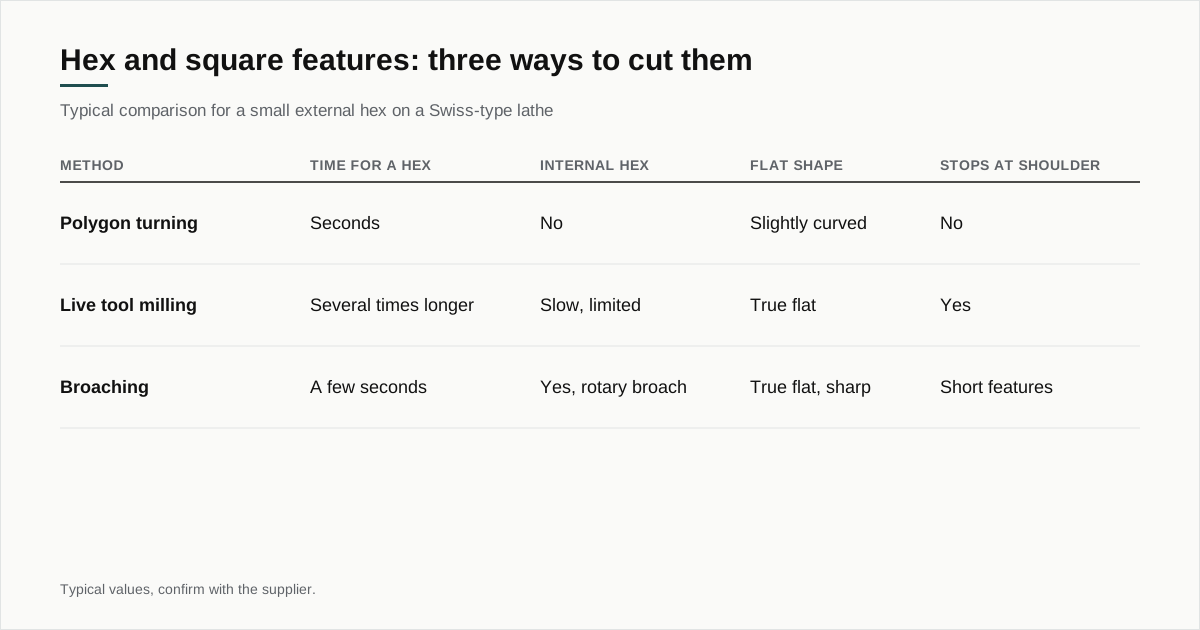
| Polygon turning | Live tool milling | Broaching | |
|---|---|---|---|
| How it cuts | Rotating cutter head, bar turning | Milling cutter, bar indexed | Pushed tool, one stroke |
| Typical time for a hex | Seconds | Several times longer | A few seconds |
| External hex | Yes | Yes | Rarely |
| Internal hex socket | No | Slow, limited by tool size | Yes, by rotary broach |
| Flat shape | Slightly curved | True flat | True flat, sharp corners |
| Stops at a shoulder | No | Yes | Yes for short features |
| Needs special attachment | Yes | Live tool station | Rotary broach holder |
Live tool milling can make a true flat that stops at a shoulder, and a hex milled with a small cutter in several passes is flexible, but it costs far more cycle time. Broaching is quick for internal shapes and for short external features. The trade-offs are in the live tooling guide, which covers what each station can and cannot do.
What polygon turning does to cycle time and cost
Time is the point. A hex cut by polygon turning is typically a few seconds of the cycle. The same hex milled can add many seconds more, and on a part with a total cycle of 30 to 60 seconds that is a large share. Over a run of 50,000 pieces the saving is real, and it shows up in the unit price.
Two costs offset the saving. The cutter head and its inserts are a tooling expense, and the first setup takes longer because the synchronization has to be proven. On a prototype quantity or a one-off the shop may mill the hex instead because it is not worth the setup. That is a sensible choice and nothing to resist. If your part will run in volume, ask the shop to quote with polygon turning for the hex and compare the figures. The cost guide shows how setup spreads across quantity.
Tolerances and what to expect
Polygon turned flats hold size well, but the numbers depend on the machine, the material and the length of the flat. Typical figures a shop might work to:
| Feature | Typical tolerance | Notes |
|---|---|---|
| Across flats, hex | about ±0.03 to ±0.05 mm | Tighter is possible on short flats |
| Flat to flat, square | about ±0.03 to ±0.05 mm | Check on the finished part |
| Flat symmetry around axis | about 0.05 mm | Depends on synchronization |
| Corner radius | not controlled tightly | Specify a maximum if it matters |
Confirm all of these with the supplier. The tolerance guide explains how to ask for a number a shop can hold without a surprise on the quote.
Three things that often go wrong in practice:
Measuring across flats. The flats are slightly curved, so a caliper reading depends on where the jaws land. For a tight requirement, agree on a gauge, such as a hex ring or a pin gauge, before the first order.
Burrs at the corners. Polygon cutting leaves a small burr where each flat meets the round. If the hex has to fit a socket or a wrench, call out a light break on the edges.
Chatter on long flats. A flat that runs a long way from the bushing can chatter, in which case the shop slows down or changes the cutter. Keep flats short where you can.
Setup, tooling and what shops watch
Setup is where polygon turning earns or loses its reputation. The cutter head must be mounted at the right height and distance from the bar axis, and the two rotations must be synchronized before the first cut. A small error in the offset shifts the size of the flats and the symmetry between them. A shop that runs the process weekly has a proven offset for each size and material. A shop that runs it twice a year often starts with trial parts.
The inserts see an interrupted cut. Each pass of an insert is a short strike on the material, followed by air, and that repeated impact wears the edge differently from continuous turning. Inserts are usually sharp, positive and polished for aluminum and brass, and tougher for steel and stainless. Insert life varies widely with material, so shops count parts per insert and change on a schedule. The tool wear guide explains why counting parts is cheaper than waiting for a visible failure.
Coolant needs to reach the cut. The cutter head spins at high speed and throws coolant away, so poor delivery shows up as heat, short insert life or a rough flat. If your hex has a surface finish requirement, mention it, because the finish on a polygon turned flat depends on feed per revolution of the cutter head and on insert condition. The surface finish guide explains how finish is specified and checked.
Speed is limited by the head, not by the bar. The head turns a fixed multiple of the bar speed, so a high bar speed needs a very high head speed. On very small diameters the bar speed is already high, and the head may reach its limit first. That is one reason polygon turning is more common on parts above a few millimeters and less common on the smallest pins.
How to draw the part so the shop can use it
The most common mistake is writing the process on the drawing. “Polygon turn this hex” tells the shop how to work but not what you need. Dimension the result instead:
- Number of sides and across-flats dimension, with a tolerance
- Length of the flat and where it starts and ends
- Corner condition, such as a maximum radius or a break
- Run-out or relief at the end of the flat, so the cutter has somewhere to exit
- Material, since stainless and tool steels take longer than brass or aluminum
If the hex must be a true hex with sharp corners, such as a hex socket in a mating tool, say so. The shop will then know to mill or broach it. Where the hex is just a wrench flat, leave the method open.
The material matters more than most buyers expect. Free machining brass takes a hex in a moment and leaves a clean surface. Austenitic stainless work hardens and pushes against the insert, so the flats run slower. Titanium behaves differently again, as covered in the titanium guide.
Where polygon turning appears in real parts
Hex collars on hydraulic fittings, where a wrench needs a grip, are the largest application by volume. See the hydraulic fittings guide. Screws with a hex drive head and shafts with a double D for set screws are common too, and the fasteners guide covers how head forms are chosen. Connector bodies and small instrument shafts use flats for orientation and for locking against rotation.
A short checklist before you send the drawing
- Does the hex need a true flat face or just a wrench grip?
- Is there a clear exit for the cutter at the end of the flat?
- Are across-flats tolerances realistic for the material?
- Have you decided how the flats will be gauged?
- Is the yearly volume stated so the shop can justify the tooling?
Getting hex and flatted parts quoted
Send the drawing and STEP file through the RFQ form. State the number of sides, the across-flats size, the material and the yearly volume. We match the part with up to three shops that run Swiss-type lathes and reply within 24 business hours.
If you are not sure whether a shop has the attachment, you do not need to ask in advance. Describe the feature and its function, and the quotes will show which shops cut it in one pass and which mill it. The price difference between those two answers is often the clearest signal about which shop fits a repeat order.
Frequently asked questions
Is a polygon turned hex the same as a milled or broached hex?
Close, but not identical. Polygon turning forms each flat as a very shallow arc, so the flat is not perfectly flat, and the corners carry a small radius. For wrench flats, drive heads and anti-rotation shapes this is almost always acceptable. If a mating part needs a true flat face or a sharp corner, say so on the drawing and the shop will choose another method.
Can polygon turning make an internal hex socket?
No. Polygon turning is an external process. Internal hex and square sockets are made by rotary broaching or wobble broaching, or by milling with a live tool. The two processes solve different problems and sometimes appear on the same part.
Does every Swiss-type lathe have a polygon turning head?
No. It is an add-on attachment that needs a tool position and a spindle that can be synchronized with the cutter head. Many shops have it on part of their fleet only, so a drawing that requires it narrows the shops that can quote it quickly.
Need a quote for this part?
Send the drawing. We match you with up to 3 Swiss shops and reply within 24 business hours.
Get matched with a Swiss shop