Guides / Process
Sub-Spindle Back Working: What a Second Spindle Saves on Swiss Parts
October 22, 2026
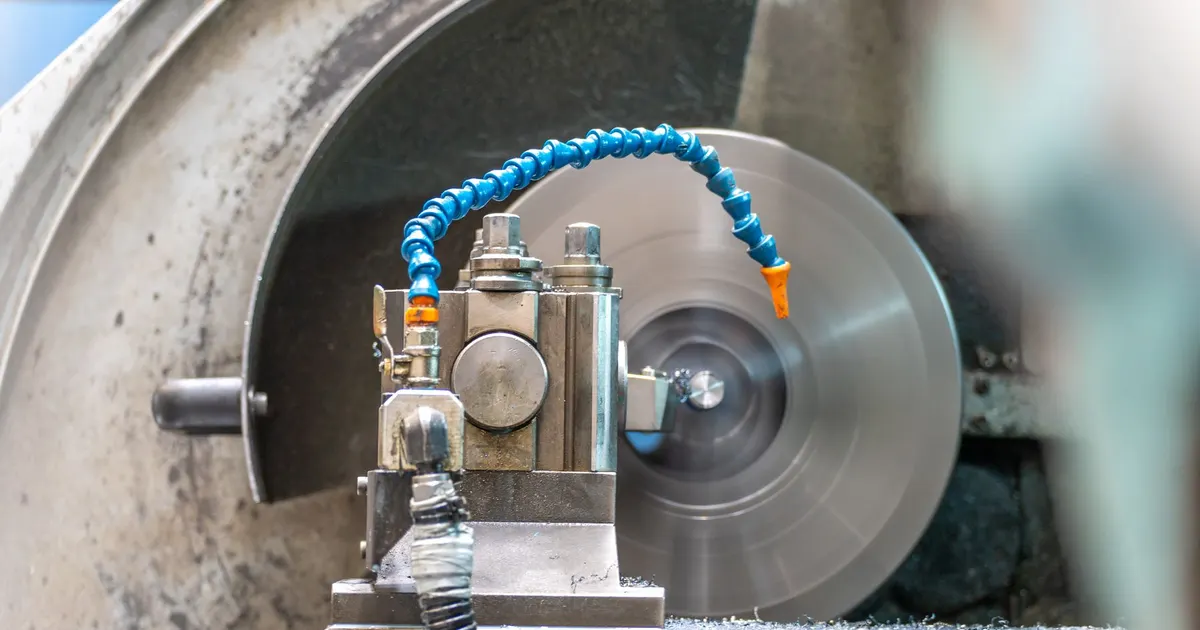
A sub spindle is a second, smaller spindle facing the main spindle on a Swiss-type lathe. It grips the part as it is cut off and then machines the end that was inaccessible while the part was still attached to the bar. The result is a finished part that falls into the catch bin with both ends done, no operator touch and no second machine.
For buyers the question is practical: what does this save, and what does it not? This guide covers the operations a sub spindle performs, what they replace, the limits and how to describe the back end of a part so the shop picks the cheapest route.
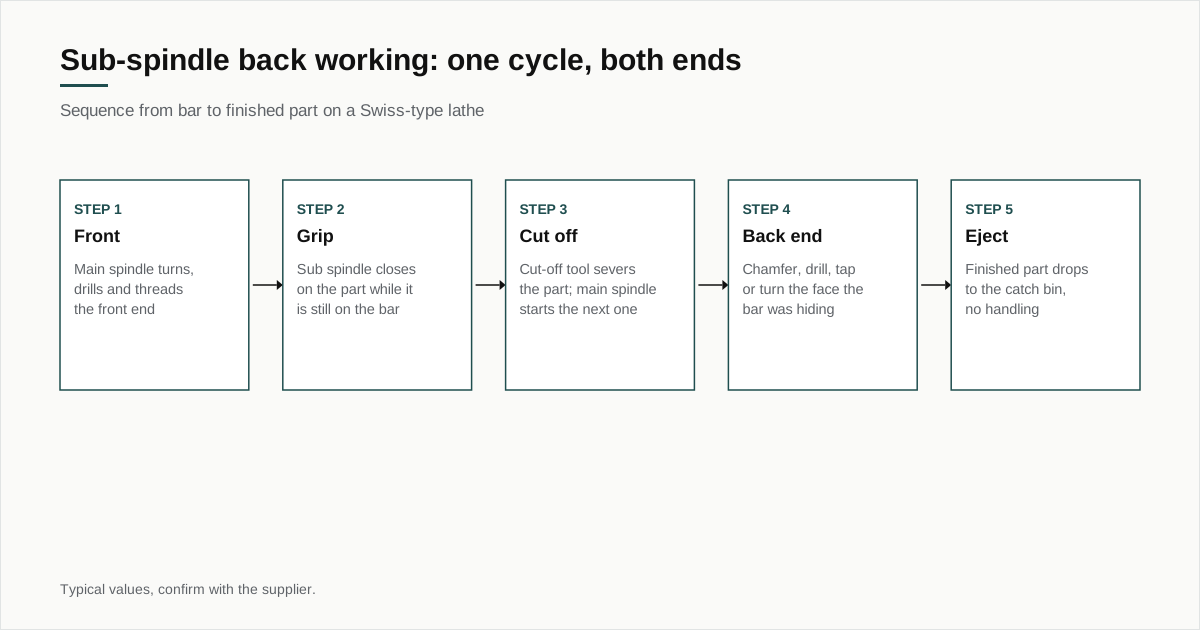
What happens at cut-off
On a lathe without a sub spindle, the cut-off tool severs the part and it drops. The back face is left with a small nub or witness mark where the tool left it, and nothing has touched that end. Anything the back needs, such as a chamfer, a drilled hole or a thread, has to wait for a second operation.
With a sub spindle the sequence changes. The sub spindle moves in and closes its collet on the front of the part while the part is still attached to the bar. The cut-off tool then severs the part. The sub spindle pulls away with the part, and a set of back-working tools, mounted on their own stations, machines the exposed end. While this happens, the main spindle has already started the next part, which is why the cycle overlaps and the time cost of back working is smaller than it looks.
When the back end is finished, the sub spindle ejects the part. Handling is zero, and the part is complete.
What back working covers
The typical operations are the ones that need access to the end face:
Back chamfer and deburr. The most common use. The cut-off tool leaves a burr or a nub, and a chamfer tool removes it and breaks the edge in the same cycle. For many parts this alone justifies the sub spindle.
Back drilling and boring. A hole drilled into the back face, such as a blind bore for a mating pin, an oil hole or a relief.
Back threading. An internal thread in the back bore, or an external thread on a back-end stub. Tapping or thread milling both work, depending on the machine.
Back turning. A step, a groove or a taper turned on the back end, with the part held by the sub spindle.
Back milling and cross holes. On machines with live tools at the back-working position, flats, slots and cross holes can be cut on the back portion.
Cut-off face finish. A part with a clean flat back face, without a nub, sometimes needs a facing pass done at the sub spindle.
What a sub spindle cannot do is machine a feature on the front end after the part has left the main spindle. The front is already finished by then, and the sub spindle has it in the collet.
What it replaces
| Back-end requirement | Without sub spindle | With sub spindle |
|---|---|---|
| Chamfer and deburr | Tumble, hand deburr or secondary lathe | In cycle, a few seconds |
| Blind hole in back face | Second machine, fixture, handling | In cycle |
| Internal thread in back bore | Tapping station or second lathe | In cycle |
| Back step or groove | Second turning operation | In cycle |
| Clean back face | Facing in a second operation | In cycle |
| Handling of finished parts | Bins, sorting, tracking | Parts fall finished |
Each line in the left column is a cost the quote would otherwise carry. A second operation has its own setup, fixture and queue time. Parts wait for the second machine, and the wait can add days to the lead time that the lead time guide describes. The secondary operations guide shows what else sits in that stage and why it adds up.
Limits you should know about
A sub spindle is a strong tool, and it has constraints that affect your drawing.
Minimum part length. The collet has to grip the part with enough length to hold it, and the back-end tools need clearance beside the collet. A very short part, or a part with a deep back feature, may not leave enough room. The actual limit depends on the machine and the part, so treat any figure you read as typical and confirm with the shop.
Maximum diameter. The sub spindle collet is often smaller than the main spindle’s, so the largest parts on a machine may need a different route. This does not matter for most parts under about 20 mm, and it is rarely an issue for the work this niche covers.
Re-grip run-out. The part is held on the main spindle for the front features and on the sub spindle for the back. Each grip adds a small error. Typically this is a few hundredths of a millimeter or less, but on parts that need tight concentricity between the two ends the shop should check it at first article. The tolerance guide covers how to set a realistic number.
Grip marks. The collet can leave light marks on a soft or polished surface. If the gripped section has a cosmetic or functional finish requirement, say so. A shop can use a soft collet or change which surface is gripped.
Long parts. A sub spindle can also pull long parts out of the guide bushing during machining, which helps with parts that are longer than the bar can reach. This is a separate use of the same hardware.
A worked example
Consider a small stainless fitting, 8 mm in diameter and 20 mm long, with a hex collar on the front, a thread at one end and a blind bore with an internal thread at the other. The bore and its thread are on the back.
Without a sub spindle, the shop turns the front, cuts the part off and drops it. The parts go into a tote. A second operation then loads each part into a collet on another lathe or a tapping station, drills the bore and cuts the thread. Every part is picked up, placed, clamped, machined, unclamped and put down. For a run of 20,000 pieces, that is 20,000 handling cycles on a second machine, plus a fixture, a setup and a wait in the queue.
With a sub spindle, the same part is gripped on the front, cut off, drilled and tapped in the same cycle, and ejected finished. The overlap with the next part’s front machining hides most of the added time. The shop prices one machine, one setup and no queue between operations. On a part like this, the difference between the two routes can easily be the largest single line on the quote.
The example also shows the limits. The bore has to be reachable from the back face, the part has to be long enough for the sub spindle to hold, and the thread has to be one the back tools can cut. If the bore were deeper than the drill could support, or the thread needed a tool that the machine did not carry at the back position, the shop would fall back to the second operation.
What back working does to cost
Back working shifts cost from handling to machine time. Cycle time grows by the back-end operations that are not overlapped with the front, and the cost of a second operation disappears. For most parts with a meaningful back feature, the net is a lower price and a shorter lead time.
There is a break-even. If the back feature is trivial, the shop may find the sub spindle adds programming and tooling for little gain. And if the volume is very low, setup dominates and the shop may prefer a simpler route. The cost guide explains how setup and run time spread across quantity.
One saving buyers miss: fewer handoffs means fewer chances for damage. Fine threads, thin walls and polished surfaces suffer when finished parts are poured into a bin and then picked up again for a second operation. A part that leaves the machine once, finished, usually arrives in better condition.
How to describe the back end on a drawing
Give the shop the information it needs to choose the route:
- List every back-end feature with its dimensions and tolerance
- State what the back face must look like, such as flat, chamfered or deburred
- State any concentricity or run-out requirement between the front and back features
- Mention the finish of any surface the collet might grip
- State the yearly volume, so the shop can weigh tooling against saving
Avoid writing “second operation required” or “finish on sub spindle”. The first rules out the cheaper in-cycle route, and the second assumes a machine the shop may not run. Describe the feature and its function, and the shop will tell you how it is made.
When a sub spindle is not the answer
Some parts need a second operation however well the machine is equipped. A back feature that requires heavy milling, a part that needs heat treatment before the back is finished or a part with a threaded or ground surface that the sub spindle collet would mark are all examples. In those cases the shop will quote a second operation on purpose. The live tooling guide covers what the tool stations can do in cycle.
Getting parts with back-end features quoted
Send the drawing and STEP file through the RFQ form. Mark the back-end features clearly, and state the material and yearly volume. We match the part with up to three shops that run Swiss-type lathes and reply within 24 business hours.
If two shops quote very different prices for the same part, ask each how the back end is made. A shop that finishes it in cycle and a shop that sends it out for a second operation are quoting different jobs, and that difference is usually the whole reason for the gap.
Frequently asked questions
How much does a sub spindle reduce the price of a part?
It depends on what the back end needs. If the alternative is a separate second operation on another machine, the saving can be large, because that operation carries its own setup, handling, fixture and queue time. If the back end needs only a light chamfer, the saving is small. Ask the shop to quote both routes for a quantity you actually plan to order.
Is there a minimum part length for back working?
Yes. The sub spindle needs enough length to grip the part, and the grip area has to clear the tools working on the back end. The limit depends on the machine and the collet, so a short part with a deep back-end feature may need a different approach. Send the drawing and the shop will tell you whether it fits.
Does back working affect concentricity between the two ends?
It can. The part is transferred from one spindle to another, and the second grip adds a small amount of run-out. On most parts this is well inside what the drawing needs. On parts with a tight concentricity requirement between front and back features, state it on the drawing so the shop checks it on the first article.
Need a quote for this part?
Send the drawing. We match you with up to 3 Swiss shops and reply within 24 business hours.
Get matched with a Swiss shop