Home / Bar materials
Swiss Machining Materials: How Bar Grade Sets Part Price
Reference page. Figures are typical.
The bar grade sets a Swiss turned part’s price twice: once through the cost of the bar itself, and again through the seconds, inserts and secondary steps the grade forces on every part. Free-cutting brass and leaded steel sit at the cheap end, 316L, titanium, cobalt chrome and nickel alloys at the expensive end. The gap on the same geometry is often several times the part price.
Key facts
| Item | Typical value |
|---|---|
| Bar diameters run on Swiss-type lathes | About 1 to 32 mm, some machines to 38 mm |
| Bar lengths fed by a bar feeder | Usually 2.5 to 3.7 m (about 8 to 12 ft) |
| Bar condition for guide bushing work | Ground or precision drawn, about h6 to h8 (ISO 286) |
| Bar condition for guide-bushing-less work | Cold drawn, about h9 to h11 |
| Fastest family | Free-cutting brass (C36000 / CW614N) |
| Slowest families | Titanium, cobalt chrome, nickel alloys |
| Material share of part price | Small on brass and steel, often the largest line on titanium and implant alloys |
| Certificate buyers usually ask for | Mill certificate to EN 10204 type 3.1, with heat number |
All figures are typical. The shop that quotes your part confirms what it buys and what it can hold.
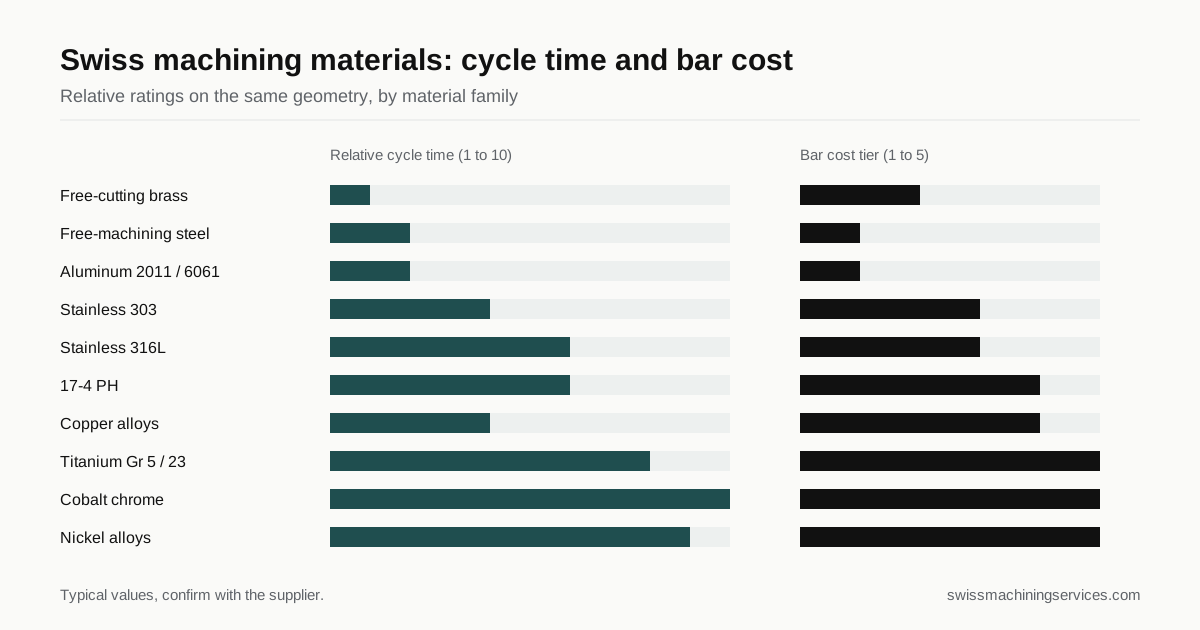
The material matrix
This is the table to read first. It ranks the families that make up nearly all Swiss turned parts by what they do on the machine and to the quote.
| Family | Common grades | Machinability on a Swiss lathe | Chip form | Bar cost tier | Typical turned finish | Typical parts |
|---|---|---|---|---|---|---|
| Free-cutting brass | C36000, lead-free C69300 | Best. Highest speed, longest tool life | Short, breaks cleanly (lead-free: longer) | Low to medium | Ra 0.4 to 0.8 µm | Fittings, connector bodies, valve parts |
| Free-machining steel | 12L14, 1215, 11SMnPb30 | Very good | Short | Low | Ra 0.8 to 1.6 µm | Pins, shafts, inserts, plated hardware |
| Aluminum | 2011, 6262, 6061, 7075 | Very good (2011, 6262), good (6061) | Short (2011), stringy (6061) | Low | Ra 0.4 to 1.6 µm | Housings, spacers, light shafts |
| Free-machining stainless | 303, 416 | Good | Short | Medium | Ra 0.8 to 1.6 µm | Shafts, fasteners, fittings |
| Austenitic stainless | 304, 316L, 316LVM | Fair. Gummy, work hardens | Long, stringy | Medium to high | Ra 0.8 to 1.6 µm | Medical, marine, fluid parts |
| Precipitation hardening stainless | 17-4 PH | Fair. Abrasive | Manageable | High | Ra 0.8 to 1.6 µm | Loaded small parts, instruments |
| Copper alloys | C14500, C17200, phosphor bronze | Good to fair | Short (C14500), varies | Medium to high | Ra 0.4 to 0.8 µm | Contacts, springs, RF parts |
| Titanium | Grade 5, Grade 23, CP Grade 2 and 4 | Fair to poor. Heat and springback | Long unless controlled | High | Ra 0.4 to 1.6 µm | Implants, aerospace pins |
| Cobalt chrome | CoCrMo (ASTM F1537) | Poor. Hard, wears tools fast | Short, hot | Very high | Ra 0.4 to 0.8 µm | Implant and dental parts |
| Nickel alloys | 625, 718, C-276 | Poor. Work hardens hard | Long, tough | Very high | Ra 0.8 to 1.6 µm | Valve and sensor parts, hot service |
| Engineering plastics | PEEK, POM, PTFE, PEI | Good, but heat and flex | Continuous ribbon | Medium to very high (PEEK) | Depends on grade | Insulators, seals, medical parts |
Machinability here is a practical ranking on sliding headstock lathes, not a single index. Published machinability ratings use different reference metals for steels and for copper alloys, so they do not line up across families.
How the bar grade reaches the price
A Swiss shop builds the part price from machine time, material, setup and finishing. The bar grade moves four of those lines at once.
Bar cost per part. The price per meter of the bar, divided by the number of good parts one bar yields. The yield depends on part length, the cut-off width and the remnant the machine cannot use. With a guide bushing the remnant is longer, so an expensive alloy wastes more money per bar. Ground bar for bushing work also costs more per meter than standard drawn bar. The ground bar stock guide covers the tolerance classes.
Cycle time. Surface speed and feed fall as machinability falls. A grade that adds a few seconds per part looks small on one part and large on a yearly volume of 50,000. On most Swiss jobs above a few thousand pieces, machine time is the largest line, as the cost guide explains.
Tooling. Gummy and hard grades wear inserts faster, so the shop changes them sooner and gauges parts more often. Titanium, cobalt chrome and nickel alloys can use several times the inserts of brass on the same part.
Secondary steps. Stainless gets passivated, titanium is often anodized, steel is plated, copper alloys get gold or tin. Some grades need heat treatment after turning, which brings distortion and sometimes grinding. These steps add days and cost that never appear in the machine rate.
A fifth, quieter effect is scrap risk. Expensive bar raises the cost of every rejected part, so shops quoting implant alloys plan more in-process checks.
Families in short
Free-cutting brass
C36000 is the benchmark for fast, cheap turned parts. It breaks chips into small pieces, lets the spindle run fast and gives a good finish with no extra pass. Lead-free and low-lead brasses such as C69300 exist for drinking water and RoHS driven products. They form longer chips and wear tools faster, so do not expect the C36000 price. The brass guide compares the grades.
Free-machining steels
12L14 (leaded) and 1215 (resulfurized) cut quickly and cost little per kilogram. They carry no corrosion resistance, so most parts are plated or oiled. They are the default for pins, inserts and hardware where stainless is not needed. See free-machining steel on Swiss lathes.
Stainless steels
The most common family on Swiss machines and the widest cost spread inside one family. 303 is the free-machining grade, 316L the medical and marine standard, 17-4 PH the high strength choice. The stainless bar page gives the grade table and processing notes. Hardenable 416 and 420 have their own post on heat treated stainless parts.
Aluminum
2011 and 6262 are the free-machining grades. 6061 is the general structural grade and cuts well but makes stringier chips. Anodizing adds thickness, so dimensions must state whether they apply before or after. See the aluminum guide.
Titanium
Grade 5 (Ti-6Al-4V) and Grade 23 (the extra low interstitial version for implants) dominate. Titanium holds heat in the cut, springs back and galls, so shops run sharp tools, moderate speeds and plenty of coolant. Bar cost and remnant matter. See the titanium guide.
Copper alloys
Tellurium copper C14500 gives high conductivity with machinability close to brass. Beryllium copper C17200 gives spring strength after age hardening and needs dust controls when ground. Phosphor bronze and nickel silver show up in contacts. Read beryllium copper on Swiss lathes.
Implant and high temperature alloys
Cobalt chrome and nickel alloys are hard on tools and slow. They go to shops that already run them and that can show tool life data. See the cobalt chrome and nickel alloy guides.
Plastics
PEEK, acetal (POM), PTFE and PEI run on Swiss lathes for insulators and medical parts. Heat softens the part, thin walls flex under the tool and the gauge and parts can move as stress relaxes. Typical tolerances are looser than on metal. See the PEEK guide.
Grade cross-reference for common bar
Drawings from different regions name the same metal in different systems. Equivalents are close, not identical: chemistry limits and test requirements differ. Write the grade and the standard you need, and approve any substitution in writing.
| Common name | UNS | EN name / number | JIS | Typical bar standard to check |
|---|---|---|---|---|
| 12L14 | G12144 | 11SMnPb30 / 1.0718 | SUM24L | ASTM A108, EN 10277 |
| 303 | S30300 | X8CrNiS18-9 / 1.4305 | SUS303 | ASTM A582 |
| 316L | S31603 | X2CrNiMo17-12-2 / 1.4404 | SUS316L | ASTM A276, A479 |
| 17-4 PH | S17400 | X5CrNiCuNb16-4 / 1.4542 | SUS630 | ASTM A564 |
| 416 | S41600 | X12CrS13 / 1.4005 | SUS416 | ASTM A582 |
| Brass C36000 | C36000 | CuZn39Pb3 / CW614N | C3604 | ASTM B16 |
| Aluminum 6061 | A96061 | EN AW-6061 | A6061 | ASTM B211 |
| Ti Grade 5 | R56400 | Ti-6Al-4V / 3.7165 | check JIS H 4650 | ASTM B348, F136 (Grade 23) |
| Beryllium copper | C17200 | CuBe2 / CW101C | C1720 | ASTM B196 |
When a part is for implants, the implant standard replaces the general one: ASTM F136 for Ti-6Al-4V ELI, ASTM F138 for 316LVM, ASTM F1537 for cobalt chrome.
Bar form, condition and certificates
Diameter and tolerance. Choose a part diameter that a standard bar size covers with a small turning allowance. A part drawn just above a common bar size forces the next size up and more material per part.
Straightness. Guide bushing work wants straight, ground bar. Bent bar whips in the bar feeder and marks the part.
Length. Bar feeders take bar lengths of roughly 2.5 to 3.7 m. Short or random lengths raise remnant waste.
Certificates. For regulated work, ask for a mill certificate per EN 10204 type 3.1 with the heat number, and for lot traceability from bar to finished part. Medical and aerospace buyers usually require it. The standards guide lists the bodies behind the numbers.
Choosing a grade without overpaying
- Write down what the material must do: corrosion medium, load, temperature, conductivity, biocompatibility, any regulation such as RoHS or drinking water rules.
- Pick the easiest machining grade that meets all of it. 303 instead of 316L, 2011 instead of 6061, C36000 instead of a copper alloy where conductivity allows.
- Ask for two grades on one RFQ when you are unsure. The difference in price is often worth a drawing change.
- Where the requirement is real, keep the hard grade and save elsewhere: open non-functional tolerances, drop features that need special tools, give a realistic yearly volume.
What to write in the RFQ
- Grade and standard, for example “316L to ASTM A276” or “Ti-6Al-4V ELI to ASTM F136”.
- Any acceptable alternative grade.
- Certificate type and traceability level.
- Finish or treatment after turning, and whether dimensions apply before or after it.
- Yearly volume, not only the first order quantity.
Grades, bar tolerances and regional equivalents are also summarized on the materials and bar stock page. Send the drawing through the RFQ form and we match it with up to three shops that already run your grade.
Frequently asked questions
What is the cheapest material for Swiss machined parts?
Free-cutting brass C36000 in most cases, followed by leaded free-machining steel such as 12L14 and aluminum 2011. They cut fast, break chips cleanly and give long tool life, so both machine time and tooling stay low. Steel needs plating or oil for corrosion protection, which adds a step.
Which materials are the most expensive to Swiss machine?
Cobalt chrome, nickel alloys such as 625 and 718 and titanium Grade 5 or 23. The bar is expensive, cycle times are long and inserts wear quickly. Certified implant bar adds documentation and lead time on top.
Why does a Swiss shop ask which bar standard I need?
Because the same common name covers bar made to different standards with different chemistry limits, tolerances and tests. The standard decides which bar the shop can buy, what the mill certificate must show and sometimes the lead time. Write it on the drawing, for example ASTM A582 for 303.
Can I supply my own bar to a Swiss shop?
Sometimes, mostly for specialty alloys you already hold. Agree on diameter tolerance, straightness, length and who carries the cost if a bar is rejected. For guide bushing work the shop may still prefer to buy ground bar it trusts.
Does material choice change the tolerance a shop can hold?
Yes. Free-machining grades let the process settle and hold tight diameters more easily. Gummy, springy or very hard grades widen the typical tolerance or raise the price of holding it. Plastics move after machining and usually get looser tolerances than metals.
Sources
- ASTM A582/A582M, Free-Machining Stainless Steel Bars
- ASTM B16/B16M, Free-Cutting Brass Rod, Bar and Shapes
- ISO 286-1:2010, ISO code system for tolerances on linear sizes
- Wikipedia, Machinability
Last reviewed October 19, 2026. Values on this page are typical ranges, not promises. The standard on your drawing and the shop that quotes your part decide what applies.
Want two grades quoted side by side?
Send the drawing with the grade you plan and any alternative you accept. We match you with up to 3 Swiss shops and reply within 24 business hours.
Get matched with a Swiss shop