Guides / Materials
Ground Bar Stock for Swiss Lathes: What h7, h8 and Straightness Mean on a Quote
October 15, 2026
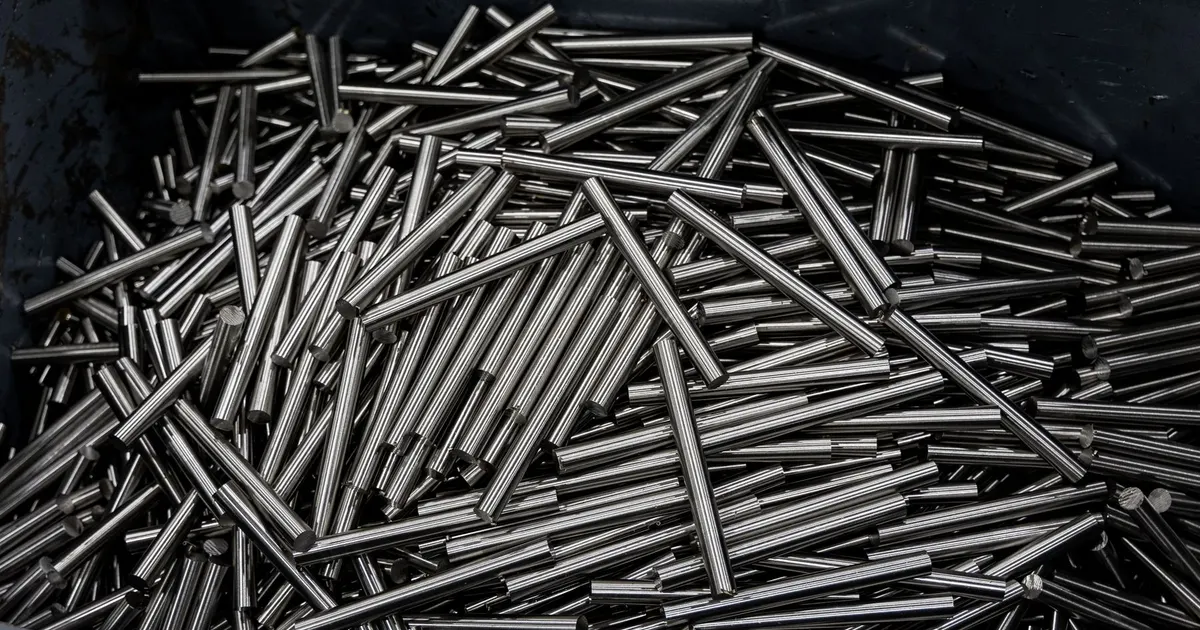
A Swiss-type lathe runs on bar. The bar slides through a guide bushing a few millimeters from the cutting tool, and the whole accuracy of the machine depends on how well the bar fits the bushing. A bar a few hundredths of a millimeter too large jams, and one that is too small rattles. Standard cold drawn bar carries a diameter tolerance that is too loose for this. That is the reason ground bar exists.
This guide explains what the tolerance letters mean, what the bar needs to be like, what it costs and what a buyer can learn from the bar line on a quote.
What the letters mean
Bar tolerances follow the ISO 286 system of limits and fits. A tolerance class has a letter and a number.
The letter h says the upper limit is the nominal size. The bar can be at nominal or smaller, never larger. It is the standard choice for shafts, and bar sold for guide bushings follows it.
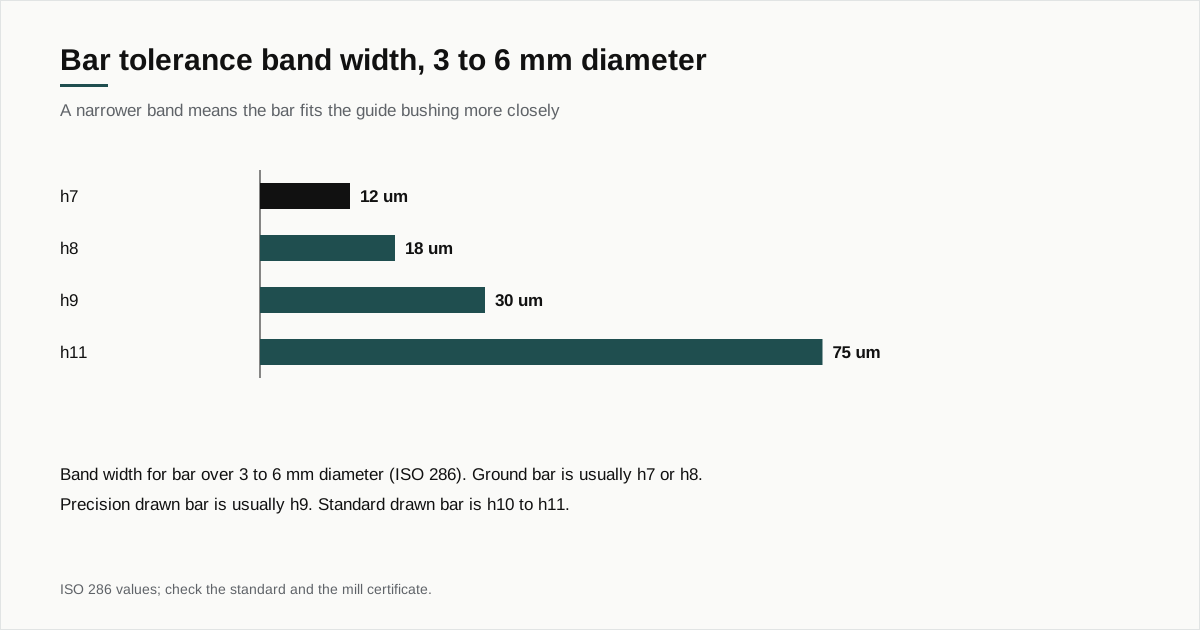
The number is the tolerance grade, which sets the width of the band. A lower number is tighter. Grade 6 is very tight, grade 7 and 8 are tight, grade 9 is common for precision drawn bar and grades 10 and 11 are looser.
The bands change with diameter. Larger bars get wider bands for the same grade.
| Nominal diameter | h7 | h8 | h9 | h11 |
|---|---|---|---|---|
| over 1 to 3 mm | 0 / -0.010 | 0 / -0.014 | 0 / -0.025 | 0 / -0.060 |
| over 3 to 6 mm | 0 / -0.012 | 0 / -0.018 | 0 / -0.030 | 0 / -0.075 |
| over 6 to 10 mm | 0 / -0.015 | 0 / -0.022 | 0 / -0.036 | 0 / -0.090 |
| over 10 to 18 mm | 0 / -0.018 | 0 / -0.027 | 0 / -0.043 | 0 / -0.110 |
| over 18 to 30 mm | 0 / -0.021 | 0 / -0.033 | 0 / -0.052 | 0 / -0.130 |
These are ISO 286 values in millimeters, and they apply to the bar diameter. Check the exact figures in the standard for your size. A 6 mm bar at h7 sits between 5.988 and 6.000 mm, while the same bar at h11 can be 0.075 mm under.
What the bar must do
A guide bushing is bored to a clearance fit around the bar, typically a few thousandths of a millimeter to about 0.01 mm. The bar has to be:
Within the diameter tolerance. A bar that is oversize binds in the bushing and heats it. One that is undersize moves around and lets the cut chatter.
Round. An oval bar fits the bushing in one orientation and jams in another as it turns.
Straight. A bent bar whips as it spins, throws the bar feeder and wears the bushing. Straightness is stated as a deviation over a length, such as a few tenths of a millimeter per meter for ground bar, and shops buy to a figure they trust.
Smooth. A bar with a rough or scored surface scratches the bushing and the part. A smooth surface also carries the lubricant better.
Consistent along its length. A taper of a few microns from end to end is common in drawn bar and noticeable in a guide bushing.
The guide bushing article explains why guide bushing work needs these properties and why bushing-less work needs fewer.
Drawn bar and ground bar
Two processes make small-diameter bar.
Cold drawn bar is pulled through a die, which sizes it and gives a smooth, work hardened surface. It is economical. Its size tolerance depends on the die and on the material, and a precision drawn bar can reach h9 or sometimes h8 in easy materials such as free machining brass and steel. It tends to carry residual stress and a slight bow.
Ground bar, also called centerless ground bar, takes the drawn bar and grinds the outside to size on a centerless grinder. The grinding removes a thin layer, corrects roundness and straightness and holds a tight tolerance, typically h7 or h8, sometimes h6. It is more expensive.
The grade you buy depends on the alloy. Free machining brass and free machining steels are sold as precision drawn bar that is tight enough for many shops without grinding. Stainless steel, titanium and cobalt chrome are more often bought ground, because drawn bar of these alloys carries more stress and varies more in size.
| Bar type | Typical tolerance class | Straightness | Typical use |
|---|---|---|---|
| Standard drawn | h10 to h11 | Moderate | Bushing-less work, large parts |
| Precision drawn | h9 | Good | Brass and free machining steel with a bushing |
| Ground | h7 to h8 | Very good | Stainless, titanium and tight tolerance work |
| Polished ground | h6 to h7 | Excellent | Special requirements |
All are typical, and the actual figure comes from the bar supplier’s certificate.
What it costs
Ground bar adds a premium over drawn bar of the same alloy. The extra operation, the grinder time, the wheel wear and the scrap on bad bar all go into the price, and the market for ground bar in small sizes is smaller.
The premium varies:
| Material | Ground bar premium over drawn |
|---|---|
| Free machining brass | Small, many shops use precision drawn |
| Free machining steel | Moderate |
| Austenitic stainless | Moderate to large |
| Titanium | Large |
| Cobalt chrome and nickel alloys | Large, limited sources |
For a cheap alloy the premium is minor against the part price. For an expensive alloy, where bar is most of the cost, the premium is a visible share. The cost guide explains how material and process combine, and the titanium guide shows the effect in one of the most affected alloys.
Bar size availability is the other cost. Ground bar comes in standard sizes, and a part that would fit in a 5.2 mm bar will be cut from 5.5 or 6 mm because that is what exists. The extra diameter turns to chips. If the design allows the part to fit a standard bar size, say so, because it saves material.
Reading the bar line on a quote
A good quote names the bar. The detail is a source of information.
- Alloy and standard. Confirms that the shop is quoting the material you specified.
- Bar size. The finished diameter plus the stock to be removed. A bar much larger than the part signals material waste, and a bar very close to the part signals a tight process.
- Tolerance class. h7, h8 or h9 tells you whether the shop buys ground or drawn bar.
- Condition. Annealed, cold worked or heat treated.
- Source. Whether the shop buys from a mill or a distributor, and whether certificates come with each lot.
If two quotes differ widely, the bar line is the first place to look. A shop quoting precision drawn bar and a shop quoting ground bar are making different decisions, which show up in price and sometimes in the finished part.
When the bar surface stays on the part
On some parts, the bar’s own diameter becomes the finished diameter. A shaft section the lathe never touches keeps the ground surface it came with. This is a real saving, since the bar did the grinding for the whole length. Specifying a diameter that matches the bar tolerance, such as h7 on a standard size, lets the shop leave that section untouched.
The condition is that the drawing’s tolerance and finish for the section match what the bar provides. If the drawing asks for h6 and the bar is h7, the shop must grind or turn, and the saving disappears. The centerless grinding guide covers what happens when the bar tolerance is not enough.
A worked example
Take a stainless pin 4 mm in finished diameter and 30 mm long, with a head, a groove and a chamfer. The shop has two bar options at 4 mm: precision drawn bar at h9, with a band from 3.970 to 4.000 mm, and ground bar at h7, with a band from 3.988 to 4.000 mm.
On drawn bar, the diameter can vary by up to 0.03 mm from one bar to the next. The guide bushing is set to the average, and the machine has to be adjusted when a bar from a different lot arrives. Some bars run loosely and some tightly. The pin diameter, if left as bar, varies with it.
On ground bar, the band is 0.012 mm wide. The bushing fits all bars, the cut stays stable and the unturned shaft section meets a tight tolerance on its own. The bar costs more per meter and the part costs less to make and inspect, because the machine does not need constant adjustment.
For this pin in a volume run, ground bar usually wins on total cost. For a short run of a few hundred pieces, the premium may outweigh the saving, and the shop might use drawn bar and accept a few more adjustments. A quote that explains the choice is one worth reading.
Questions to ask about bar
If your part is made in an alloy where bar quality matters, a few questions reveal how the shop buys:
- What tolerance class do you buy for this alloy and size?
- Do you buy from a mill or a distributor, and do you receive a certificate with each lot?
- Do you check incoming bar for diameter, straightness and surface?
- How do you store and handle bar between delivery and the machine?
- What happens to a bar that is out of tolerance?
- How long does it take to get this size if you do not hold it in stock?
The last question is the one that most often affects delivery. A shop that holds standard sizes can start in days, and one that orders from a mill may wait weeks.
Handling and storage
Ground bar is delicate. Its surface is smooth and free of scale, and it scratches and rusts more easily than drawn bar. Bars are stored in racks that support their length, since a bar lying unsupported bends under its own weight. Bar feeders need clean, straight bars of the right size. The bar feeder guide covers how bar quality affects the machine.
A bar that arrives bent, scratched or with a rusty patch should be rejected or straightened. A shop that checks incoming bar with a micrometer and a straightness check protects its bushings and your parts.
What to put on the drawing
You rarely need to specify the bar. If the bar matters, state:
- Material and standard
- Condition
- Any surface that must come from the bar untouched
- Tolerances on that surface
Leave the bar size and tolerance class to the shop, which has to match them to its machine and bushings.
Getting parts quoted
Send the drawing and STEP file through the RFQ form. State the material, the finished dimensions and the yearly volume. We match the part with up to three shops that run Swiss-type lathes and reply within 24 business hours.
If you see a large difference in the material line, ask what bar each shop quoted and at which tolerance class. The answer explains the price gap and tells you which shop is buying bar that the machine can run well.
Frequently asked questions
Does every Swiss-type part need ground bar?
No. Parts run with a guide bushing need bar that fits the bushing closely and runs straight, and ground bar is the usual way to get it. Parts run bushing-less, or short parts in easy materials, may run on standard drawn bar. The shop decides on the geometry and the material.
Do I specify the bar tolerance on my drawing?
Usually not. You specify the finished part. The shop chooses the bar size and grade to produce it. Specify the bar only if it has a functional role, for example when a ground surface on the bar must remain untouched on the finished part.
Why does ground bar cost more than drawn bar?
It takes an extra operation, centerless grinding, with its own machine time, wheel wear and scrap, and it is sold in a smaller market. The premium varies with the alloy and the size, and it is larger in titanium and specialty steels than in brass or free machining steel.
Need a quote for this part?
Send the drawing. We match you with up to 3 Swiss shops and reply within 24 business hours.
Get matched with a Swiss shop