Guides / Materials
416 and 420 Stainless on Swiss Lathes: Small Parts That Harden After Machining
October 6, 2026
Most stainless steel parts that come off a Swiss-type lathe are austenitic, such as 303 and 304. They are tough, they resist corrosion and they cannot be hardened by heat. A smaller group of stainless grades behaves differently. The martensitic family, led by 416 and 420, can be heat treated to a hardness that austenitic grades never reach. That makes them the choice for small parts that need a hard surface, an edge or wear resistance together with some corrosion resistance.
This guide covers what the two grades are, how they machine, what heat treatment does to a turned part and what the drawing should state.
The two grades
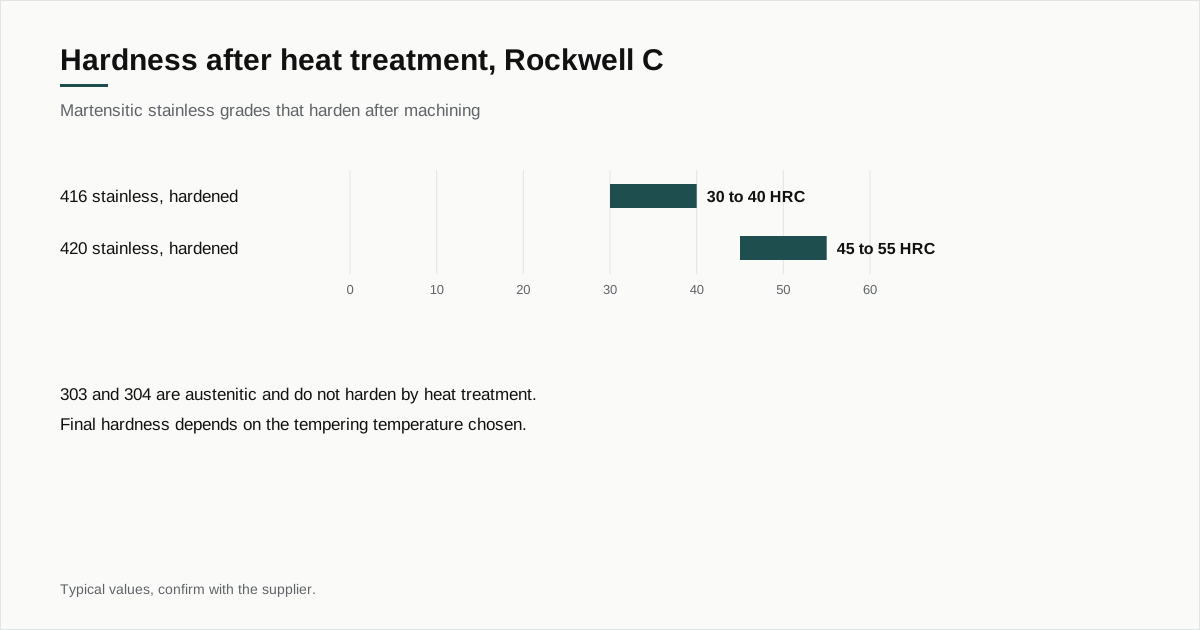
416 is a martensitic stainless steel with about 12 to 14 percent chromium and added sulfur. The sulfur forms small inclusions that break chips, so 416 is among the easiest stainless grades to machine. After hardening it reaches a moderate hardness, in the range of about 30 to 40 on the Rockwell C scale, depending on the tempering temperature.
420 has the same basic chromium level and a higher carbon content, typically 0.15 percent or more. The carbon lets it harden to a much higher level, up to the low 50s on the Rockwell C scale in the hardened and lightly tempered condition. It has no free machining additive in its plain form, so it machines more slowly than 416. A sulfur-added variant, 420F, exists and sits between the two.
Typical uses for small turned parts:
- Valve stems, seats and pins that need wear resistance
- Shafts and spindles that see sliding or light load
- Surgical and dental instrument parts where an edge or hard surface is needed
- Nozzles and fittings exposed to mild corrosion and wear
- Fasteners and pins in hard condition
For surgical instruments, a specification such as ASTM F899 covers wrought stainless steels, including these grades, for instrument use. Check the standard your customer requires. The medical guide explains how materials are chosen for medical parts.
How they compare
| Property | 303 / 304 | 416 | 420 |
|---|---|---|---|
| Family | Austenitic | Martensitic | Martensitic |
| Hardens by heat treatment | No | Yes, moderate | Yes, high |
| Typical hardness after hardening | Not applicable | about 30 to 40 HRC | about 45 to 55 HRC |
| Magnetic | Mostly no | Yes | Yes |
| Corrosion resistance | Good | Fair | Fair |
| Machinability (relative) | Good for 303, fair for 304 | Very good | Moderate to poor |
All values are typical. They move with the exact chemistry, the heat treatment and the supplier, so confirm with the certificate.
Machining behavior
416. It cuts freely, produces short chips and leaves a good surface. Speeds are higher than for 304, and tool life is long. It is a favorite where the part needs to harden afterward and cycle time matters. The free machining steel guide covers the related carbon steel grades.
420. It cuts like a tougher steel. Chips are longer, cutting forces are higher and surface speeds are lower. On slender parts the higher force can deflect the part, which the guide bushing helps to counter. Sharp carbide and good coolant are the norm.
Condition of the bar. Both grades are supplied annealed, which is soft and machinable, or in a pre-hardened or tempered condition, which is harder. Most shops machine annealed bar and heat treat afterward. A part machined in the hard condition wears tools quickly and leaves a rougher surface.
Sulfide inclusions. In 416, the sulfides help machining and hurt in other ways. They can pit under certain conditions, they lower corrosion resistance compared with 420 and they prevent a mirror polish. If the part needs a high polish or must resist corrosion near its limit, 416 may not be the best choice.
The stainless guide compares the austenitic grades that make up most of the work.
Heat treatment and what it does to a turned part
Martensitic stainless hardens by being heated to a high temperature, held, cooled quickly and then tempered at a lower temperature. Each step has effects the buyer should know.
Hardening. The part is heated to roughly 950 to 1050 degrees Celsius, held and quenched in oil, air or gas. The steel becomes hard and brittle.
Tempering. A second heat at a lower temperature, anywhere from about 200 to 650 degrees Celsius, relieves stress and sets the final hardness. The temperature determines the hardness, and shops pick it from a chart for the grade.
Distortion. Quenching moves the metal. A slender part can bow, a thin wall can go out of round and the length may change by a small amount. The effects are smaller with gentle quenching and a stress relief before hardening.
Scale and surface. In an air furnace, a layer of oxide forms on the surface. Vacuum or protective atmosphere furnaces avoid it. If scale forms, it must be removed, which changes the size slightly.
Sequence. Rough turn, heat treat, finish. Parts that need a tight tolerance after hardening are turned a little oversize, hardened and finished by grinding or hard turning. Parts with a looser tolerance may go straight from the lathe to the furnace to the customer.
Heat treatment is usually done outside the machine shop, and that adds a step to the lead time. The secondary operations guide covers what that adds.
Corrosion and finishing
Martensitic stainless resists corrosion less than austenitic grades, and the hardened condition resists best when tempered at lower temperatures, which keeps carbon in solution. Passivation after machining removes free iron from the surface and restores the protective film. A passivation specification such as ASTM A967 is commonly referenced, though shops differ in the process they use. Check the requirement that applies to your part.
Parts in 416 are the weakest of the three on corrosion because of the sulfides. For salt environments, repeated sterilization or chloride exposure, look at 420 passivated and polished, a precipitation hardening grade such as 17-4, or an austenitic grade if hardness is not required. The nickel alloy guide covers the corrosion-resistant end of the range.
Choosing between 416, 420 and the alternatives
The decision usually comes down to three numbers: the hardness the part needs, the corrosion the part sees and the volume that justifies a heat treatment step.
If the part needs no hardening, an austenitic grade such as 303 is simpler and more corrosion resistant. If it needs moderate hardness and fast machining, 416 is the natural choice. If it needs a hard edge or high wear resistance, 420 is the next step, with 420F as a compromise on machinability. If it needs hardness and better corrosion resistance than either, a precipitation hardening grade such as 17-4 deserves a look, because it hardens in a single low-temperature aging step with less distortion than a quench and temper cycle.
Each option carries a price. 17-4 costs more per kilogram and machines slower than 416. 420 costs more in machine time. Neither is a bad choice, and the right one depends on the function. Ask the shops to quote two grades if you are unsure. The materials guide gives the wider comparison.
Where hardenable stainless goes wrong
Cracking in the quench. A part with a sharp internal corner, a thin section next to a thick one or a cross hole near an edge can crack in the quench. Generous radii and even sections reduce the risk. If the design cannot change, a gentler quench and a stress relief before hardening help.
Decarburization. In an air furnace the surface loses carbon, and the outer layer of the part ends up softer than the core. A hardness test on the surface can read low even when the core is on target. Protective atmospheres avoid the problem, and so does removing a small amount of stock after heat treatment.
Soft spots. A part that was not heated evenly or quenched evenly shows hardness variation. A hardness test at more than one location catches it, and a drawing that names the test positions makes the check meaningful.
Mix-ups. 416 and 420 look alike and both are magnetic. Mixing two grades in one furnace load produces parts at the wrong hardness. Shops that heat treat several alloys keep lots separate and tagged, and a certificate with the lot number is the record.
Cost picture
The material itself costs about the same as other stainless grades. The cost differences arise elsewhere.
| Factor | Effect |
|---|---|
| 416 machining | Fast, cheaper cycle than 304 |
| 420 machining | Slower, closer to 304 or above |
| Heat treatment | Added step, batch cost, lead time |
| Post-hardening finishing | Grinding or hard turning if tight tolerance |
| Inspection | Hardness test on a sample, added to the report |
| Scrap from distortion | Priced into the quote |
If you are choosing between 416 and 303 and the part does not need hardening, 303 is usually cheaper and more corrosion resistant. The cost guide explains how these factors combine.
A worked example
Take a valve pin, 3 mm in diameter and 18 mm long, with a pointed seat at one end and a groove at the other. It must have a surface hardness of about 40 HRC for wear and a diameter tolerance of ±0.01 mm.
In 416 annealed, the pin turns quickly. The shop machines it with a diameter allowance of about 0.05 mm, sends the pins out for hardening and tempering to the target hardness and finishes the diameter by centerless grinding. The tip is polished and the part is passivated. The centerless grinding guide shows how the finishing step works.
If the same pin needed 52 HRC, 416 would not reach it, and 420 would be the choice. The pin would machine more slowly, harden in a similar sequence and take more finishing care. The material choice follows from the hardness number.
What to put on the drawing
- Grade and standard, such as 416 per ASTM A582 or 420 per ASTM A276, if you require a specific one
- Condition of the bar and the heat treatment route
- Target hardness, with the scale and a range
- Which dimensions apply after heat treatment
- Surface finish and any polishing
- Passivation or other finishing requirement
- Hardness test location, since small parts need a defined point
Getting hardenable stainless parts quoted
Send the drawing and STEP file through the RFQ form. State the grade, the target hardness, the tolerances that apply after heat treatment and the yearly volume. We match the part with up to three shops that run Swiss-type lathes and reply within 24 business hours.
If you are unsure between 416 and 420, give the hardness and the corrosion environment. The shops can usually tell you which grade fits and quote the other as an alternative.
Frequently asked questions
What is the difference between 416 and 420 stainless?
416 has sulfur added for free machining and reaches a moderate hardness after heat treatment. 420 has more carbon and reaches a higher hardness, but it machines more slowly. A free machining variant of 420 exists for parts that need both. The choice comes down to how hard the finished part must be.
Are these grades magnetic and do they rust?
Both are magnetic. Both resist corrosion in mild conditions but less than 304 or 316, and they are not suited to salt water or strong chlorides. Hardened parts resist corrosion best when polished and passivated. If the part sees a harsh environment, consider another grade.
Do hardened parts change size in heat treatment?
Yes, slightly. Hardening can cause growth, warp and a thin scale, and tempering relieves some of it. Shops machine with a small allowance and finish after heat treatment when a tight tolerance applies. State on the drawing which dimensions apply after hardening.
Need a quote for this part?
Send the drawing. We match you with up to 3 Swiss shops and reply within 24 business hours.
Get matched with a Swiss shop