Guides / Materials
Beryllium Copper C17200 on Swiss Lathes: Temper, Heat Treatment and Handling
October 10, 2026
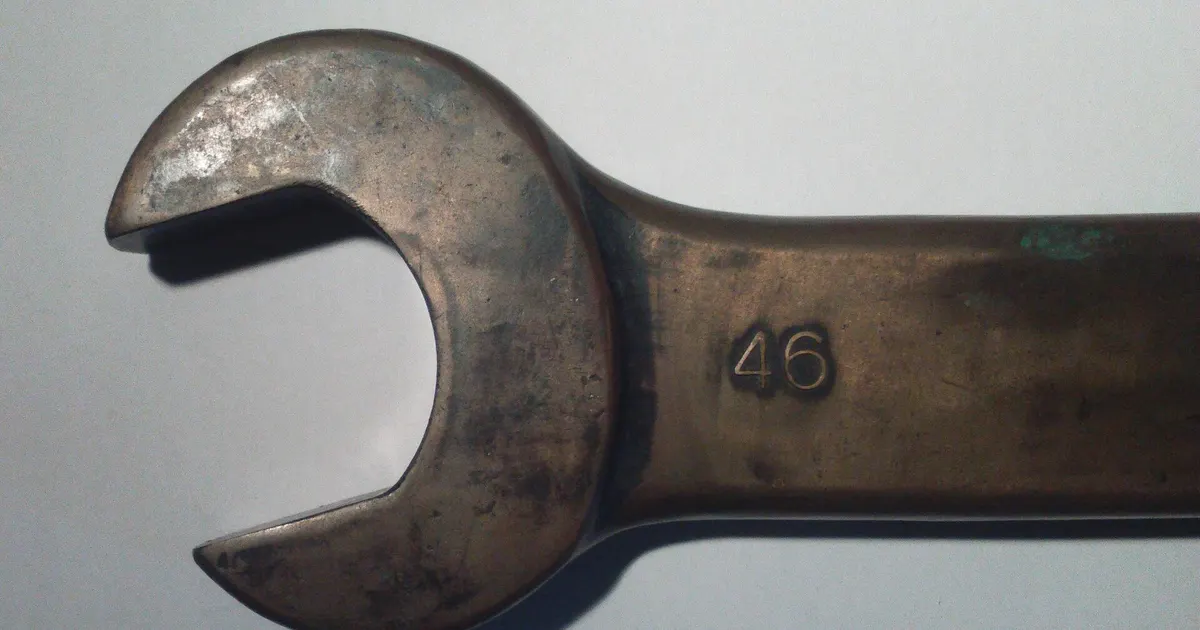
Beryllium copper combines something rare in a single alloy: the strength of a spring steel and a conductivity well above that of any steel. It makes springs, connector contacts, probes and bushings that carry current while flexing millions of times. It also asks more of a machine shop than almost any other copper alloy, because the material changes its properties in a heat treatment step and because machining it produces dust that needs control.
This guide explains the common alloy, the tempers a buyer will see, what age hardening does to a turned part and what to ask a shop about handling.
What C17200 is
C17200 is the high strength grade of beryllium copper, with roughly 1.8 to 2.0 percent beryllium. A lower beryllium grade, C17000, also exists. A separate family of low-beryllium alloys with cobalt or nickel, such as C17500 and C17510, trades some strength for higher conductivity.
C17200 is a precipitation hardening alloy. Heated to a high temperature and quenched, it is soft and ductile. Heated again to a moderate temperature for a few hours, tiny particles form inside the metal, and the strength rises sharply. This is called age hardening or precipitation hardening, and it is what separates beryllium copper from ordinary brass or bronze.
Typical applications for small turned parts:
- Connector contacts and sockets that must keep their spring force
- Test probe and pogo pin parts where wear and conductivity both matter
- Bushings and bearings that need strength with a smooth surface
- Non-sparking tools and fittings used where a spark is a hazard
- Instrument parts and springs that must not corrode or magnetize
The connector pin guide and the pogo pin article show where beryllium copper sits among connector materials.
Tempers a buyer will see
Bar is sold in tempers that describe its heat treatment state. The designations come from the copper industry, and the two letters after the first one matter most.
| Temper | Name | State | Typical use |
|---|---|---|---|
| TB00 (A) | Solution annealed | Soft | Machining, forming, then age hardening |
| TD02 (1/2H) | Half hard | Cold worked, stronger | Machining, then age hardening |
| TF00 (AT) | Solution annealed and aged | Hardened | Parts that need no further heat treatment |
| TH02 (1/2HT) | Half hard and aged | Hard | High strength finished parts |
Typical hardness rises from the soft range, roughly 45 to 80 on the Rockwell B scale, to the hard range, about 36 to 45 on the Rockwell C scale after aging. Confirm values with the supplier, because they vary with product form and the standard.
The temper on the drawing tells the shop what to buy and what to do. A drawing that says “C17200 TF00” calls for hardened bar, and a drawing that says “C17200 TB00, age harden to TF00” calls for soft bar and a heat treatment step after machining.
Machine soft, harden after
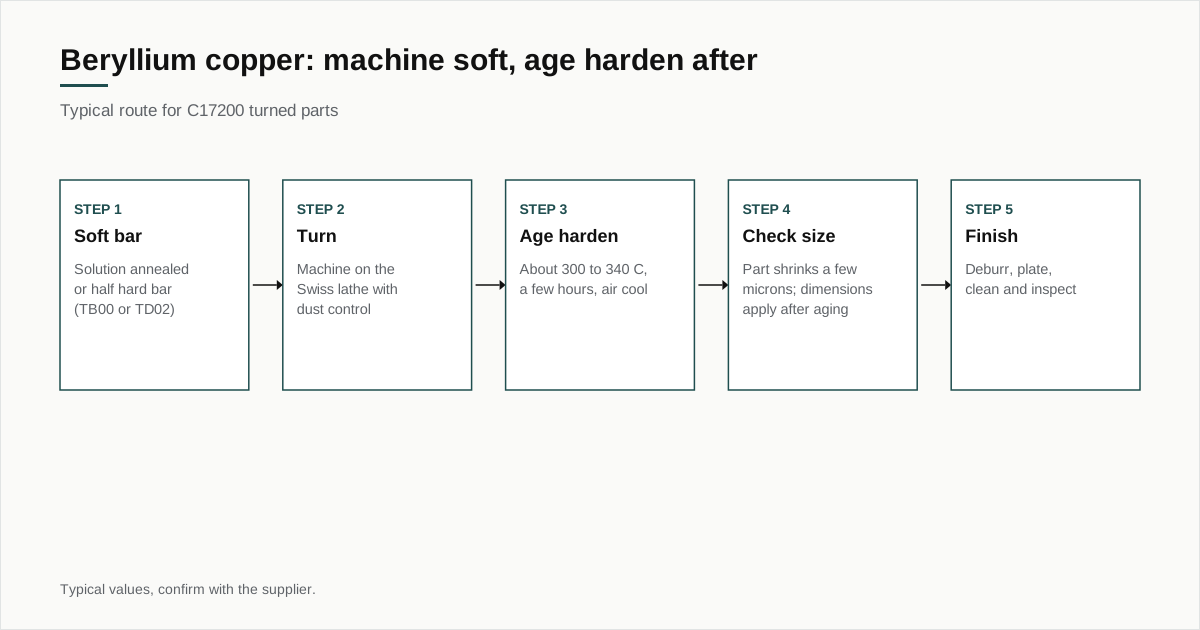
The usual route is to machine in the soft or half hard condition and age harden afterward. Soft bar machines more easily, tools last longer and surfaces come out cleaner. After machining, the parts go into a furnace for a few hours at a moderate temperature, typically in the range of 300 to 340 degrees Celsius, and cool in air. The hardness rises to the target.
The alternative is hardened bar, machined as received. It avoids the heat treatment step and the size change that comes with it, but it is harder on tools and often leaves a rougher finish. For parts with fine details, such as thin walls or small threads, many shops prefer the soft route.
The heat treatment is usually done at a specialist, which means a second operation. The secondary operations guide covers what that adds to lead time and cost.
What aging does to size
Age hardening shrinks the part slightly. The change is small, in the order of a fraction of a percent, and it is predictable for a given alloy lot and heat treatment. For a 3 mm diameter part, the change is a few microns, and for a long slender part the length also changes slightly.
Why it matters for the drawing:
- Tight tolerances are set after aging. A diameter held to a few microns has to be turned slightly oversize so that it shrinks into the band.
- Thin sections can distort. A slender part or a thin wall may bend during aging, because the shrinkage is not uniform.
- Fixturing helps. Some shops age parts in a fixture to hold them straight, which adds cost.
- The shop learns the shrink from the first lot. A first article is machined, aged and measured, and the program is adjusted.
If the dimension is critical, state that it applies after heat treatment. Otherwise the shop may measure before aging and ship parts that move out of tolerance in the furnace.
Machining behavior
Beryllium copper is harder than most copper alloys and machines as a tough, moderately abrasive material. Typical features:
Machinability. The alloy is rated well below free cutting brass, around one fifth of it, which means longer cycle times than brass or tellurium copper. The soft temper machines better than the hard one.
Tooling. Carbide inserts, sharp and polished, give the best results. Coated tools help in the hard condition. Tool life is shorter than in brass and longer than in stainless.
Chips. The chips are continuous in the soft condition, so chip control, with breakers and pressure coolant, is important on a Swiss-type lathe.
Burrs. Burrs form, and removing them from small contact parts is a delicate job.
Surface finish. Good finishes are possible. The surface finish guide explains how contact surfaces are specified.
Handling and dust
Beryllium is a health hazard in one particular form: fine airborne particles that are breathed in. Chronic exposure can cause lung disease in sensitized people. Solid parts are safe to handle, and the hazard arises from processes that make fine dust, fume or mist, which includes machining, grinding, polishing and some cleaning methods.
Shops that machine beryllium copper typically do the following:
- Control the air with local exhaust and filtered ventilation at the machine
- Capture coolant mist and manage chips and swarf as controlled waste
- Use wet cutting where possible to keep dust down
- Monitor exposure against the limits that apply in their country
- Train and equip staff and keep records
- Label parts and packaging according to local rules
Exposure limits are set by national regulators and are low. In the United States, for example, the occupational limit for general industry is expressed in fractions of a microgram per cubic meter of air over a work shift. Confirm current limits with the regulator that applies to your shop.
For a buyer, this means two things. First, fewer shops quote beryllium copper, because of the controls it needs, and the ones that do should be able to describe their program. Second, if your part ships to a customer, check whether labeling or a safety data sheet is required for the product. The auditing guide lists questions for a supplier visit, and handling controls belong on that list for this material.
A worked example
Take a contact sleeve 3 mm in outside diameter and 12 mm long with a 1.5 mm bore, a slot cut along part of its length and a collar. The sleeve must spring open slightly when a pin is inserted and return to size, so it needs spring temper, and it carries a small current.
The shop buys C17200 bar in the half hard temper, turns the outside and the bore, cuts the slot and the collar and removes burrs. The parts then go to an age hardening furnace and come out at the target hardness, shrunk by a few microns. The bore, which was turned slightly large, is now at nominal. A final check measures the bore with a pin gauge and the spring force with a test pin.
Compare the alternative of buying hardened bar. The sleeve would machine more slowly, the slot would burr more and the bore would not shrink, so it would be turned directly to size. Neither route is wrong. The first is typically cheaper per part at volume because tools last longer, and the second avoids the furnace step and the lead time that goes with it.
A drawing that states the hardness after aging, the bore size after aging and the spring force test lets the shop pick the route that fits its equipment and your volume.
Mill hardened bar
Some suppliers also sell mill hardened bar, which has been aged at the mill and drawn to a hard temper in a way that leaves it machinable. It is a middle route: the strength is close to the aged condition, machinability is better than fully hardened bar and the size change after machining is small or absent. The trade-off is that the final hardness is lower than a full age hardening of the machined part can reach.
For parts that do not need the highest strength, mill hardened bar saves the heat treatment step and its size change. Ask the shop whether it stocks it for your size, and check the properties against the spring or wear requirement of the part.
Beryllium-free alternatives
Some buyers prefer to avoid the material. Alternatives exist, each with trade-offs.
| Alloy family | Strength | Conductivity | Notes |
|---|---|---|---|
| Phosphor bronze | Moderate | Low to moderate | Common spring material, lower strength |
| Copper-nickel-silicon alloys such as C70250 | High | Moderate | Precipitation hardening, a frequent substitute |
| Copper-titanium alloys | High | Low to moderate | Newer, less common in bar form |
| Chromium copper (C18200) | Moderate to high | High | Less spring behavior, no beryllium |
| Stainless steel springs | High | Low | Different material class |
A substitute is a design change, not a drop-in swap. Stress relaxation, fatigue life and contact resistance differ, and a part that works in beryllium copper may fail in another alloy. Test before committing, and ask the shops to quote both.
What to put on the drawing
- Alloy and temper, such as C17200 TB00, and the standard if one applies
- Heat treatment, with the target hardness and the point in the sequence
- Which dimensions apply after aging
- Surface finish and burr limits on contact faces
- Plating, if any, with thickness
- Labeling or documentation requirements
Getting beryllium copper parts quoted
Send the drawing and STEP file through the RFQ form. State the alloy, the temper, the heat treatment and the yearly volume. We match the part with up to three shops that run Swiss-type lathes and reply within 24 business hours.
If a shop that quotes beryllium copper cannot describe its dust control and heat treatment arrangements, treat it as a signal. A shop that runs the material regularly can answer both in a few sentences.
Frequently asked questions
Is beryllium copper dangerous to handle?
Solid beryllium copper parts are not a hazard to handle. The risk comes from fine dust, fume or mist that machining, grinding or polishing can produce, which is harmful if inhaled over time. Shops that machine it control the air, filter the coolant mist and follow the exposure limits that apply where they work.
Should the part be machined before or after age hardening?
Usually before. Bar bought in the solution annealed or mill hardened condition machines more easily, and the part is then age hardened as a batch at a moderate temperature. Aging causes a small size change, which the shop allows for. Bar bought already hardened can be machined, but it wears tools faster.
Can I replace beryllium copper with another alloy?
Sometimes. Beryllium free copper alloys exist for springs and contacts, and they suit many designs, but they differ in strength, conductivity and stress relaxation. Treat any substitute as a design change that needs testing, and ask the shops to quote both.
Need a quote for this part?
Send the drawing. We match you with up to 3 Swiss shops and reply within 24 business hours.
Get matched with a Swiss shop