Guides / Process
Centerless Grinding After Swiss Turning: When a Turned Part Needs a Ground Diameter
October 12, 2026
Swiss-type lathes hold tight tolerances, and most parts leave the machine ready to use. A few do not. When a drawing calls for a diameter held within a few thousandths of a millimeter, a mirror finish or near-perfect roundness, the turned surface is the rough shape and grinding makes the final one. Centerless grinding is the usual choice for small round parts.
This guide explains how centerless grinding works, what it adds, which parts need it and how it changes the quote. It also covers the other side of the question: when a buyer is paying for grinding the part does not need.
How centerless grinding works
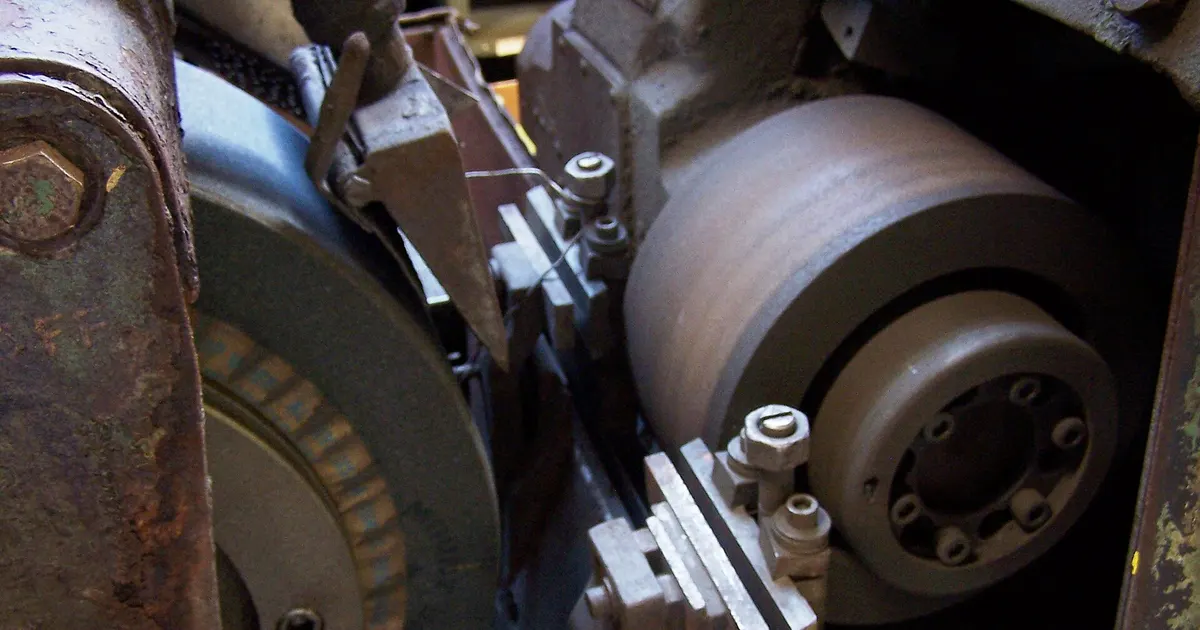
In centerless grinding, the part is not held in a chuck or a collet. It rests on a fixed work blade between two wheels. The larger wheel is the grinding wheel, which cuts. The smaller wheel is the regulating wheel, which has a rubber or resin bond and grips the part, controlling how fast it turns and, when tilted, how it moves along the blade.
The part’s surface finds its own center, which is the source of the name. It is not forced onto an axis, so any slight bend or off-center mounting does not carry into the result. The ground surface is round to the extent that the wheels and the blade allow, and the process is known for very good roundness and size consistency on long runs.
There are two main modes:
Through-feed. The regulating wheel is tilted a degree or two, which pushes the part along the blade, through the gap and out the other side. The part must be a straight cylinder along its whole length, with no shoulders or heads. This is the fast mode, and it suits pins, shafts and rods.
Infeed or plunge. The part sits in one place, and the wheels move in. This allows shoulders, heads, grooves and short ground sections, with a limit set by the width of the wheel. It is slower per part, since each part is loaded and unloaded individually, and it handles shapes through-feed cannot.
What grinding adds
| Property | Typical as Swiss turned | Typical after centerless grinding |
|---|---|---|
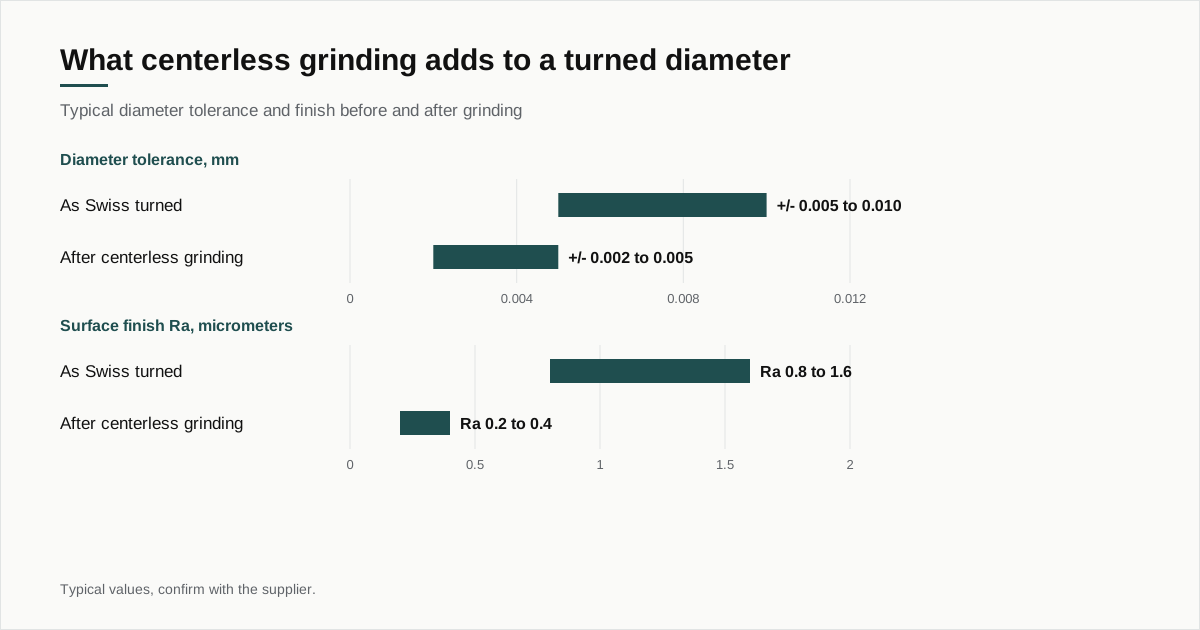
| Diameter tolerance | about ±0.005 to ±0.01 mm | about ±0.002 to ±0.005 mm |
| Roundness | a few microns | about 1 micron or better |
| Surface finish, Ra | about 0.8 to 1.6 µm | about 0.2 to 0.4 µm |
| Straightness | Good on slender parts, moderate | Better, set by the process |
| Surface condition | Visible tool marks | Uniform, matte to polished |
These are typical figures, and the real values depend on the material, the machine and the part. Confirm with the supplier before the figure goes on a drawing. The tolerance guide and the surface finish guide explain how turned parts are specified.
When grinding is needed
Grinding earns its cost in a few situations:
The diameter tolerance is tighter than turning holds. A pin that slides in a bushing with a few microns of clearance, or a plunger in a close-fit bore, needs a ground diameter. Turning can sometimes meet the number on short runs but not reliably on a long one.
The finish must be fine. Sealing surfaces, bearing journals and sliding parts need a smooth surface. Turned surfaces carry feed marks that act like a thread, and a fine ground finish removes them.
The part is hardened. Heat treatment hardens the steel and often distorts it slightly. Turning a hardened part is possible but slow and expensive, and grinding is the usual way to bring a hardened diameter to size.
Roundness matters. A rotating shaft or a part in a precision assembly may need a roundness figure that only grinding provides.
The turned surface is hard to hold. Slender parts with a large length to diameter ratio can come off the lathe with a slight taper or bow. Grinding corrects both.
When grinding is not needed
Many buyers pay for grinding out of caution. The questions that help:
- What does the diameter do? If it is a clearance feature, a decorative surface or a fit with a generous clearance, turning is enough.
- Is the tolerance a real requirement or a default? A note such as “all diameters ±0.005” carried over from another drawing may apply to features that do not need it.
- Is the finish functional? A finish requirement on a surface nothing touches adds cost for nothing.
- Is the part already ground at the bar stage? If the bar is purchased ground to a close tolerance and the part leaves a section untouched, that section is already at the bar’s size. The guide bushing article explains why Swiss work often starts with ground bar.
If the answer to the first three is “not sure”, ask the shops to quote both ways. The difference shows what the requirement costs.
What limits the process
Centerless grinding has limits that shape the drawing.
Shoulders and heads. A through-feed pass cannot handle a part with a head wider than the ground section. Parts like that use infeed grinding, which is slower, or are ground on a different machine.
Length. Very short parts do not rest properly on the blade and tumble. A minimum length of a few diameters is typical, and a shop may add a slug or a fixture to carry short parts.
Small diameters. Grinding below about 1 mm becomes difficult, as the part flexes under the wheel pressure. Some specialist shops go smaller.
Interrupted surfaces. A flat, a slot or a cross hole along the ground length causes the part to jump as the interruption passes the wheel, and the finish suffers. Flats are usually cut after grinding.
Marks and burrs. The ground surface will show wheel marks, and the part ends may need a light chamfer to prevent damage on loading.
Stock allowance and sequence
The sequence has two orders, and the choice matters.
Turn then grind. The Swiss-type lathe cuts the part with a small amount of extra material on the diameter, and the grinder takes the final cut. The allowance is typically a few hundredths of a millimeter per side for a part that is not hardened, and more if the part is heat treated, since distortion needs room. The shop sets the figure.
Grind then turn. The bar is ground before it goes in the lathe, and the lathe leaves part of the diameter untouched. This is the reason ground bar exists, and the ground bar article covers it. The shop turns only the features that change.
For a part with a ground section and turned features, the second route is often cheaper, because the grinding happens once on a long bar and not on each part. It is also the route that depends on the bar’s quality, so it needs a supplier who checks incoming bar.
If the part is hardened, the order is turn, harden, grind. Say so on the drawing, along with the hardness. A shop that does not know about the hardening step will cut the turned diameter to its final size and leave nothing for grinding.
A worked example
Take a hardened steel locating pin, 3 mm in diameter and 25 mm long, with a chamfer on each end and a groove near one end. The pin slides in a bushing with a few microns of clearance, and the drawing calls for a diameter tolerance of ±0.003 mm and a finish of Ra 0.4 µm.
Swiss turning alone would leave tool marks and a tolerance several times wider than the drawing. Turning the pin to size after hardening is slow and wears tools quickly. The sensible route is to turn the pin from a suitable steel with about 0.1 mm of extra diameter, cut the chamfers and the groove in the same cycle, send the pins out for hardening and then centerless grind the diameter to size.
The groove is the catch. A groove in the ground section interrupts the surface, so the shop either places it outside the ground length or grinds in infeed mode with a wheel narrower than the pin. The drawing should show where the ground length begins and ends, which is exactly the kind of detail that avoids a quote revision later.
What it does to price and lead time
Grinding is a second operation. The part leaves the lathe, goes to the grinder, which is often in a different building or a different company, and returns. Each step adds handling, a queue and a move.
| Effect | Why |
|---|---|
| Unit cost rises | Machine time and handling on the grinder |
| Setup cost | Wheels dressed, regulating wheel set, first article |
| Lead time grows | Parts wait for the grinder and the transport |
| Minimum lot size | Grinder setup favors batches |
| Inspection | Tighter tolerances need better gauging |
The secondary operations guide covers what else sits in that stage, and the lead time guide shows how extra steps lengthen delivery. The cost guide explains how setup spreads over quantity.
How to specify it
Put the requirement on the diameter, not the process:
- Finished diameter and tolerance
- Surface finish on the ground section, with Ra
- Roundness if it matters, as a figure
- Length of the ground section and its position
- Material and heat treatment, including hardness and order of operations
- How the diameter will be measured, such as a snap gauge or an air gauge
Naming “centerless grinding” on the drawing is rarely necessary. If the tolerance and finish need it, the shop will arrive at grinding on its own, and if another route meets the requirement, you will not pay for the process you named.
Getting ground parts quoted
Send the drawing and STEP file through the RFQ form. State the diameter, tolerance, finish, material and any heat treatment, and the yearly volume. We match the part with up to three shops that run Swiss-type lathes and reply within 24 business hours.
If a shop does not grind in house, ask who does and where. The answer affects lead time and accountability, and the auditing guide lists the questions that bring out how a supplier manages outside processes.
Frequently asked questions
How tight a diameter can Swiss turning hold without grinding?
Well tuned Swiss-type machines routinely hold diameters within a few thousandths of a millimeter to about 0.01 mm on small parts in stable materials. Tighter than that, or with a fine finish and roundness requirement, is where grinding starts to make sense. Confirm the number with the shop for your material and length.
Can any turned part be centerless ground?
No. The part must be round along the length being ground, have enough length to rest on the work blade and be free of shoulders that block the wheels, unless the shop uses an infeed method. Short parts, parts with large heads and parts with off-axis features need another route, such as a fixture grinder.
Should I leave grinding stock on the drawing?
State the finished dimension and tell the shop grinding follows. The shop sets the stock allowance on the turned diameter. If the part is hardened between turning and grinding, mention the heat treatment so the shop allows for distortion.
Need a quote for this part?
Send the drawing. We match you with up to 3 Swiss shops and reply within 24 business hours.
Get matched with a Swiss shop