Guides / Industries
Pogo Pin and Test Probe Barrels: How Swiss Lathes Make the Housing
October 20, 2026
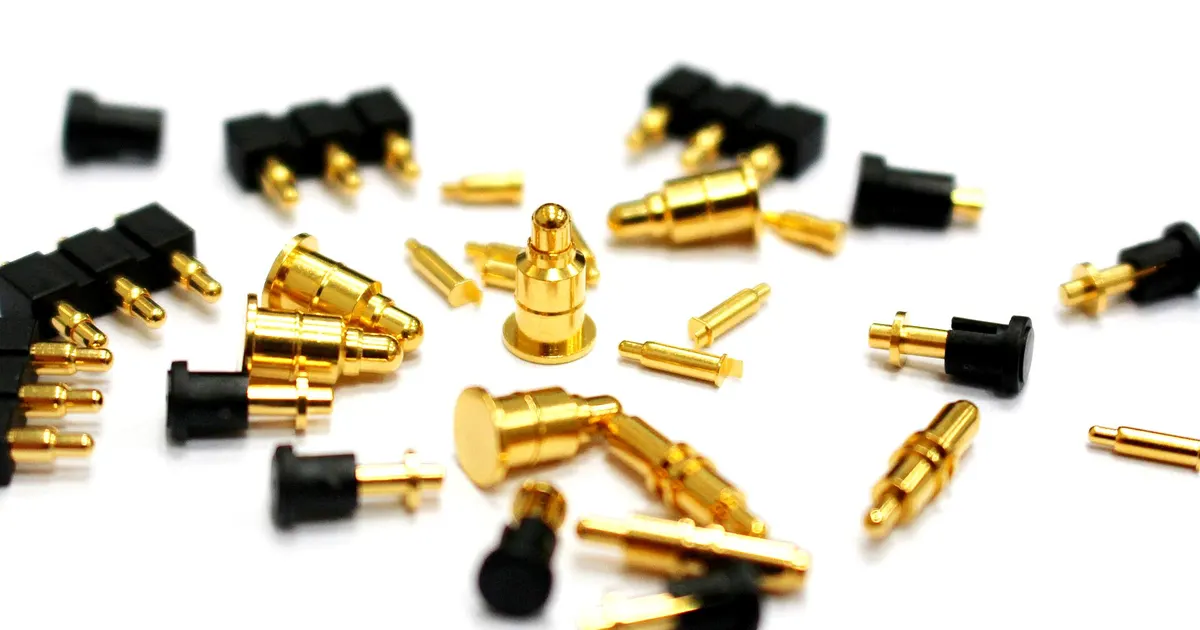
A pogo pin is a small spring-loaded contact. A plunger slides in a barrel, a spring pushes it out and the tip presses against a pad or a surface. Pogo pins connect phone docks, battery packs, smart watches, medical devices and, in the form of test probes, almost every circuit board that gets tested in production. The barrel is the housing of the pin, and it is a classic Swiss-type lathe part.
This guide explains what the barrel does, how it is made, which tolerances and walls matter, where plating fits and what drives cost.
Parts of a pogo pin
Four components make up the typical pin.
Plunger. A rod with a tip that touches the target. It slides in the barrel and is often made from copper alloy such as beryllium copper, or from steel for hard contacts.
Barrel. A tube that guides the plunger, holds the spring and carries the current. It is closed or crimped at one end and has a flange, a retention groove or a tail at the other.
Spring. A small coil, commonly music wire or stainless, that sets the contact force.
Tail or base. The end that connects to a board, a wire or a mounting plate. It can be a solder cup, a press-fit end or a plain stub.
The Swiss-type lathe makes the barrel, and often the plunger and the tail as well. The connector pin guide covers related contact parts, and the beryllium copper article describes the plunger material.
What the barrel has to do
The barrel’s job looks simple and the requirements are tight.
- Guide the plunger smoothly. A bore that is too tight binds and one that is too loose lets the plunger wobble and lose contact.
- Carry current. A good conductor with a low resistance path from plunger to tail.
- Hold the spring. The bore must contain the spring without buckling it.
- Retain the plunger. The mouth is crimped or rolled inward after assembly so the plunger cannot fall out, which requires a thin, ductile wall at that end.
- Mount in a socket or plate. The outside diameter, flange or retention groove sets how the pin sits in its housing.
Typical dimensions
Pogo pins range from sub-millimeter probes to larger pins for power contacts. Typical barrel figures for common signal pins:
| Feature | Typical range | Notes |
|---|---|---|
| Outside diameter | about 0.5 to 3 mm | Smaller for fine-pitch test probes |
| Length | about 3 to 15 mm | Set by stroke and spring |
| Wall thickness | about 0.05 to 0.15 mm | Thin to save space, limits stiffness |
| Bore diameter tolerance | about ±0.005 to ±0.01 mm | Controls plunger clearance |
| Plunger to bore clearance | about 0.01 to 0.03 mm | Balance of smoothness and alignment |
All are typical and depend on the design. Confirm with the supplier.
How the barrel is made
A barrel is a thin-walled tube with a closed or open end. On a Swiss-type lathe the sequence runs roughly like this.
- Turn the outside diameter, flange and groove. The guide bushing supports the thin bar next to the cut.
- Drill the bore. A deep hole, often 5 to 10 times the diameter or more, so the drilling methods in the micro drilling guide apply.
- Finish the bore. Reaming or boring brings it to size and finish. The bore surface decides how the plunger slides.
- Cut the tail features, such as a solder cup or a press-fit end.
- Part off. The sub spindle takes the part and finishes the back end.
The thin wall limits how hard the machine can push. A clamped barrel can ovalize if the collet squeezes too hard, and a barrel cut too fast can chatter and leave a wavy wall. Shops use light grip, sharp tools and a steady feed.
The bore and the outside diameter must be concentric, or the wall is thicker on one side and the crimp fails unevenly. Cutting both in one setup, from the same end, keeps them aligned, and the fiber ferrule article explains how concentricity is held on small parts.
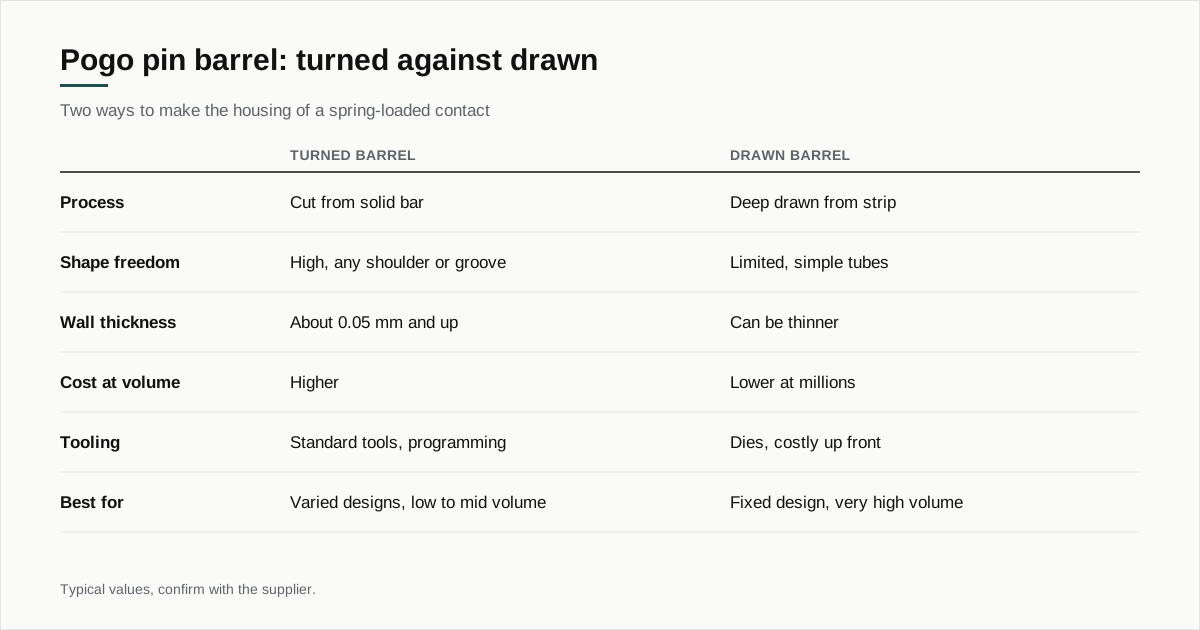
Turned and drawn barrels
Two ways of making a barrel compete.
| Turned barrel | Drawn barrel | |
|---|---|---|
| Process | Cut from solid bar | Deep drawn from strip or sheet |
| Shape freedom | High, any shoulder or groove | Limited, simple tube shapes |
| Wall thickness | About 0.05 mm and up | Can be thinner and more uniform |
| Cost at volume | Higher | Lower at very high volume |
| Tooling | Standard tools plus programming | Dies, costly up front |
| Best for | Varied designs, low to mid volume | Millions of identical pieces |
| Material | Free machining alloys | Ductile alloys that draw well |
Drawn barrels win on cost when the design is fixed and the volume is in millions. Turned barrels win when the shape is complex, the volume is moderate or the design changes. Many pogo pin makers use both, depending on the product.
Materials
| Material | Why it is used | Notes |
|---|---|---|
| Free cutting brass | Cheap, easy to machine | Lead-bearing grades face restrictions in some markets |
| Lead-free silicon brass | Replaces leaded brass | Machines well, a little slower |
| Tellurium copper | High conductivity | The tellurium copper guide covers it |
| Phosphor bronze | Spring behavior, wear | Free cutting grades often leaded |
| Beryllium copper | Strength and conductivity | Heat treated after machining |
| Stainless steel | Corrosion resistance | Poor conductivity, for special pins |
The choice depends on the current, the cycle life and whether the product must be lead-free. If your end product has a lead restriction, say so before quoting, because it removes the cheapest brass.
Plating
Almost all pogo pin barrels are plated. A common stack is nickel for a barrier and hardness, then gold for low contact resistance and corrosion resistance. Gold thickness depends on the cycle life and the environment, and it is a major cost driver, so the drawing should state it.
What matters for the turned part:
Surface quality. Plating copies the surface, so burrs, tool marks and scratches show through. A rough bore makes a rough plated bore.
Dimensional allowance. Plating adds thickness. Nickel and gold together can add several microns per side, enough to change a close sliding fit. The turned bore must be sized for the plated result.
Bore coverage. Plating inside a long, narrow bore is hard, since solution flows poorly in. Specify whether the bore needs plating, and if so, how thickly.
Cleanliness. Cutting oil or chips left in the bore cause plating faults. Cleaning before plating is part of the process.
The surface finish guide explains finish callouts, and the secondary operations guide covers plating and the other steps that follow turning.
The crimp and why the wall matters
After the spring and plunger go in, the mouth of the barrel is rolled inward so the plunger cannot leave. This crimp is a forming step on a part with a wall a tenth of a millimeter thick, and it only works if the wall behaves.
A wall that is too thick resists the crimp and the barrel splits or the mouth does not close. A wall that is too thin or uneven collapses. Material temper plays in as well, since a hard bar cracks where a soft one folds. Shops that make pogo pins match the temper of the bar to the crimp, and sometimes anneal the mouth.
Because the crimp is done by the pin maker or an assembler, the turned barrel must arrive with consistent wall thickness and a clean mouth. Wall variation of a few microns between the two sides, which comes from poor concentricity, shows up as pins that crimp unevenly and retain unevenly. This is one reason the bore and the outside diameter are made from the same end in one setup.
Testing a pin: stroke, force and resistance
Buyers of pogo pins care about numbers the barrel affects.
| Property | What the barrel contributes |
|---|---|
| Stroke | Bore length and the position of the crimp |
| Contact force | Spring seating, bore diameter, friction |
| Contact resistance | Barrel material, plating and the sliding fit |
| Cycle life | Bore finish, plating wear and alignment |
| Side load tolerance | Bore length and plunger guidance |
Sliding friction depends on the bore’s finish and the plating, and a rough or burred bore raises friction and wear, which lowers cycle life. Test sockets that run hundreds of thousands of cycles are sensitive to this. A shop that makes pins for test fixtures will tell you what finish and plating its parts reach, and a buyer can ask for measurements from sample lots.
A worked example
Take a barrel for a 1.0 mm signal pin: outside diameter 1.0 mm, length 6 mm, bore 0.8 mm and a flange at the tail end. The wall is 0.1 mm. The material is lead-free brass, plated with nickel and gold.
The shop turns the outside and the flange from 1.0 mm bar, drills a 0.8 mm bore in two or three pecks, reams it to a tolerance of a few microns and parts off the barrel with the sub spindle holding the flange. A light deburring pass removes burrs at the mouth. The barrels are cleaned and sent for plating.
The cost has three parts: material and machining, deburring and cleaning, and plating. Plating is often the largest share of the three. If the plating thickness is doubled to extend cycle life, the unit price rises more than any change to the turned part could save. If the volume rises to millions and the shape is simple, a drawn barrel would undercut the turned one, and the buyer should compare.
Burrs and cleanliness
A burr in the bore or at the mouth scrapes the plunger and sheds debris into a contact. Two spots matter most: the entry of the bore, where a small chamfer guides the plunger, and the crimp zone, where a burr can crack when the mouth is rolled in. Shops deburr by controlled methods, and the check is made under magnification.
Particles are a failure mode of their own. A metal chip in a contact raises resistance or shorts a pair of pins. If your pins go into a product with fine pitch, say so, and state the cleanliness you expect.
Cost drivers
| Driver | Why it matters |
|---|---|
| Wall thickness | Thin walls need slower cuts and lower yield |
| Bore depth and tolerance | Deep drilling and finishing take time |
| Material | Lead-free and copper alloys cost more |
| Plating | Gold thickness, selective plating, bore coverage |
| Volume | Setup spreads, and a drawn barrel may compete |
| Inspection | Small bores need optical or air gauging |
The cost guide explains how setup and run time combine. For pogo pins, the plating can exceed the machining cost, so a change in gold thickness may matter more than any change in the turned part.
What to put on the drawing
- Outside diameter, length and wall thickness with tolerances
- Bore diameter, tolerance and finish
- Concentricity of bore and outside diameter
- Crimp zone requirements, including wall and burr limits
- Material and lead-free requirement
- Plating stack and thickness, and whether the bore is plated
- Cleanliness requirement
- Yearly volume
Getting barrels quoted
Send the drawing and STEP file through the RFQ form. State the wall thickness, the bore tolerance, the plating and the yearly volume, and mention whether a drawn barrel would also be acceptable. We match the part with up to three shops that run Swiss-type lathes and reply within 24 business hours.
If you are comparing turned and drawn barrels, tell the shops your expected volume. A shop that knows you are heading toward millions will say when a different process fits better, and that conversation is worth having early.
Frequently asked questions
What is the difference between a turned and a drawn pogo pin barrel?
A turned barrel is cut from solid bar on a lathe, so it can carry any shoulder, flange or internal step the design needs. A drawn barrel is formed from sheet or strip by deep drawing, which is cheaper at very high volume but limited in shape. Turned barrels cost more and offer more freedom.
What wall thickness can a turned barrel have?
Walls of about 0.05 to 0.15 mm are made on well set up machines, depending on diameter, length and material. Thinner walls need careful tooling, light clamping and often a lower yield. State the minimum wall your design needs, not the thinnest you can imagine.
Who plates the barrels?
Plating is normally a separate process, done by a specialist, with nickel under gold in most cases. The turned dimensions must allow for the plating thickness, and the order of operations has to be fixed on the drawing so the shop and the plater agree.
Need a quote for this part?
Send the drawing. We match you with up to 3 Swiss shops and reply within 24 business hours.
Get matched with a Swiss shop