Guides / Process
Deep Hole Drilling on Swiss-Type Lathes: When Gun Drilling Is the Answer
October 13, 2026
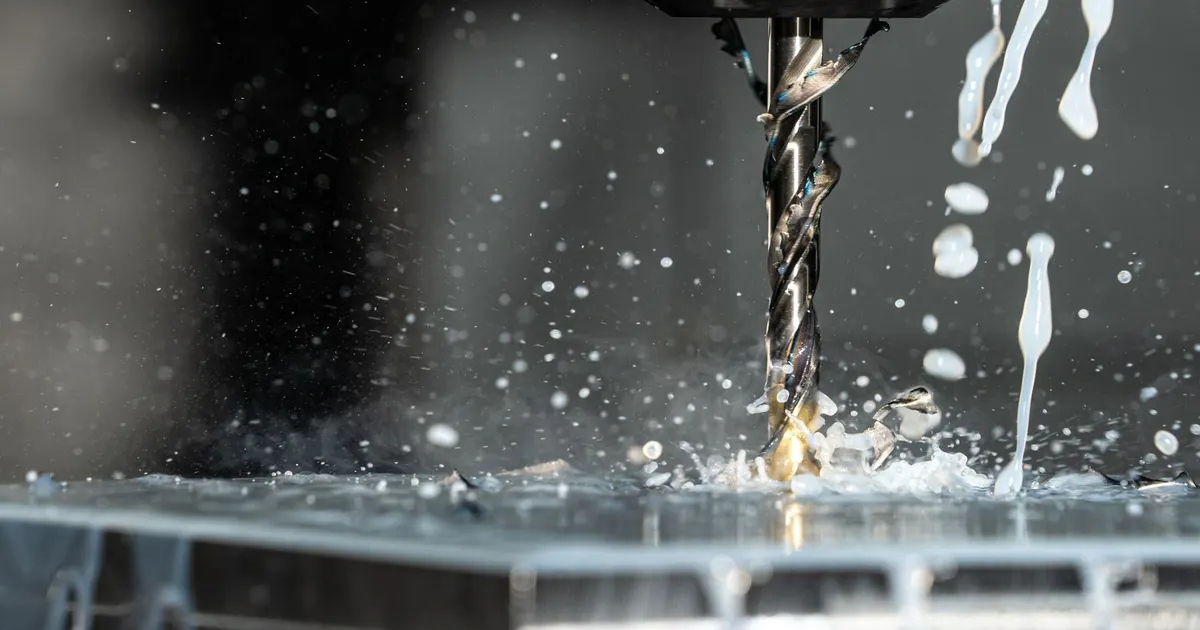
A deep hole is a hole whose depth is many times its diameter. On a Swiss-type lathe, such holes appear in needle housings, fluid nozzles, medical cannulas, shafts that carry oil and fuel system parts. They are also one of the features that most often moves a part from an ordinary quote to a specialist one.
This guide explains where ordinary drilling stops, how gun drilling works, what each method can hold and how to describe a deep hole so the shop can price it without guessing.
What counts as deep
Depth only has meaning against diameter. A hole 10 mm deep is shallow at 5 mm wide and deep at 0.5 mm wide. The usual measure is the depth to diameter ratio, written as a multiple of the diameter.
Rough working bands, which shops define a little differently:
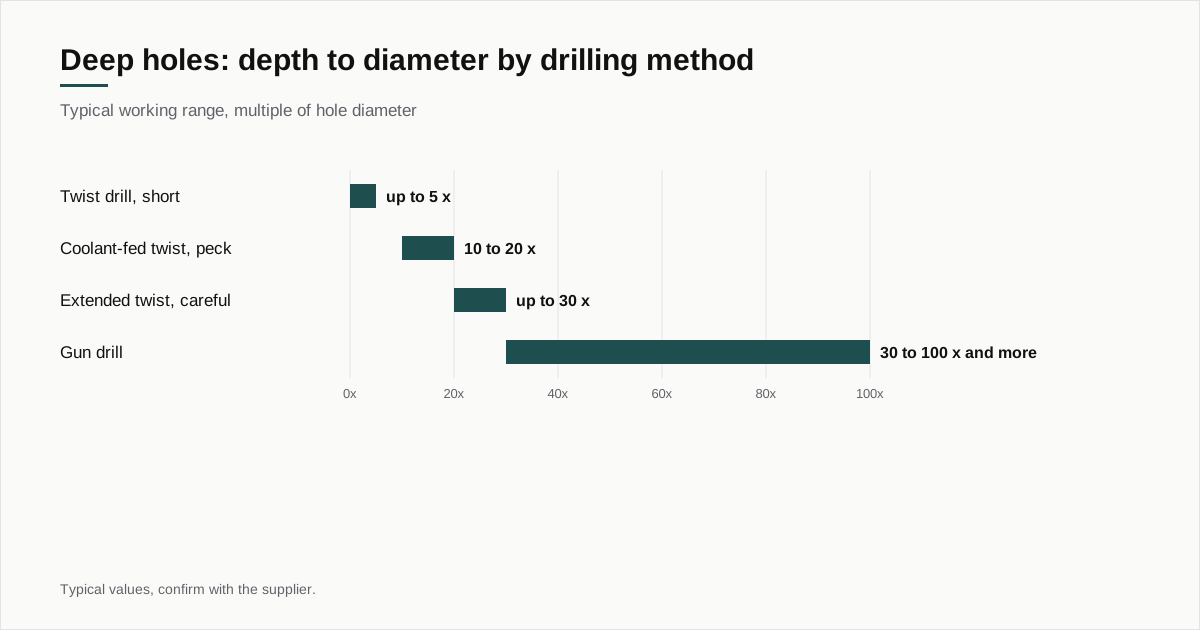
- Up to about 5 times diameter: ordinary drilling, no special care
- 5 to 10 times diameter: needs pecking or coolant-fed drills, still routine
- 10 to 30 times diameter: deep hole territory for a twist drill, needs coolant delivery and tool selection
- Beyond 30 times diameter: gun drilling or a similar process
The difficulty is chip evacuation and drill stiffness. As the hole deepens, chips have farther to travel, coolant has trouble reaching the tip and the drill, which is long and thin, bends more easily. A drill that bends drifts off the axis, and the hole comes out curved.
How far a twist drill can go
On a Swiss-type lathe, a standard twist drill does most of the shallow work. For deeper holes shops use a drill with internal coolant channels, which push coolant straight to the tip and flush chips back along the flutes. With such a drill and a spindle that supplies coolant at pressure, ratios of 10 to 20 are common, and 30 is possible with patience and the right material.
Peck drilling is the usual technique. The drill advances a few diameters, retracts to clear the chips, then advances again. Each peck adds cycle time, and the deeper the hole, the more pecks there are. Cycle time for a deep hole can come to exceed the rest of the part combined.
How gun drilling works
A gun drill is a straight, single flute drill with a hollow shank. Coolant is pumped through the shank at high pressure, exits near the cutting tip and pushes chips back out through a V-shaped groove along the outside of the drill. The cutting tip is carbide, and pads on the tip burnish the wall of the hole as it cuts, which is why gun drilled holes are straight and smooth.
Some features of the method:
It needs a starting guide. The gun drill is long and has no self-centering point. A short pilot hole or a guide bushing starts it on the axis. Without this the drill wanders in the first few millimeters, and the error carries through the whole hole.
It needs high coolant pressure. Pressures far above those of normal machining coolant are typical, and the coolant has to be clean, since fine particles wear the guide pads and the tip. Filtration is part of the process.
It cuts slowly per revolution. The feed is small, and the spindle speed is set by the drill size. The advantage is that the feed is continuous, with no pecking, and chips leave the hole on their own.
Hole sizes are limited at the bottom end. Gun drills for small holes exist, and holes around 1 mm are within the range of specialized shops. Below that the drills become fragile, and the process is rarely offered on a Swiss-type lathe.
Comparison of methods
| Method | Typical depth ratio | Typical smallest diameter | Straightness | Typical finish as drilled |
|---|---|---|---|---|
| Twist drill, short | up to 5 × | below 0.5 mm possible | Fair | Moderate |
| Coolant-fed twist drill with peck | 10 to 20 × | about 0.5 mm | Good | Moderate |
| Extended twist drill, careful | up to 30 × | about 1 mm | Fair | Moderate |
| Gun drill | 30 to 100 × and more | about 1 mm | Very good | Good |
| Gun drill plus finishing step | 30 to 100 × and more | about 1 mm | Very good | Very good |
Treat the figures as typical and confirm with the shop. Depth ratio depends on material, machine and the tolerance on straightness.
Tolerances and what affects them
Hole diameter on a gun drilled hole is typically held within a few hundredths of a millimeter, for example about ±0.01 to ±0.03 mm depending on the size and the material. Straightness is the property gun drilling does best, and it is usually described as a deviation from the axis over the full depth. Finish is typically smoother than twist drilling, and a shop can state the range it achieves.
Several things push these numbers around:
- Material. Austenitic stainless steel and titanium wander more and wear the drill faster than brass or aluminum.
- Part length and support. A deep hole in a thin-walled tube is hard to drill straight, because the wall flexes. The part must be well supported near the cut.
- Rotation. Drilling with a rotating part and a stationary drill gives better straightness than the reverse, and the best results often come from counter-rotating part and drill. Shops know which their machine supports.
- Entry and exit. The first few millimeters set the direction, and the last few break out unpredictably. Surface features near the exit need extra care.
The cost picture
Deep holes cost more because they take longer and carry more risk. The cost components are:
| Cost driver | Why it matters |
|---|---|
| Cycle time | Slow feeds and pecking make the hole the longest step |
| Tooling | Gun drills and coolant-fed drills cost more than standard drills |
| High pressure coolant | Needs a pump, filtration and maintenance |
| Scrap risk | A drill that breaks or drifts in a nearly finished part ruins it |
| Second operation | If sent out, adds handling and lead time |
If the shop runs the hole in cycle, the saving is mostly in lead time and handling. If it sends the part out, expect the price and delivery to reflect it. The secondary operations guide lists what usually moves out of the main cycle and why. The cost guide shows how time, tooling and scrap combine into a unit price.
Design choices that make a deep hole cheaper
A small change on the drawing can drop the cost noticeably.
Allow a larger diameter. A 3 mm hole at 60 mm deep is easier than a 2 mm hole at the same depth, because the drill is stiffer and the coolant path is wider. If the function allows it, ask.
Allow a shorter hole. Cutting the depth by a third cuts the cycle time by more than a third, since the peck count goes down with it.
Drill from both ends. For a through hole in a long part, drilling from each end halves the depth ratio of each pass. The holes must meet, and a small step at the junction is the usual result, so this suits only holes where a step does not matter.
Accept a conical bottom on a blind hole. A drill point forms a conical bottom, and a flat bottom needs an extra tool. If the function does not need the flat, the cone is cheaper.
Avoid a tight straightness requirement without a reason. State the actual requirement, such as a needle or a rod that must pass through. A straightness figure that is not tied to a function costs money for nothing.
A worked example
Take a stainless steel tube-like part, 6 mm in outside diameter and 70 mm long, with a 2 mm bore running its full length. The depth to diameter ratio is 35, which is beyond what a twist drill does reliably. The shop has three realistic routes.
The first is drilling from both ends with a coolant-fed twist drill, each pass 35 mm deep at a ratio of 17. This is quick and stays in the cycle, but the two bores meet with a small step, and the straightness depends on how well the second pass finds the first.
The second is gun drilling from one end on the lathe, if the shop has the attachment and the coolant unit. The bore is straight and smooth, the cycle is longer and the price per part reflects the slower feed.
The third is sending the parts to a dedicated deep hole machine. Quality is highest and the cost per hole can be low at high volume, but each part is handled twice and the lead time grows.
Which route wins depends on volume and on the function. If the bore carries a fluid and a small step does not matter, the two-ended twist drill is cheapest. If a wire or a needle must pass through, straightness decides and gun drilling is the safer choice. A good quote will say which route it assumes, and a good buyer will ask.
What to put on the drawing
Treat the hole as a feature with a job:
- Diameter and tolerance
- Depth, and whether through or blind
- Straightness or position at the far end, if the function needs it
- Surface finish inside the bore, if it carries fluid or a sliding part
- Entry and exit condition, such as chamfer or deburr
- Cleanliness, since a deep bore traps chips and coolant
- What passes through it, as the function drives the other requirements
Cleanliness deserves a note. A deep narrow bore is hard to inspect and to clean, and a stray chip can block it. Say how the hole will be checked, such as a pin gauge that must pass the full depth, or an air flow test. The inspection guide describes how checks like these are agreed.
Where deep holes appear
Fuel and fluid parts use deep, narrow bores for flow, and the nozzle and injector article covers a related case. Medical needles, cannulas and bone screws with a central channel use them, as the medical guide explains. Shafts with an oil feed for lubrication and instrument parts that carry a probe or wire use them too.
Getting deep-hole parts quoted
Send the drawing and STEP file through the RFQ form. State the hole diameter, depth, tolerance, material and yearly volume, and mark whether the hole is through or blind. We match the part with up to three shops that run Swiss-type lathes and reply within 24 business hours.
If the quotes differ widely, ask each shop how it drills the hole and where. A shop that gun drills in cycle and a shop that sends the part to another machine are quoting different jobs, and the answer tells you which one fits the lead time you need.
Frequently asked questions
How deep can a Swiss-type lathe drill?
With a coolant-fed twist drill, shops commonly reach 10 to 20 times the hole diameter in a single setup, and sometimes 30 with careful peck drilling. Beyond that, gun drilling takes over and can reach far deeper ratios, but it needs high pressure coolant and a pilot hole. The practical limit depends on the shop, so ask for a quote on the real hole.
Is gun drilling done on the Swiss-type lathe or somewhere else?
Both happen. Some shops carry a gun drilling attachment and a high pressure coolant unit on the lathe and drill in cycle. Others send the part to a dedicated deep hole drilling machine as a second operation. The second route adds handling, cost and lead time, so ask which one the quote assumes.
Does a deep hole need to be reamed?
Not always. A gun drilled hole is typically straighter and smoother than a twist drilled one, and for many functions it needs no further work. If the drawing needs a tight diameter or a fine finish, a finishing step such as reaming or honing may follow. State the requirement and let the shop choose.
Need a quote for this part?
Send the drawing. We match you with up to 3 Swiss shops and reply within 24 business hours.
Get matched with a Swiss shop