Guides / Process
Micro Drilling on Swiss-Type Lathes: How Small and How Deep Holes Can Go
October 17, 2026
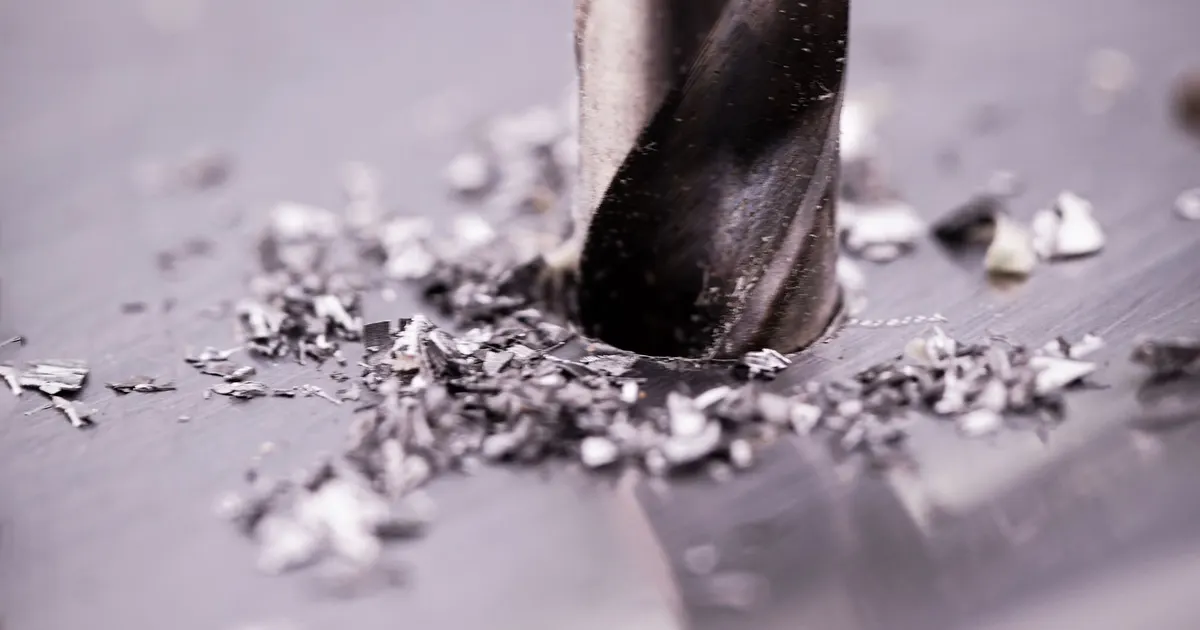
Micro drilling is one of the reasons buyers choose a Swiss-type lathe in the first place. A hole a fraction of a millimeter wide, drilled in a part the width of a pencil lead, is routine work for the right machine and a source of scrap for the wrong one. The question for a buyer is where the limits sit and which choices on the drawing move them.
This guide covers practical hole sizes, depth limits, tolerances, the effect of material and how to specify a small hole so the quote is sensible.
Why a Swiss-type lathe suits small holes
Three features of the machine help.
The bar is supported next to the cut. The guide bushing holds the bar a few millimeters from the tool, so a thin part does not deflect under drilling load. A drill pushing into an unsupported thin part would walk, bend the part or both.
Drilling on center with a rotating part. For a hole along the axis, the part turns and the drill stays still on the machine’s center line. A drill with a rotating workpiece tends to produce a straighter, more concentric hole than a rotating drill entering a stationary part. This is the usual method for axial holes.
Live tools at high speed. For cross holes the drill rotates in a live tool holder. Small drills need high rotational speed to reach a workable cutting speed, and many shops fit a speed-increasing attachment for the smallest sizes. The live tooling guide explains how the tool stations work.
How small and how deep
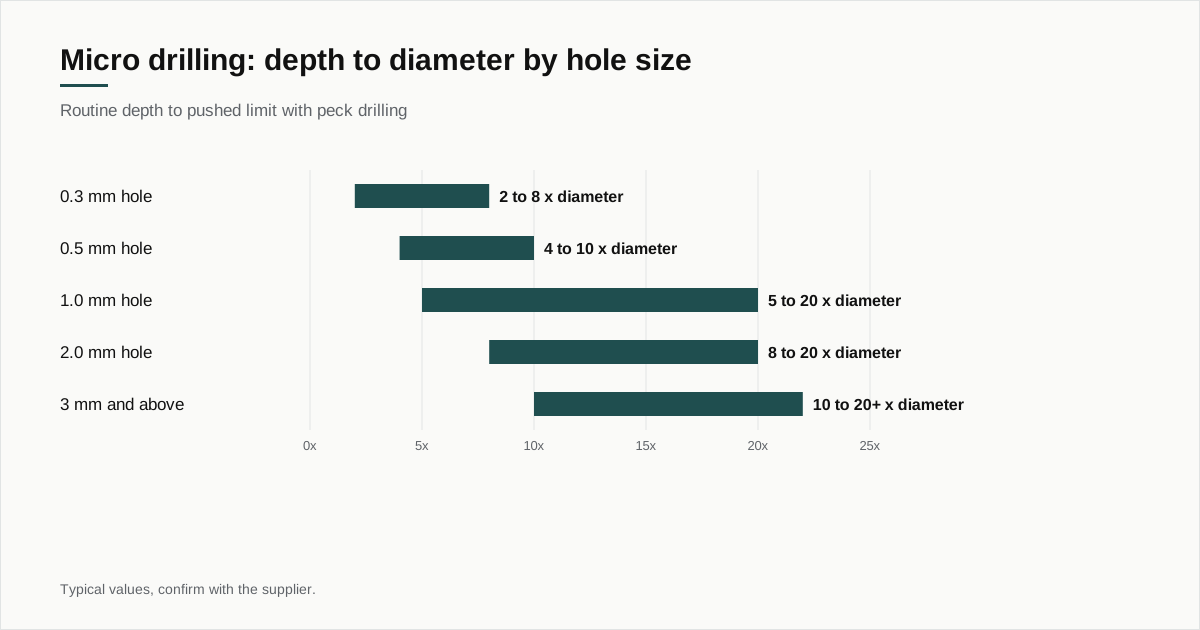
The limits depend on hole diameter, depth, material and the shop’s tooling. The table below shows typical working ranges for a well equipped shop. Treat them as indicative and confirm with the supplier.
| Hole diameter | Typical routine depth | Pushed limit with peck drilling | Typical tolerance as drilled |
|---|---|---|---|
| 0.3 mm | 2 to 3 × diameter | about 5 to 8 × diameter | about ±0.02 mm |
| 0.5 mm | 4 to 5 × diameter | about 10 × diameter | about ±0.02 mm |
| 1.0 mm | 5 to 8 × diameter | about 15 to 20 × diameter | about ±0.01 to ±0.02 mm |
| 2.0 mm | 8 to 10 × diameter | about 20 × diameter | about ±0.01 mm |
| 3.0 mm and above | up to 10 × diameter | beyond 20 × diameter with special drills | about ±0.01 mm |
Depth is expressed as a ratio of depth to diameter, because that is what drives drill life and chip clearing. A 1 mm hole 5 mm deep is a ratio of 5 and is ordinary. A 0.3 mm hole 3 mm deep is a ratio of 10 and is not.
The ranges widen sharply when a shop has through-spindle coolant at high pressure, a speed-increasing holder and a long history with the material. They narrow when any of the three is missing.
Why depth raises cost
Peck drilling. Chips from a small drill do not leave the hole on their own. The drill advances a small step, retracts to clear chips and advances again. A deep hole can involve dozens of pecks, and each peck adds time. Cycle time grows faster than depth.
Drill breakage. Small carbide drills break when a chip packs or the tool touches a hard spot. The cost is the drill, the stopped machine and, if the drill breaks inside the part, the scrap. Shops price this risk into small deep holes.
Inspection. A hole 0.4 mm wide cannot be checked with a standard pin gauge in the same way as a 3 mm hole. Checking involves small pin gauges, optical measurement or an air gauge. Add this to the cost and the lead time. The inspection guide covers how to agree on a method.
Material changes the answer
| Material | Micro drilling behavior | Notes |
|---|---|---|
| Free machining brass | Easy, short chips | Smallest holes are most reliable here |
| Aluminum | Easy, but chips can stick | Coolant and drill coating matter |
| Free machining stainless | Moderate | Sulfur additions help chip breaking |
| Austenitic stainless | Difficult | Work hardens, long stringy chips |
| Titanium | Difficult | Heat and chip welding at small sizes |
| Nickel alloys | Very difficult | Slow, with frequent drill changes |
| Plastics such as PEEK | Moderate | Heat softening and burrs at the exit |
Material and hole size interact. A 0.5 mm hole in brass is a routine request. The same hole at the same depth in a nickel alloy may be a quote the shop declines or prices at many times the brass figure. The brass guide and the nickel alloy guide show how the materials differ in practice.
Burrs, exits and breakthrough
The exit of a micro hole is where problems show up. A drill breaking through leaves a burr, and a hole 0.4 mm wide with a 0.05 mm burr has lost a noticeable part of its area. If the hole carries fluid or light, the burr matters. Options include:
- A pilot or spot drill at the start to keep the drill from wandering
- A reduced feed at breakthrough, which most shops program automatically
- A chamfer or countersink at the entry to give the drill a guide and remove the entry burr
- A supporting step behind the hole, such as a thin wall that the drill breaks into cleanly
- A secondary deburr step, such as abrasive flow or a chemical process, for parts where a burr is not acceptable
Say which end of the hole is critical. An entry burr is usually easy to remove, and an exit burr inside a deep bore is not.
Drills, coolant and speed
The hole is only as good as the drill and the conditions around it. Three details separate a reliable process from a lucky one.
Drill material and geometry. Solid carbide drills dominate below about 3 mm because high speed steel is too soft and too flexible at that size. The point angle, the flute shape and the coating are chosen for the work material, and a drill ground for brass is the wrong drill for stainless. Shops that drill small holes often keep a library of proven drills by alloy.
Coolant delivery. Chips in a deep small hole must leave, and coolant is what pushes them out. Through-spindle or through-tool coolant at high pressure helps most, but it needs a drill with an internal channel, which exists only in larger micro sizes. For the smallest holes a shop relies on flood coolant, short pecks and a clean entry. The coolant guide covers why filtration and pressure matter for small features.
Surface speed. A drill 0.5 mm wide needs a very high spindle speed to reach the same surface speed as a 5 mm drill. Machines without a speed-increasing holder cannot reach it, and a drill run too slowly rubs instead of cutting, which dulls it fast. This is the single most common reason a shop declines a sub-millimeter hole.
Tool wear is steady rather than sudden, and shops often change a micro drill on a count of holes instead of waiting for it to fail. The tool wear guide explains how a count-based change keeps scrap down at the cost of a few extra drills per run.
What to put on the drawing
Treat a micro hole as a feature with a function:
- Diameter and tolerance, with the lowest tolerance the function actually needs
- Depth, and whether it is a through hole or a blind hole with a flat or a conical bottom
- Position, in particular concentricity to the outer diameter for axial holes
- Entry and exit condition, such as chamfer, deburred or burr-free
- What flows through it, if anything, because that changes how clean the bore must be
- Whether a drill point angle at the bottom is acceptable, since a flat bottom costs extra
A blind hole with a conical bottom is the cheapest, because the drill point forms it. A flat bottom needs a second tool. If the function does not require the flat, the cone saves money.
Where micro holes appear in parts
Fuel and fluid parts use them as orifices, and the nozzle and injector article covers that use. Medical components use them for suture eyes, cannula tips and drug delivery features, as in the medical machining guide. Connector and optical parts use them for pins and sleeves, as in the optics and instrument guide.
A worked example
Take a stainless steel nozzle blank, 4 mm in diameter, with an axial orifice 0.6 mm wide and 3 mm deep. The depth to diameter ratio is 5, which is ordinary. The shop spot drills the center, drills the hole with a solid carbide drill at high speed in two or three pecks and checks the diameter with a small pin gauge on the first part and on a sample every so often.
Now change one number. Make the orifice 0.3 mm wide at the same depth. The ratio is 10, the drill is half as stiff and four times as likely to deflect, and the feed has to drop. The cycle time for the hole may double, a drill change may be needed every few hundred parts and inspection moves from a pin gauge to an optical check. The unit price rises by a lot more than the 0.3 mm change suggests.
The lesson is that hole size and depth interact. If your design allows a larger orifice or a shallower hole, ask for a quote at both values before you freeze the drawing.
Questions to ask a shop
If your part has a micro hole, a few questions reveal how routine it is for the shop:
- What is the smallest hole you drill regularly, and in which material?
- Do you use a high speed attachment for holes below 1 mm?
- Do you have through-spindle coolant, and at what pressure?
- How do you gauge a hole this size?
- What is your scrap allowance on this feature in the quote?
Answers like “we do that weekly in this alloy” are worth more than a general statement of capability.
Getting micro-drilled parts quoted
Send the drawing and STEP file through the RFQ form. Give the hole diameter, the depth and the material, and say which holes are critical. We match the part with up to three shops that run Swiss-type lathes and reply within 24 business hours.
If one shop quotes a much higher price for the hole than the others, ask why. The reason is often a real constraint, such as a lack of high speed tooling, and it tells you which shops to trust for the repeat order.
Frequently asked questions
What is the smallest hole a Swiss-type lathe can drill?
Holes around 0.2 to 0.3 mm are within reach of well set up shops with high speed drilling attachments, and 0.5 mm and above is routine. Below that the answer depends on the material, the depth and how many parts you need. Send the drawing and ask for a quote on the exact hole rather than relying on a general limit.
Should I specify drill and ream for a small hole?
Only when the tolerance needs it. A drilled micro hole is usually held to a looser band than a reamed one. If you need a tight diameter or a better finish, state the requirement on the drawing and let the shop decide whether to ream, and whether reaming is practical at that size.
Why do deep micro holes cost so much more than shallow ones?
Depth forces peck drilling, which means retracting the drill many times to clear chips. Cycle time rises with depth, and the risk of a broken drill rises with it. A broken drill in a finished part can mean scrap, which the shop prices in.
Need a quote for this part?
Send the drawing. We match you with up to 3 Swiss shops and reply within 24 business hours.
Get matched with a Swiss shop