Guides / Process
Swiss Turning vs Cold Heading: When Forming Beats Cutting
October 31, 2026
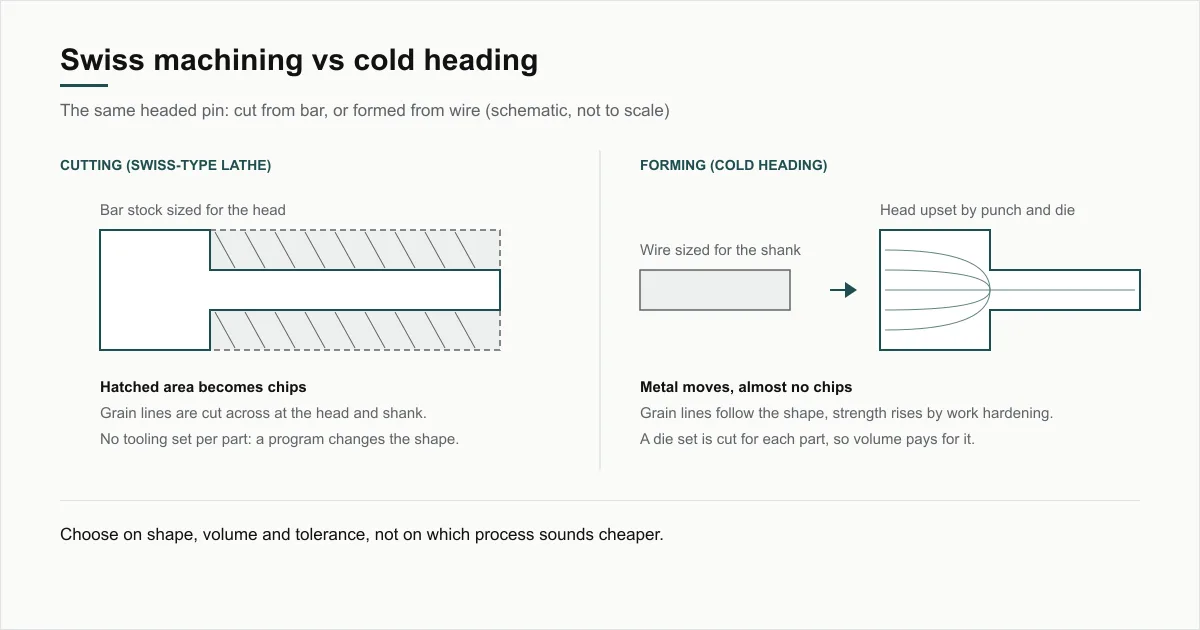
Cold heading wins when the part is a headed shape that is made in very large numbers and needs little machining afterward. A Swiss-type lathe wins when the part has several machined features, a tight tolerance or a volume that does not pay for a die set. Most buyers who ask the question have a part that sits in the gray zone, and the answer depends on three numbers: annual volume, the share of the part that must be machined anyway and the tolerance on the critical diameter.
This guide compares the two processes on rate, scrap, tooling, tolerance and risk, and says what to put in an RFQ so both routes can be priced fairly. Our guide to how Swiss-type turning works covers the machine side in more detail.
Cutting and forming are different physics
A Swiss lathe removes metal. Bar feeds through a guide bushing and tools cut the shape, so everything that is not the part leaves as chips. That is slow in terms of parts per minute, but it needs no part-specific tooling beyond inserts and holders, and a new part number is a program and a setup.
Cold heading forms metal. A wire is cut to a slug and punches and dies squeeze it, usually in several stations, until the head and shank take their shape. Nothing is cut away, which is why it is described as a near net shape process. Wikipedia lists heading under squeezing processes in cold working and notes that it typically produces a near net shape workpiece, with plating or heat treating sometimes still required.
Each process has a cost that the other does not. Cutting pays for chips and machine time on every part. Forming pays for a die set before the first part and again whenever the shape changes.
Part rate and scrap
Published rates for cold heading run from 60 to 400 parts per minute, according to the Wikipedia article on heading. A medical component article that compares the two routes for a complex part gives 90 to 300 parts per minute for cold heading against roughly 6 to 20 for multi-spindle screw machining of a similar design. That article also puts the scrap from screw machining at about 50 percent of the final part mass, and says cold forming creates virtually no waste.
Read those figures as directional. They come from a vendor article and a general reference, not from an audited study, and neither gives a Swiss-type rate. A Swiss cycle depends on the features and on how much sub-spindle work overlaps with main spindle work, and no reliable public number covers it. Ask each shop for the cycle time on your drawing.
The scrap argument matters most when the bar or wire is expensive. Wikipedia’s cold working entry says material savings grow with volume and are greater for expensive metals such as copper, nickel and tantalum. On a part in brass or free machining steel the chip value comes back partly through recycling. On titanium or a nickel alloy the difference is larger. Our bar remnant and material yield guide shows how much of the bar cost a Swiss part already carries.
What each process cannot do easily
Cold heading has geometry limits. Wire can buckle when the unsupported length to diameter ratio is too high, and Wikipedia gives a usual limit of less than 3:1 that dies can sometimes extend. Multi-die headers get around some of this by forming the part in stages. In practice that favors parts with a head and a shank of modest length, and it disfavors parts that are long and thin with no head.
Cold heading also leaves features for later. The medical component article lists the secondary operations on cold formed parts as knurls, cross threads, barbs and clips or detents. Cross holes, flats, slots and tight bores are typically machined afterward.
A Swiss lathe has different limits. It is built for slender turned parts of about 1 to 32 mm diameter in typical shop practice, and it handles long thin shapes well because the guide bushing supports the bar at the cut. Very large head diameters on a short body are a poor fit, since the bar must be sized for the head and most of it becomes chips. The diagram at the top of this article shows the difference: bar sized for the head on one side, wire sized for the shank on the other.
Tolerance and strength
Cutting holds the diameter tightly on a stable process. Our tolerances guide lists typical production ranges, with short turned diameters reaching about ±0.005 to ±0.013 mm in free machining materials. Cold forming usually holds the formed diameters and head dimensions to the die, and the critical precision diameter is then often finished by a machining or grinding step afterward. No reliable public figure gives a formed tolerance for all parts, so ask the heading shop what it holds on a part like yours, with capability data.
Strength is the real forming advantage. Cold working distorts grains to follow the metal flow and can raise strength through work hardening, which Wikipedia says can reach a level comparable to heat treatment. The medical article makes the same point about tensile strength. Cutting severs the grain at the head and under it, which is where a fastener or a pin is loaded. If the part carries a tensile or fatigue load at the head, ask for test data from each route.
Tooling, volume and risk
A cold heading die set is built for one part number. It costs money and takes time to make, and it changes the risk profile of the order:
- A design change after the dies are cut means new dies or rework, not a new program.
- The die cost has to be recovered across the volume, so a forecast that fails leaves a stranded cost.
- Wear on punches and dies sets how many parts a set makes before it is reworked, which affects part cost in long runs.
The Swiss route carries less up-front cost. Our guide to tooling and NRE charges explains what a Swiss quote may include, and the minimum order quantity guide explains why small lots are still practical.
Wikipedia’s cold working entry states the other side too: hardened metal needs more force, harder tools and heavier equipment, which can make cold working suitable only for large-volume manufacturing. That is the reason volume sits at the top of the decision.
A comparison table
| Question | Swiss-type machining | Cold heading |
|---|---|---|
| How is the shape made? | Cut from bar, chips leave | Formed from wire, near net shape |
| Part-specific tooling | Programs, inserts, setup | Die set per part number |
| Typical reported rate | Depends on cycle, no public Swiss figure | 60 to 400 parts per minute reported |
| Scrap | Chips, about half the part mass in one source for screw machining | Virtually none reported |
| Geometry strength | Long thin shapes, cross holes, slots, bores | Headed shapes with short shanks |
| Design change | New program | New or reworked dies |
| Best fit | Mid volumes, many features, tight diameters | Very high volumes, simple headed shapes |
A practical way to decide
Start with the share of the part that is machined after forming. If a cold headed blank still needs a cross hole, a groove, a thread and a tight diameter, the heading shop’s price is only the first line of the cost. The total is the blank plus the machining, so the Swiss quote on the finished part is the fair comparison. Our total cost guide lists what belongs in that comparison.
Then compare at three volumes: the first year, the steady state and the peak. Ask for the Swiss unit price at each volume and the cold heading unit price plus die cost at each volume. Plot both. The crossover is specific to your part and nobody can read it from a table.
Finally, check the fastener case separately. Standard fasteners are cold headed in huge volumes and are usually bought as catalog items. Custom headed parts and special fasteners are where the choice is real, and our guide to custom Swiss machined fasteners covers when standard parts are not enough.
What to include in the RFQ
Send the drawing and a STEP file with these notes so each shop can price its own route:
- Material and grade, including any standard or certificate requirement.
- Annual volume now and in two years, plus the lot size.
- Which features are critical: diameters, head dimensions, concentricity and position.
- Whether the head must be formed or can be machined.
- Surface finish, plating and heat treatment.
- Strength or fatigue requirements at the head, with a test method if one exists.
If you are not sure which route fits, send the part through the RFQ form. We match it with up to three shops that run Swiss-type lathes and reply within 24 business hours. If forming is the better route for your volume, a shop will usually say so, and that is useful to know before you commit to dies.
Sources
- Heading (metalworking), Wikipedia: process, wire buckling limit, rates, comparison with CNC and Swiss machining.
- Cold working, Wikipedia: squeezing processes, material savings, work hardening, limitations.
- Achieving Quality and Economy with Cold Forming, Medical Design Briefs: vendor article, directional only; rates, scrap and secondary operations.
Frequently asked questions
At what volume does cold heading beat Swiss machining?
No public break-even figure exists, because it depends on the die set cost, the part and the material. The logic is simple: cold heading adds a die cost per part number and removes most of the machining time and scrap. Ask for both quotes at the same three quantities and compare the curves.
Can cold heading make a part with a cross hole or a slot?
Not in the heading machine itself. Secondary operations on cold formed parts include knurls, cross threads, barbs and detents, and a cross hole or a slot is normally machined afterward. If your part needs several such features, a Swiss lathe may be the simpler route, with live tooling doing them in the same cycle.
Are cold headed parts stronger than turned parts?
Often, at the head and under it. Forming moves the metal so grain lines follow the shape, and work hardening raises strength, while cutting severs the grain. The gain depends on alloy and design, so ask for test data on your part rather than assuming it.
Can a Swiss shop and a cold heading shop work together on one part?
Yes, and it is common. A headed blank is formed first and a Swiss lathe or another machine then adds the precision features. Plan the datum features and the stock left for machining before the dies are cut, because changing a die later costs far more than changing a program.
Need a quote for this part?
Send the drawing. We match you with up to 3 Swiss shops and reply within 24 business hours.
Get matched with a Swiss shop