Guides / Industries
Orthopedic Bone Screws on Swiss Lathes: Threads, Cannulas and Drive Recesses
October 11, 2026
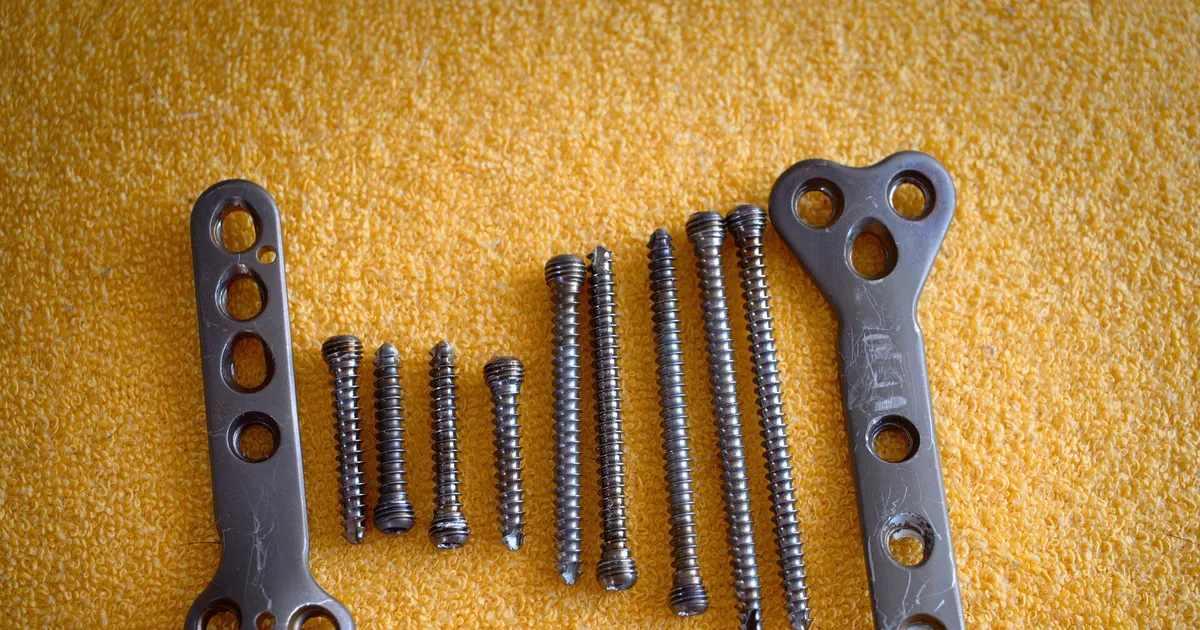
A bone screw is a small, slender part with a demanding job. It must grip bone, carry load without breaking and stay in place for months or years. It is also one of the parts that suits a Swiss-type lathe best: long, thin, threaded and made in volume from difficult materials.
This guide walks through how a bone screw is made, which operations matter, where the risks lie and what a buyer should state on the drawing and in the request for quote.
What a bone screw is made of
Implant grade materials are specified by standard, and the bar must arrive with a certificate that matches it.
| Material | Typical standard | Notes |
|---|---|---|
| Ti-6Al-4V ELI | ASTM F136 | The common titanium alloy for implants |
| Ti-6Al-7Nb | ASTM F1295 | Niobium in place of vanadium |
| Commercially pure titanium | ASTM F67 | Softer, used in some grades and products |
| 316LVM stainless | ASTM F138 | Low carbon, vacuum melted stainless |
| Cobalt chrome | ASTM F1537 | Hard and wear resistant, harder to machine |
Titanium dominates modern bone screws because it is light, strong and compatible with the body, and it does not interfere with imaging as much as steel. Stainless remains in use because it is less costly and easier to machine. The titanium guide and the cobalt chrome guide describe how those materials behave on the lathe.
Anatomy of a screw
Screws come in many shapes, and most share a few features.
Head. A flat, rounded or conical head that sits in the bone or in a plate. It carries the drive recess.
Shaft or shank. The smooth portion between the head and the thread, present on some screws and absent on fully threaded ones.
Thread. The portion that grips bone. Cortical screws have a fine pitch for dense bone, and cancellous screws a coarse pitch and a deep thread for softer bone.
Tip. Either blunt, with a pre-drilled hole, or self-tapping, with cutting flutes that start the thread in the bone.
Cannula. On cannulated screws, a hole running through the center so the screw can follow a guide wire to the exact position.
Drive recess. A hex, star or other internal shape in the head that takes the driver.
Typical sizes run from about 1.5 mm in diameter for small bones to 4.5 mm for cortical screws and 6.5 mm or more for cancellous ones, with lengths from under 10 mm to over 100 mm. Treat these as typical, since each product has its own range.
The sequence on a Swiss-type lathe
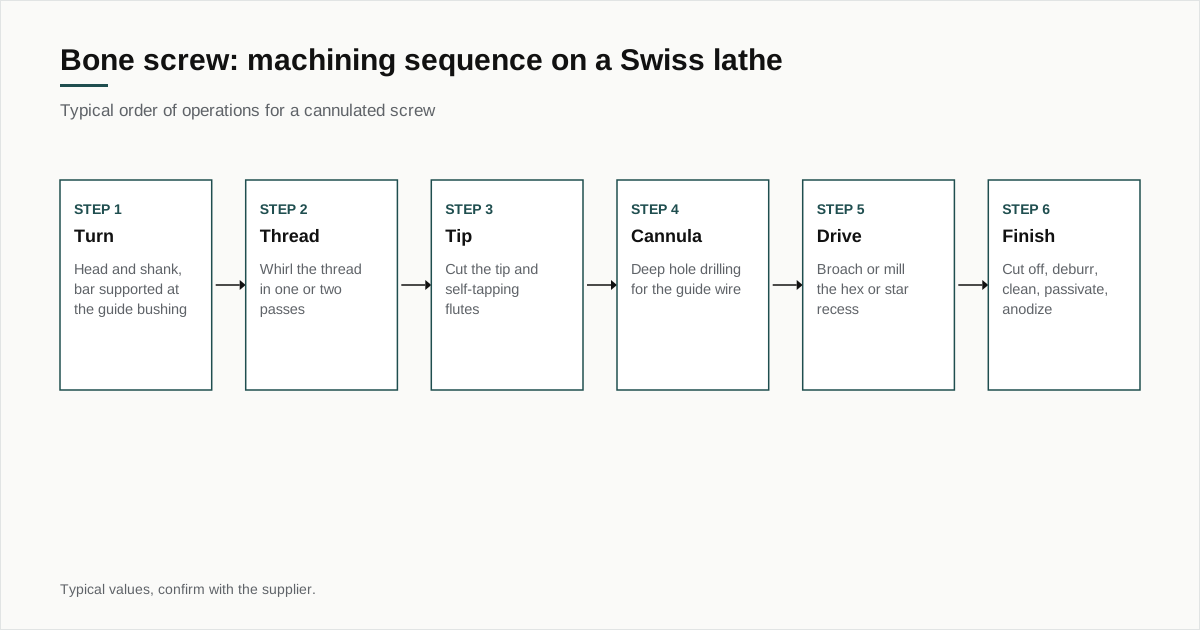
A bone screw moves through a series of operations in the machine, and the order is not arbitrary.
- Turn the shank and head profile. The machine turns the outside diameter and cuts the head shape while the bar is supported next to the tool.
- Whirl or cut the thread. The thread is formed along the shaft, usually by whirling.
- Cut the tip and the self-tapping flutes, if the screw has them.
- Drill the cannula, if the screw is cannulated.
- Form the drive recess by broaching or milling.
- Cut off the part. The sub spindle grips the head or the shank and the part separates from the bar.
- Finish the back end on the sub spindle, if any feature remains.
- Deburr and clean, followed by finishing steps outside the machine.
Doing everything in one cycle is the reason Swiss-type lathes suit this work. The how it works pillar explains the sliding headstock and the guide bushing that make the slender cut possible.
Threads
The thread is the defining feature, and it is difficult because it is long, deep and on a slender core.
Thread whirling is the standard method. A ring of inserts orbits the bar and cuts the thread in a pass or two, with cutting forces that largely cancel, so the slender shaft does not bend. The thread whirling guide explains the process, and it applies directly here.
Bone screw threads often have non-standard profiles. The flank angles, the root radius and the pitch are designed for grip in bone and for strength, not for a mating nut. A profile drawing, not a standard designation, defines them. Inspection of such a profile needs optical measurement or a custom gauge, which takes time to set up.
Thread length and run-out matter. A thread that runs up to the head, or ends against a shoulder, is harder than one with a relief, and the drawing should show what the design needs.
The cannula
A cannulated screw has a hole along its axis, typically 1 mm to 2 mm in diameter depending on the screw, for a guide wire. The wall left between the hole and the thread root is thin, and any drift of the drill thins one side.
The hole is a deep hole, often 20 to 40 times its diameter or more, and the deep hole drilling guide explains the methods. Gun drilling is common for the longer screws, drilled from the head end or in two passes from both ends when the screw is long. The requirements that matter:
- Concentricity between the cannula and the outside, which sets the minimum wall
- Straightness of the hole, so a guide wire passes freely
- Surface finish in the bore, because a rough bore binds the wire
- Burr-free entry and exit, since a burr inside a cannula is a hazard
A cannulated screw costs noticeably more than a solid one, and scrap risk is a large part of the reason. A drill that drifts or breaks late in the cycle scraps a part that already carries a thread and a head.
The drive recess
The head carries an internal drive, commonly a hex or a six-lobed star shape. It must be accurate, because a loose fit strips under torque and a tight fit prevents full seating of the driver.
Two methods dominate. Rotary broaching presses a shaped tool into the head while it spins and forms the recess in a few seconds. Milling cuts the shape with a small live tool and is slower but more flexible. The live tooling guide covers both. The recess depth, the corner form and the draft all affect how the driver engages, and the drawing should dimension them or refer to a driver standard.
Finishing and cleanliness
Medical parts need surfaces and cleanliness that ordinary turned parts do not.
Deburring. Burrs on a screw can shed into tissue. Edges are broken and burrs removed by controlled processes, and the result is inspected under magnification.
Passivation. Stainless parts are passivated to restore the protective film, commonly referring to ASTM A967 or the implant-specific ASTM F86. Titanium is passivated too, for a clean oxide.
Anodizing. Titanium screws are often anodized, which thickens the oxide layer and produces a color. Colors identify sizes, so a surgeon can tell them apart on the table.
Cleaning. Parts are cleaned to remove cutting fluid and particles, usually in ultrasonic baths with validated steps. Packaging follows the customer’s requirements.
Marking. Laser marking of part numbers or lot codes may be required.
The secondary operations guide lists how these steps fit around the turning, and the medical machining guide covers the wider requirements for medical parts.
Inspection and traceability
Medical customers expect records. Typical requirements:
- Material certificates linking bar lot to the finished lot
- First article inspection against the drawing
- In-process checks of thread, head and length
- Lot traceability from bar to shipment
- Torque and pullout tests where the specification requires them, such as those in ASTM F543
The inspection guide and the vision inspection article describe how small turned parts are measured. Shops differ in what they can document, and a buyer should ask rather than assume.
Where screw production goes wrong
Thread run-out and head transitions. A thread that ends right at a sharp corner under the head makes a stress concentration, and a radius there matters for fatigue. Drawings that specify the radius avoid a surprise at testing.
Drive recess damage. A recess formed after a heavy thread cut can distort slightly, and a recess formed before a hard clamp on the head can deform. The sequence, and how the sub spindle grips the part, decide which risk applies.
Heat in the thin core. Titanium holds heat near the cut. On a slender screw the heat can bend the core during a long cut. Coolant delivery and cut sequence manage it.
Embedded particles. Fine particles of tool material or other metals on the surface are a concern for implants. Tool selection, cleaning and handling keep them out, and shops that make medical parts keep implant materials separate from others.
Mix-ups between lots. Screws that differ by a few tenths of a millimeter in length look alike. Lot control, labeling and line clearance at every changeover are not optional.
What drives cost
| Cost driver | Why it matters |
|---|---|
| Material | Certified titanium or stainless bar costs more than commercial bar |
| Thread whirling | Needs an attachment and a ring per form |
| Cannula | Deep drilling, slow, higher scrap risk |
| Drive recess | Tooling and setup for the shape |
| Finishing | Passivation, anodizing, cleaning and packaging |
| Inspection and records | Time per lot, particularly for first articles |
The cost guide explains how setup and volume combine. For a family of screws in several lengths, ask the shops to quote the family together, because the thread form and drive are shared and setup time spreads over more parts.
What to put on the drawing
- Material and standard, with the condition
- Thread profile drawing, with pitch, depth and run-out
- Cannula diameter, tolerance and concentricity
- Drive recess dimensions or driver standard
- Surface finish, anodizing color and passivation
- Cleanliness and packaging requirements
- Documentation and traceability requirements
- Yearly volume and lot sizes
Getting bone screws quoted
Send the drawing and STEP file through the RFQ form. State the material, the standard, the cannula if any and the documentation you need, along with yearly volume. We match the part with up to three shops that run Swiss-type lathes and reply within 24 business hours.
Mention your quality and documentation expectations at the start. A shop that cannot meet them will say so early, and that saves both sides time.
See also: the bone screw reference page: thread forms, materials and standards.
Frequently asked questions
Which materials are used for bone screws?
The common ones are titanium alloys, such as Ti-6Al-4V ELI and Ti-6Al-7Nb, and implant grade stainless steel such as 316LVM. Commercially pure titanium and cobalt chrome appear in some products. The drawing or the customer specification names the standard, and the shop buys certified bar to match.
What makes a cannulated screw harder to machine than a solid one?
The cannula is a long narrow hole running the full length of a slender part. It needs deep hole drilling, which is slow and prone to drill drift, and the thin wall that remains must stay concentric with the outside thread. The risk of scrap is higher than on a solid screw.
Does a shop need special approvals to make implant parts?
That depends on the customer and the market. Many medical customers require a quality system and documentation that match their own obligations. Ask each shop what it can show, and state your requirements in the request for quote rather than assuming a shop has them.
Need a quote for this part?
Send the drawing. We match you with up to 3 Swiss shops and reply within 24 business hours.
Get matched with a Swiss shop