Guides / Industries
Watch and Clock Parts on Swiss Lathes: Pinions, Winding Stems and Screws
October 28, 2026
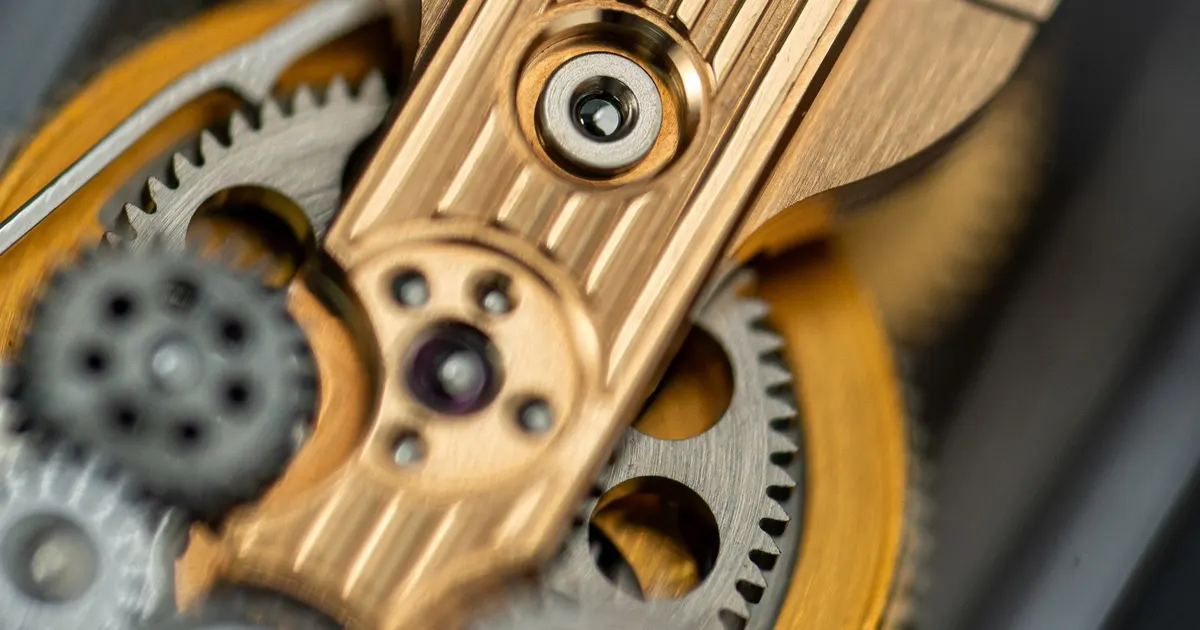
The Swiss-type lathe started in watchmaking. Pinions and staffs, the thin steel parts that carry gears inside a movement, were too slender to turn on an ordinary lathe because the work bent away from the tool. The sliding headstock fixed that, by moving the bar through a guide bushing next to the cutter. Two centuries later, the principle still holds, and watch and clock parts remain a demanding use of the machine.
This guide covers the parts, the features that make them hard, the tolerances involved, the materials and the finishing steps that follow turning. It treats the machine type as a machine type: where a part is made has nothing to do with the name.
The parts
A mechanical movement contains dozens of turned parts, most of them very small.
| Part | What it does | Typical size | Notes |
|---|---|---|---|
| Pinion | Small gear that meshes with a wheel | 0.8 to 4 mm | Leaves cut into a turned arbor |
| Arbor and staff | Axle carrying a wheel or the balance | 0.5 to 3 mm | Pivots at each end |
| Winding stem | Connects crown to movement | 1 to 3 mm | Square or threaded end, grooves |
| Crown tube and case tube | Seals the stem through the case | 2 to 6 mm | Thin wall, polished or threaded |
| Screws | Hold plates and parts together | 0.5 to 1.5 mm | Fine thread, slotted head |
| Pillar and post | Spaces plates | 1 to 5 mm | Tight length tolerance |
| Setting lever parts | Switch between winding and setting | 0.5 to 2 mm | Small pins and screws |
| Clock parts | Larger pinions, arbors and pivots | 2 to 10 mm | Similar methods at a bigger scale |
Clock parts are larger, and the same methods apply. Alarm clocks, wall clocks and mechanisms for instruments use arbors, pinions and screws that a Swiss-type lathe makes in volume.
What makes a pinion
A pinion is the most characteristic watch part. It is a small gear, usually with six to twelve teeth called leaves, cut directly into a turned arbor, with pivots at both ends and sometimes a shoulder for pressing on a wheel.
The Swiss-type lathe turns the arbor to its diameters and cuts the pivots. The leaves are then formed by one of three methods.
Hobbing. A hob, a gear-shaped cutter that rotates in step with the part, cuts the leaves in one pass. Some machines carry a hobbing attachment for this.
Milling. A small cutter forms each leaf in turn. Slower and more flexible.
Broaching. A shaped tool pushed along the arbor forms the profile.
Pinions are generally heat treated for wear resistance, then ground or polished, with the pivots finished last. The leaf profile has to match the wheel that meshes with it, so the profile is part of the drawing, not an afterthought.
Pivots
A pivot is the small, hardened tip of an arbor that turns in a jewel or bearing. Pivot diameters can be well under half a millimeter, and the surface has to be smooth and round to reduce friction and wear.
After turning, pivots are usually burnished or rolled, a process that presses a hard, polished tool against the surface to compact it and give a mirror finish. This is a secondary operation on dedicated equipment, and it determines how a movement runs.
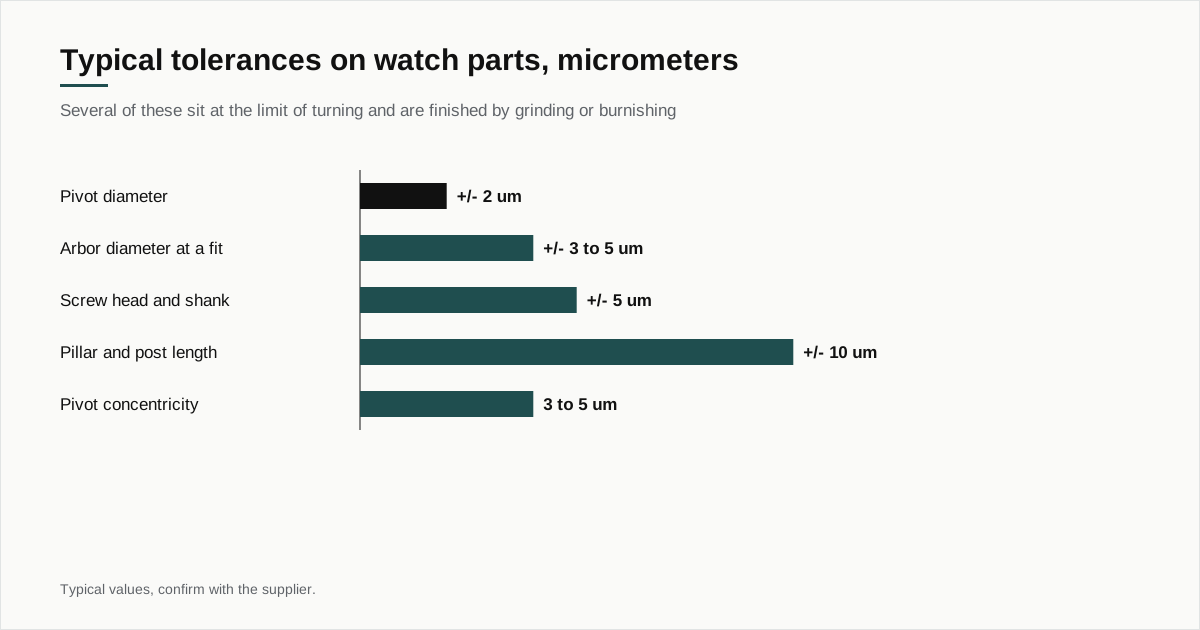
The turned pivot must arrive within a tolerance of a couple of microns and a round, clean shape for burnishing to work. A pivot with chatter marks or taper cannot be rescued by burnishing. The surface finish guide and the tolerance guide explain how such requirements are stated.
Screws
Watch screws are among the smallest threaded parts in common production. Diameters of 0.5 to 1.5 mm, a slotted head and a fine thread are typical. They are made by turning a head and a shank, cutting or rolling the thread and cutting the slot with a live tool or a slitting saw.
Considerations:
Thread form. Watch threads follow their own standards, such as those of the watch industry’s standards body, not ISO metric coarse. Name the standard on the drawing.
Thread formation. Rolling gives a stronger, smoother thread than cutting, though it needs the right core diameter. For very small sizes, rolling is common. The fasteners guide covers how threads and heads are chosen.
Head and slot. A slot with a clean edge and an exact depth, so a screwdriver seats. Burrs on the slot make a screw hard to turn and mark the screwdriver.
Finish. Screws are polished, blued by heat or plated, depending on the movement. Heat bluing is a controlled temper that gives a color and a slight hardening.
Winding stems and tubes
A winding stem links the crown to the movement. It has a square or threaded end for the movement, grooves for the setting lever and a thread for the crown. The shaft is slender and the features are cut by a combination of turning, thread rolling and live tooling.
Tubes are thin-walled and the walls are the issue. A crown tube with a wall of a tenth of a millimeter must stay round and finish well, since it seals the case. The thread whirling guide covers slender threaded parts, and the thin-wall issues resemble those of the pogo pin barrel.
Clock parts and larger mechanisms
Clock and instrument mechanisms use the same part types at a larger scale. Arbors run 2 to 10 mm, pinions have fewer and coarser leaves and screws are standard small sizes. Tolerances are looser than for wristwatch work, typically a few hundredths of a millimeter on most features, and tight only at pivots and fits.
This makes clock work friendlier to price. Brass is the usual material, the features are easy to turn and finishing steps are fewer. Volumes can be large, as in alarm clocks, timers and appliance mechanisms, and the same shop that makes a clock pinion may make a motor shaft or a gear pin for another product. If your part is closer to a clock than a wristwatch, say so in the request, because it changes which shops will quote and at what price.
Common problems
Burrs on leaves and slots. A burr on a pinion leaf damages the wheel that meshes with it, and a burr in a screw slot ruins a screwdriver. Cleaning and inspection under magnification are normal for these parts.
Distortion in hardening. A slender arbor with leaves bends in the furnace. Shops straighten after hardening and leave grinding stock on the pivots, but the arbor must be designed with an even section where possible.
Pivot damage in handling. A pivot is a fine tip, and parts that touch in a bin bend or nick them. Individual trays or separators are standard for finished arbors. The packaging guide covers the options.
Thread tearing in soft metals. Brass and nickel silver screws tear if the tool is dull. Tool changes by count keep it clean.
Magnetization. Steel parts that become magnetic attract dust and swarf, and in a watch they can affect timekeeping. Demagnetizing is a normal step on steel parts.
Typical tolerances
| Feature | Typical tolerance | Notes |
|---|---|---|
| Pivot diameter | about ±0.002 mm | Burnished after turning |
| Arbor diameter at a fit | about ±0.003 to ±0.005 mm | Often ground or lapped |
| Screw head and shank | about ±0.005 mm | Fine tolerance on small sizes |
| Length of pillars and posts | about ±0.01 mm | Spacing of plates |
| Concentricity of pivots | about 0.003 to 0.005 mm | Both ends from one setup where possible |
| Roundness | a few microns | Measured with a roundness gauge |
All are typical and some sit at the limit of turning. Temperature affects measurements at this scale, since a steel pin changes length with a degree or two of temperature. Shops that hold these tolerances measure in a controlled room and keep parts there before checking. Confirm what the supplier can hold for your part.
Materials
| Material | Typical use | Notes |
|---|---|---|
| Free machining carbon steels made for watch work | Pinions, staffs, stems | Hardened after turning |
| 303 and 316L stainless | Stems, screws, tubes | Corrosion resistance, wearer contact |
| Brass | Pillars, plates, clock parts | Easy to machine |
| Nickel silver | Decorative parts, plates | Silver color |
| Phosphor bronze | Bearings, bushings | Wear surface |
| Gold and silver alloys | Crowns, cases | Precious, yield matters |
| Titanium | Cases, crowns | Light, hard to machine |
Stainless is often a good compromise, and the stainless guide and the brass guide cover the common materials. Precious metals bring the issue of scrap value, and the bar remnant article explains yield, which matters a great deal when the metal is gold.
Finishing after the lathe
Much of what makes a watch part a watch part happens after turning.
Hardening. Steel pinions and staffs are heat treated for wear resistance.
Grinding and lapping. Fits and pivots reach their final size and finish.
Burnishing. Pivots are rolled to a mirror finish.
Polishing. Visible parts, such as screw heads and crowns, are polished or finished with a satin pattern.
Plating or coloring. Gold, rhodium, black coatings or heat bluing.
Cleaning. Ultrasonic cleaning removes oil and particles, which matter in a mechanism that runs on a drop of lubricant.
The secondary operations guide lists how these steps sit around turning and what they add to lead time.
What drives cost
| Driver | Effect |
|---|---|
| Tolerance | Every micron needs slower cuts and more checks |
| Material | Precious metals and stainless cost more than brass |
| Hobbing and special tools | Tooling per profile |
| Secondary processes | Hardening, grinding, burnishing, polishing |
| Inspection | Optical and roundness measurements per lot |
| Volume | Watch parts run in large lots, which spreads setup |
The cost guide shows how these combine. For watch parts the secondary steps often outweigh the turning, so a change in finish can cost more than any change in the turned shape.
A worked example
Take a steel pinion arbor: 1.2 mm at the leaf section with six leaves, pivots of 0.2 mm at each end, total length 6 mm. The drawing asks for hardened leaves, pivots ground to a micron tolerance and a burnished surface.
The shop turns the arbor from a free machining watch steel, cuts the leaves by hobbing, turns the pivots slightly oversize and parts off the piece. The parts go to hardening, then to grinding for the pivots, then to burnishing. Inspection uses optical measurement for the leaves and a roundness check for the pivots.
The lathe does perhaps a third of the work. The drawing should name the pivot size after burnishing, the leaf profile and the hardness, and leave the stock allowances to the shop, which knows what its grinder and burnisher need.
What to put on the drawing
- Material and condition, including the standard for watch steels
- Leaf profile or gear data for pinions
- Pivot dimensions after finishing, with tolerance and finish
- Thread standard and form for screws
- Critical fits and concentricity, with the datum scheme
- Heat treatment and hardness
- Finish and plating
- Cleaning and packaging
- Yearly volume
Getting watch and clock parts quoted
Send the drawing and STEP file through the RFQ form. State the material, the critical features and finishes, and the yearly volume. We match the part with up to three shops that run Swiss-type lathes and reply within 24 business hours.
Say which finishing steps you expect the shop to arrange and which you will do yourself. A quote that includes hardening and burnishing and a quote that does not are different jobs, and stating the scope makes the quotes comparable.
Frequently asked questions
Why are Swiss-type lathes tied to watchmaking?
The machine type was developed in the watch industry to turn long, thin parts such as pinions and staffs without bending. The name describes the machine, not where a part is made. Today the same machines make medical, connector and electronic parts, and watch work is one use among many.
What tolerances do watch parts need?
Pivots and fits are often held to a couple of microns, and screw threads and heads to a few microns. These figures are at the limit of turning, and some surfaces are finished by rolling, grinding or polishing after the lathe. State which features are critical so the shop knows where to spend effort.
Are watch parts made from special steel?
Several free machining steels are made for the purpose, and 303 or 316L stainless is common for parts that face the wearer. Brass and nickel silver cover plates and decorative parts, and precious metals and titanium appear in cases and crowns. The material follows the function and the finish.
Need a quote for this part?
Send the drawing. We match you with up to 3 Swiss shops and reply within 24 business hours.
Get matched with a Swiss shop