Guides / Industries
Valve Spools on Swiss Lathes: Fits, Roundness and Finish
November 5, 2026
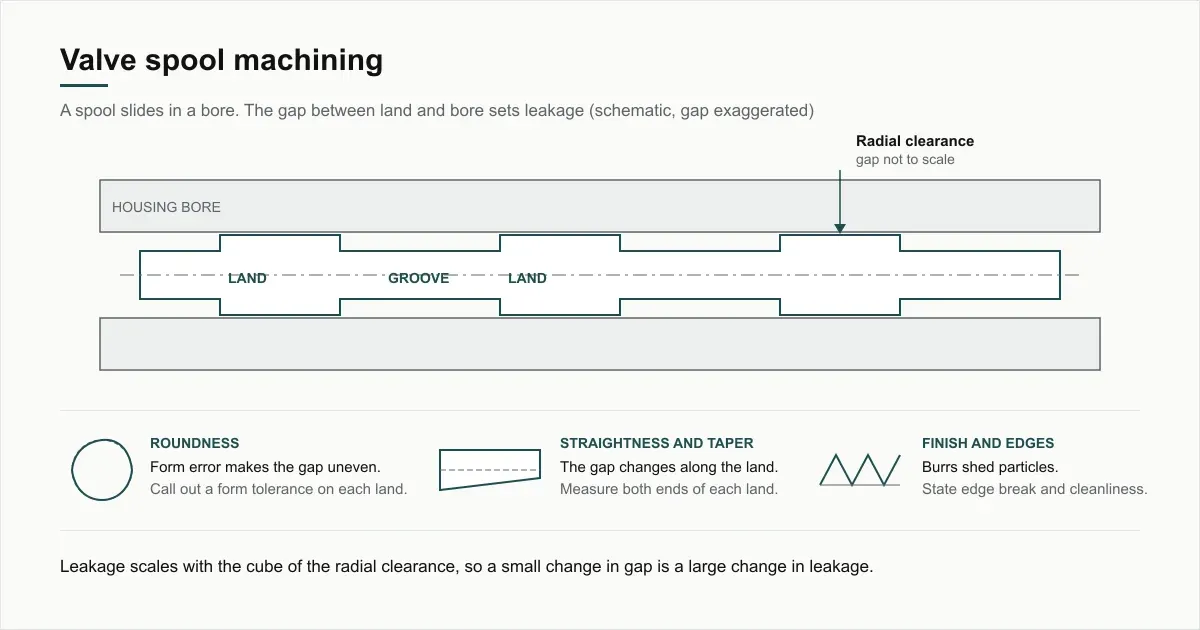
A valve spool is a precision fit before it is a turned part. The lands slide in a bore with a radial clearance of a few micrometers, so the diameter tolerance is only one part of the drawing. Roundness, straightness and taper of the lands, the finish on them and the edges at every groove decide whether the spool slides freely, leaks or sticks. A Swiss-type lathe makes the shape well in one cycle. Whether it makes the fit depends on what the drawing asks for and how the shop checks it.
This guide explains where leakage comes from, how clearance and form errors interact, what to specify and what to ask a shop before it quotes. Our hydraulic fitting guide lists spools among the other components that suit Swiss lathes, and this article goes deeper on the spool.
Where a spool leaks
A spool needs clearance to slide, so a spool valve always leaks a little. The question is how much. According to Wikipedia’s article on hydraulic clearance, flow through the gap scales with the cube of the clearance height, and the clearance has much more influence on leakage than the length of the gap. For a spool centered in its bore, leakage depends on the pressure drop, the spool diameter, the oil viscosity and the gap length, and it applies to laminar flow with a steady spool. If the spool touches the wall, a rule of thumb in the same article is that leakage rises to 2.5 times the concentric value.
Two consequences follow from those relations:
- Doubling the gap multiplies leakage by about eight. That is our arithmetic from the cube law: 2 cubed is 8. A gap that wears or grows with temperature from 5 to 10 micrometers is a large change.
- Eccentricity costs as much as a bigger gap. A land that is out of round or a spool pushed to one side behaves like a different gap on one side. Wikipedia’s 2.5 times figure is for a spool in contact with the wall.
The figure at the top of this article shows the parts of the problem: lands, grooves, a bore and a gap. Everything below is about the lands.
Clearance figures from the field
No public standard gives one clearance for all spools, so treat any number as directional. A commercial hydraulics article states that precision clearances are typically two to eight microns and gives a table by spool size: for spools of 10 to 15 mm, 2 to 4 micrometers; for 16 to 25 mm, 4 to 6 micrometers; and for 26 to 40 mm, 6 to 10 micrometers. It works an example of a 20 mm spool with a 5 micrometer radial clearance at 210 bar, which gives about 1.83 mL per minute of leakage when concentric, and over 4.5 mL per minute at full eccentricity. This is a vendor source, so use it to understand the scale and not as a design value.
It also reports a field case where a 4 micrometer clearance went to zero because thermal growth differed between the spool and the body as the fluid warmed from 30 to 65 degrees C, and the fix was a 6 micrometer cold clearance. The point for a buyer is that the spool material and the body material are part of the fit. Say what the mating part is made of when you send the drawing, and let the valve designer own the clearance.
Because the clearance belongs to the pair, ask whether the spool is made to a size band or to match a specific bore. A shop that does not know the answer cannot hold the fit.
Roundness, straightness and taper
The gap is only even if the land is round and straight. In geometric tolerancing, form controls are separate from size. Wikipedia’s article on geometric dimensioning and tolerancing lists the ISO references: ISO 12181 for roundness, ISO 12180 for cylindricity and ISO 12780 for straightness, with ISO 1101 as the standard for form, orientation, location and run-out tolerances. The article on cylindricity adds that it extends roundness by controlling the fidelity of a cylinder to its longitudinal axis, which is the control that catches taper and bow along a land.
Wikipedia defines roundness as how closely a shape approaches a mathematically perfect circle, and describes the minimum circumscribed circle as the smallest circle that encloses the whole profile, with the error as the largest deviation from it. Measuring roundness on a precision instrument takes a minimum of three readings in the extrinsic method and plots them as a polar plot.
Here is how we would read it for a buyer. A two-point micrometer reading across a land gives a diameter. It does not show lobing, where the land has equal diameter at several angles but is not round. A form tolerance with an agreed measuring method, usually a roundness instrument, is what shows it. If a land has a few micrometers of form error in a gap of a few micrometers, the error uses much of the gap on its own. That is a reason to give form tolerances on lands and not to rely on the size tolerance.
Our centerless grinding guide explains when grinding after turning is needed for roundness and diameter, and the ground bar stock guide covers starting from a bar that is already ground. Our tolerance guide lists what shops hold as turned.
Finish, edges and particles
The land surface is the sliding surface, so the finish callout matters. Our surface finish guide explains Ra and Rz and how finish choices change the cost.
Edges matter as much. The edge between a land and a groove is where the spool meters flow, and a burr there can shed a particle into the fluid. The same article says fine particles can lodge in the radial clearance gap and physically lock a spool in place. It also notes that hydraulic lock from pressure imbalance can seize a spool when balancing grooves are omitted, and describes a field fix of three circumferential balancing grooves, each 0.5 mm wide, machined on the lands. Those grooves are small features. Put their width, number, depth and edge condition on the drawing, because they are made with the same tool path as the rest of the spool.
Deburring a spool is a delicate job: the edge must be clean without rounding a metering edge that must stay sharp. State the edge break as a range on named edges, and say which edges must not be touched. Our deburring guide covers the methods and their limits, and our technical cleanliness guide covers how a particle limit is stated and checked.
The article also lists bore distortion from over-tightening as a cause of sticking. That belongs to the valve body, not the spool, but it is a reminder that a perfect spool in a distorted bore still sticks.
Material and heat treatment
A spool is often hardened to resist wear. Hardening can move a slender part, which is why grinding usually follows heat treatment. As our centerless guide notes, if the part is hardened between turning and grinding, mention the heat treatment so the shop allows for distortion. Our secondary operations guide covers heat treatment and its effect on dimensions. Name the material grade and the hardness requirement in the RFQ and let the shop propose the process route. Our 416 and 420 stainless guide covers grades that can be hardened.
What to specify
| Feature | What to put on the drawing | How it is usually checked |
|---|---|---|
| Land diameter | Size and tolerance, matched to the bore or a size band | Air gauge or comparator against a master |
| Roundness | A form tolerance on each land | Roundness instrument |
| Straightness and taper | A cylindricity or straightness tolerance over the land | Roundness instrument or profile measurement |
| Surface finish | Ra on the lands, agreed measurement direction | Profilometer |
| Metering edges | Edge break range on named edges | Magnification |
| Grooves | Width, depth, number and edge condition | Optical or vision check |
| Cleanliness | Particle limit and the test method | Cleanliness test |
The inspection column is typical practice, not a rule. Ask each shop which instruments it has for your tolerances. A shop that cannot measure roundness cannot promise it. Our inspection guide lists what to agree before an order.
Getting a spool quoted
Send the drawing with the mating bore size and material, the sealing fluid, the working pressure and the form and finish requirements. Ask each shop how the fit is made and measured, whether grinding is done in house, what the scrap rate looks like on a trial lot and what the first article report includes. Compare quotes on the same inspection scope, since one shop may price a roundness check and another may not. Our quote comparison guide shows how.
Send the drawing through the RFQ form. We match it with up to three shops that run Swiss-type lathes and reply within 24 business hours. If the spool is hardened, say so in the first message.
Sources
- Hydraulic clearance, Wikipedia: leakage relation and the 2.5 times rule.
- Geometric dimensioning and tolerancing, Wikipedia: form tolerances and ISO references.
- Roundness, Wikipedia: definition, minimum circumscribed circle, measurement.
- Cylindricity, Wikipedia: relation to roundness and axis.
- Spool valve clearance and leakage, EPCLAND: vendor figures for clearance, a thermal case and balancing grooves. Commercial source, directional only.
Frequently asked questions
What clearance does a hydraulic valve spool have?
Very small. One commercial hydraulics article states that precision clearances are typically two to eight microns, with larger spools carrying larger gaps. No public standard sets one figure for all valves, because it depends on pressure, fluid and spool size. The clearance belongs to the spool and bore as a pair, so ask the valve designer.
Why does roundness matter so much on a valve spool?
Because the gap is only a few micrometers. Leakage scales with the cube of the radial clearance, and a spool pressed against the bore wall leaks about 2.5 times as much as a centered one. Out-of-round or tapered lands make the gap uneven, which raises leakage and can cause sticking.
Can a Swiss lathe make a valve spool?
Yes for the small diameters that fit its bar capacity. The lathe turns lands, grooves and chamfers in one cycle with good concentricity. If the fit calls for a diameter and form tighter than turning holds, grinding follows the turning. Ask each shop which route it uses and what it can measure.
How do I specify a valve spool on a drawing?
Give the land diameters with tolerances, form tolerances for roundness and straightness, surface finish on the lands, the edge condition at each land and groove, the cleanliness requirement and how each will be checked. Add the material and heat treatment, because both change how the part moves in service.
Need a quote for this part?
Send the drawing. We match you with up to 3 Swiss shops and reply within 24 business hours.
Get matched with a Swiss shop